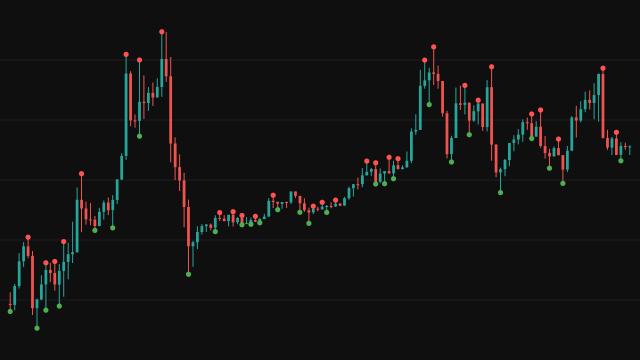
Candlestick Patterns tests every bar for fifteen patterns and labels each one it finds. Bullish patterns are marked with a green arrow below the bar, bearish ones with a red arrow above it, and neutral ones in white.
- Doji: the body is at most
Doji sizeof the bar's range. - Harami (bullish and bearish): a body that sits inside the previous bar's body, in the opposite colour.
- Engulfing (bullish and bearish): a body that covers the previous bar's body, in the opposite colour.
- Piercing Line: after a down bar, a gap below its low that closes back above the middle of its body.
- Bullish Belt: a bar that opens on its low, below the lowest low of the previous ten bars, and closes up.
- Kicker (bullish and bearish): a bar that opens beyond the previous bar's open and runs the other way.
- Hanging Man, Shooting Star, Hammer (H) and Inverted Hammer (IH): small bodies at one end of a long range.
- Morning Star and Evening Star: three bars where a small middle bar gaps away and the third bar reverses.
The harami, engulfing, piercing, belt, kicker and hanging man patterns also require a prior move: the open Trend in Bars bars ago must be above the current open for a bullish pattern and below it for a bearish one.
How to read Candlestick Patterns
Treat each label as a description of what the last bars did, not as an instruction. A reversal pattern matters most where a move is stretched and the pattern forms at a level you already watch, such as a prior high or low; the same pattern in the middle of a range means little.
Look for confirmation from the next bar: a bullish engulfing followed by a higher close says more than the engulfing alone. On a busy chart several patterns can mark the same bar, because the definitions overlap (a hammer can also be a hanging man, depending on the trend before it).
Settings
- Trend in Bars
- How many bars back the open is compared with, to require a prior move before a reversal pattern counts.
- Doji size
- The largest body, as a fraction of the bar's range, that still counts as a doji.
- Bullish Arrow Color
- Colour of the arrows and labels for bullish patterns.
- Bearish Arrow Color
- Colour of the arrows and labels for bearish patterns.
- Other (Doji) Symbol Color
- Colour of the doji, hammer and inverted hammer marks.
Frequently asked questions
Why do some bars carry more than one label?
The definitions overlap. A bar with a small body near its high can be a hammer and a hanging man, and a doji can also meet another pattern's rules, so each pattern that holds is marked.
What does Trend in Bars do?
It asks for a move before the pattern: for a bullish pattern the open that many bars ago must be above the current open, so the pattern comes after a decline. A larger value looks further back.
Can I be alerted to a pattern?
Yes. Each of the fifteen patterns has its own alert, raised on the bar it forms.