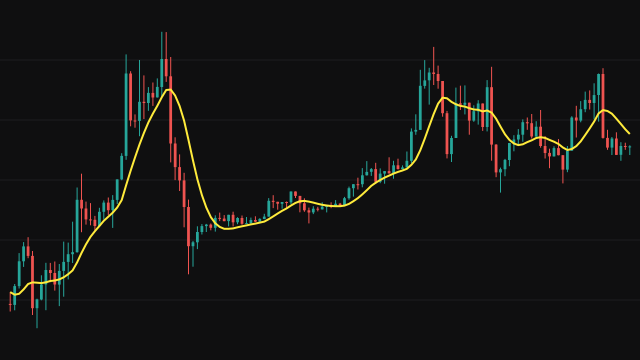
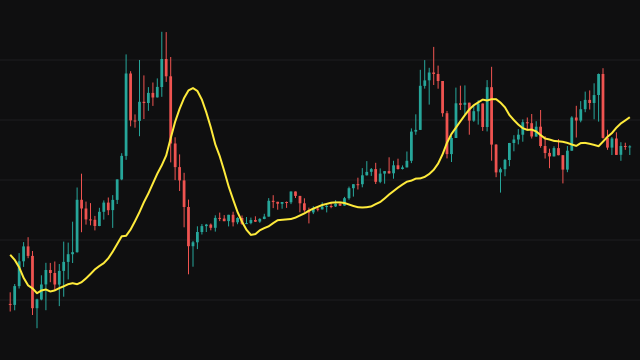
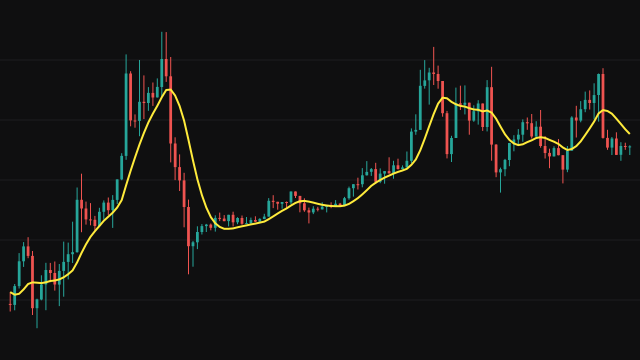
The Super Passband Filter subtracts a slow exponential smoothing of price from a faster one. Both use a smoothing factor of 5 / period rather than the usual 2 / (period + 1), so they react more quickly than standard exponential averages of the same length. Written as one formula, the difference becomes a two-pole recursion on the current and previous price and the filter's own last two values. The result, SuperPB, swings around zero as price moves between the two speeds.
The study also measures how large those swings have been. It squares the passband value on each bar, sums the squares over the last RMS Period bars, divides by RMS Period and takes the square root. That root-mean-square is drawn as +RMS above zero and -RMS below it.
Before a full RMS window exists the sum is still divided by the whole RMS Period, so the envelope grows in from zero over the first window.
How to read Ehlers Super Passband Filter (SPBF)
Read SuperPB as a fast cycle oscillator: above zero the short smoothing is above the long one and price is pushing up, below zero it is pushing down. The RMS lines give the typical size of those swings. A move of the passband beyond +RMS or -RMS is a swing larger than usual and can be read as a cycle extreme forming; a cross back inside the envelope can be read as the first sign of a turn.
The values are in price units, not normalised. The envelope adapts to recent volatility but only over RMS Period bars, so a sudden regime change can leave the line outside the envelope for some time.
Settings
- Short Period
- The period of the fast smoothing; its factor is 5 divided by this value.
- Long Period
- The period of the slow smoothing; its factor is 5 divided by this value.
- RMS Period
- How many bars the root-mean-square envelope is averaged over.
- Source
- The price series the filter runs on, the close by default.
Frequently asked questions
Why 5 / period instead of the usual factor?
A factor of 5 / period makes each smoothing much faster than a standard exponential average of the same period, which keeps the passband responsive.
What do the RMS lines show?
The root-mean-square of the passband over the last RMS Period bars, which is a measure of its typical swing size. They are mirrored above and below zero.
Why are the RMS lines small at the start?
The sum of squares is always divided by the full RMS Period, so until that many bars exist the envelope is smaller than it will be later.