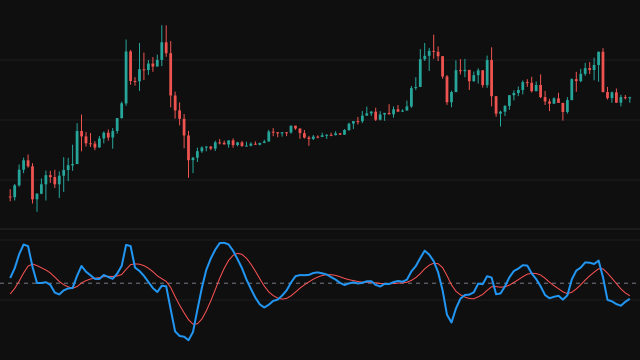
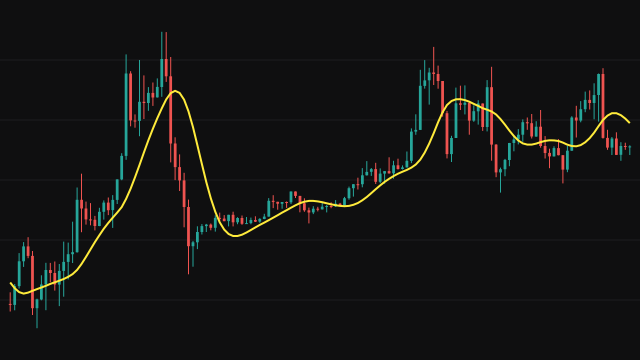
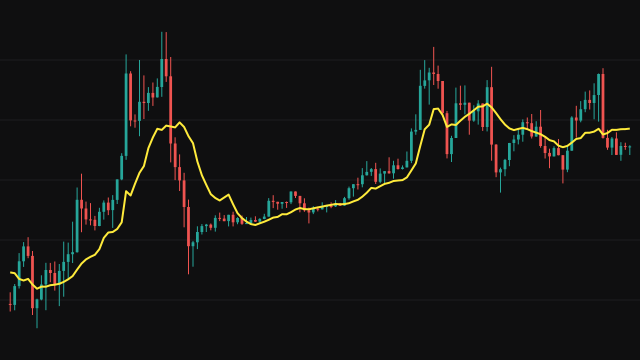
The Ultrasmooth Filter is a two-pole recursive filter that reads this bar's price, its two previous prices and its own two previous values. With arg = sqrt(2) * pi / length, it sets c2 = 2 * exp(-arg) * cos(arg), c3 = -exp(-2 * arg) and c1 = (1 + c2 - c3) / 4, then computes USF = (1 - c1) * price + (2 * c1 - c2) * price[1] - (c1 + c3) * price[2] + c2 * USF[1] + c3 * USF[2].
The extra terms on the earlier prices act as a momentum correction: they let the line keep up with a steady trend while the two-pole feedback removes short-term noise. Before the filter has two values of its own it uses the price in their place, so it answers from the first bar.
The length sets how slow a swing must be to pass through. Shorter swings are flattened; slower ones are followed closely.
How to read Ultrasmooth Filter (USF)
Read the USF as a smooth trend line that hugs price more tightly than a moving average of the same length. Its slope is the clearest signal: a line turning up marks the slower part of the market turning up, and a line turning down marks the reverse. Crossings of price, or of a second USF with a different length, can time those turns.
The momentum term means the line can overshoot after a sharp reversal. It still describes what price has done, and it lags a true turning point by at least a few bars.
Settings
- Length
- The cutoff period in bars. Larger values give a smoother line that turns later.
- Source
- The price series the filter smooths, the close by default.
Frequently asked questions
How does it differ from the Supersmooth Filter?
Both share the same two-pole feedback. The Ultrasmooth Filter also feeds in the two previous prices through a momentum term, which tracks a steady trend more closely.
Why can it overshoot price?
The feedback and momentum terms carry the recent direction forward for a bar or two, so a sudden reversal leaves the line briefly beyond price.
Does it repaint?
No. Each value uses only this bar and earlier bars, so a value never changes once its bar has closed.