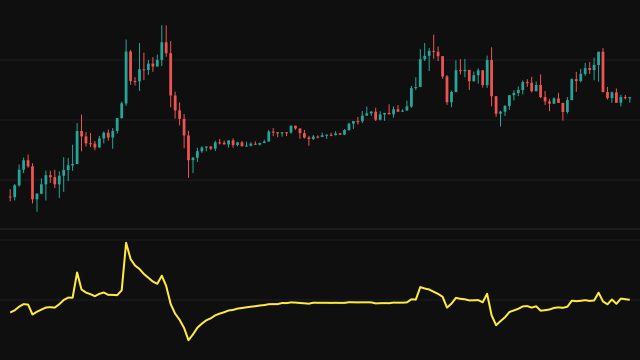
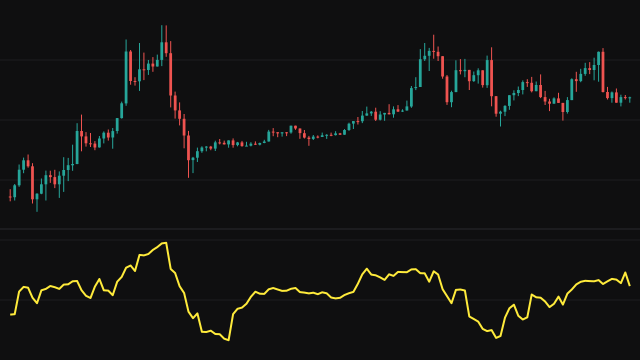
Chaikin Money Flow measures whether volume over a recent window has been arriving on closes near the bars' highs or near their lows. Each bar gets a money flow multiplier from where it closed inside its range: +1 at the high, -1 at the low, 0 in the middle and 0 on a bar with no range. The multiplier times the bar's volume is that bar's money flow volume.
The study sums the money flow volume over the last length bars and divides by the total volume of the same bars. The result runs between -1 and +1. While fewer than length bars exist, the window covers every bar so far, so the line reads from the first bar. A window with no volume at all reads 0.
How to read Chaikin Money Flow (CMF)
Above zero, recent volume has traded mostly on closes in the upper part of each bar, which is read as buying pressure; below zero, the lower part, read as selling pressure. Readings far from zero show a one-sided market, and a cross of the zero line marks a change in which side is in control.
Watch for disagreement with price, such as price rising while the line slips below zero. The reading looks only inside each bar, so a gap between bars does not count, and the first few bars rest on a short window.
Settings
- Length
- How many bars the money flow and the volume are summed over. A longer window gives a smoother, slower line.
Frequently asked questions
What range can the value take?
Between -1 and +1. It reaches +1 only if every bar with volume in the window closed at its high, and -1 only if every such bar closed at its low.
Why is there a value on the very first bar?
The sums start from the first bar and cover every bar so far until the window is full, so the line reads from the start on a shorter window.
What happens when the window has no volume?
The division has no meaning, so the study reads 0 for that bar.