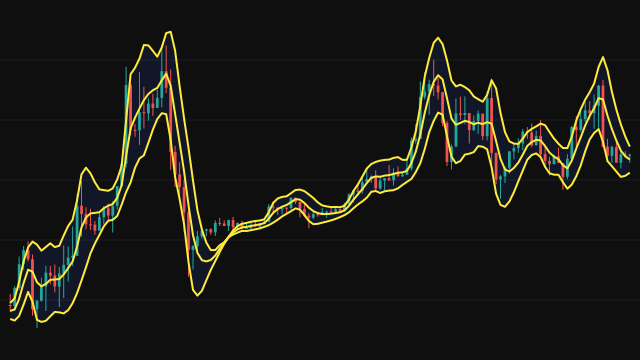
The middle band is an ultrasmooth filter of the source. It is a two pole recursive filter whose coefficients come from the length: each output blends the current and two previous source values with the two previous outputs. The filter needs two earlier outputs, so on the first two bars it passes the source straight through.
The residual on each bar is the source minus the filter. The band width is the root mean square of those residuals over the last length bars, or over every bar so far while the window fills, multiplied by the RMS multiplier. The upper band adds that width to the filter and the lower band subtracts it.
Because the filter tracks price with little lag, the residual is small in a steady move and grows when price jumps away from it, which is when the bands open.
How to read Ehlers Ultimate Bands (UBANDS)
The middle band is a smooth estimate of price that turns early. Price above it is running ahead of the smooth path and price below it is lagging. The bands show how far price usually strays from that path, so a close beyond a band is a larger than usual departure.
Narrow bands mean price is following the filter closely; wide bands mean it is jumping around it. With a multiplier of one the bands are fairly tight, so touches are common and a close well beyond a band matters more than a touch.
Settings
- Source
- The price series that is filtered and measured, the close by default.
- Length
- The filter length and the number of bars in the root mean square window. Longer gives a smoother middle band.
- RMS Multiplier
- How many root mean square residuals the bands sit from the middle band. Larger values widen the channel.
Frequently asked questions
What is the residual?
The source minus the filter on each bar. Its root mean square over the window sets the band width.
Why does the middle band equal the source on the first two bars?
The filter needs two earlier outputs. Until it has them it passes the source through unchanged.
How is this different from a deviation band around an average?
The spread is measured from a low lag filter rather than from a lagging average, so a trend by itself does not widen the bands as much.