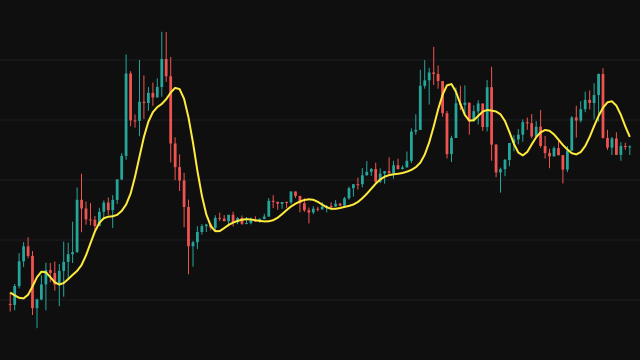
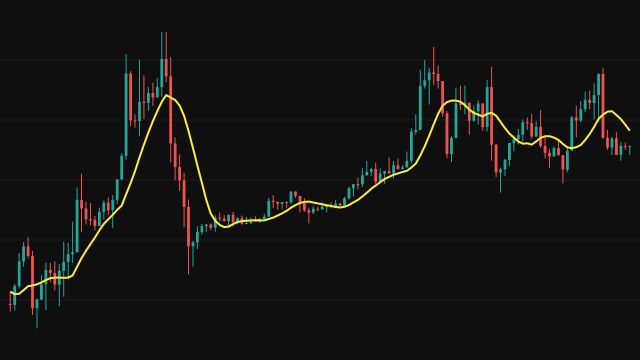
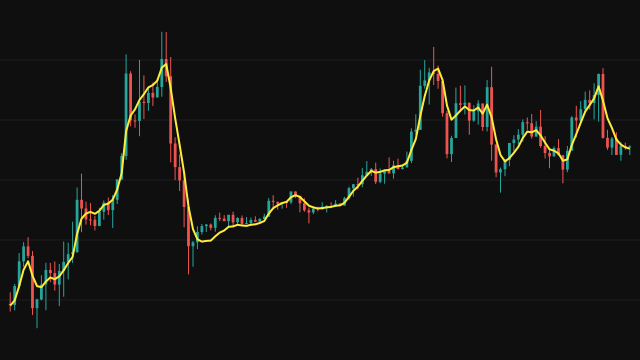
The Hamming Moving Average weights the bars of its window with the Hamming taper, 0.54 - 0.46 * cos(2 * pi * k / (N - 1)), where k counts bars back from the newest and N is the window length. The weight is 0.08 at both ends of the window and rises to 1 in the middle, so the central bars dominate. The weighted prices are summed and divided by the sum of the weights.
The window grows with the chart until it holds period bars, with the weights rebuilt for each length. A window of a single bar weights that bar by one, so the line starts on the first bar at the price itself. A missing price is skipped with its weight, and a window with no usable weight falls back to the current price.
How to read Hamming Moving Average (HAMMA)
Read the HAMMA as a smooth trend line. Tapering the ends means a large bar entering or leaving the window moves the line gently rather than in a step, so its path is cleaner than a simple average of the same length. Because the weight sits in the middle of the window, the line runs roughly half a window behind price.
Use it for the direction and slope of the trend. It is slow to confirm a reversal, and a cross of price through the line comes after much of the move has happened.
Settings
- Period
- Number of bars in the full window. A longer period smooths more and lags more.
- Source
- The price series the average is taken from, the close by default.
Frequently asked questions
How does it differ from the Hanning average?
Both use a cosine taper. The Hamming taper keeps a small weight of 0.08 at the ends of the window, while the Hanning taper falls all the way to zero.
Why is the line smoother than a simple average?
Bars enter and leave the window with small weights, so a single large bar shifts the line gradually instead of in one jump.
Where does the line start?
On the first bar. The window grows with the chart, and a one-bar window simply returns the price.