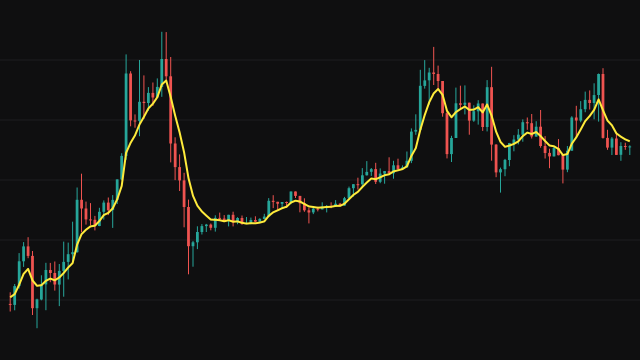
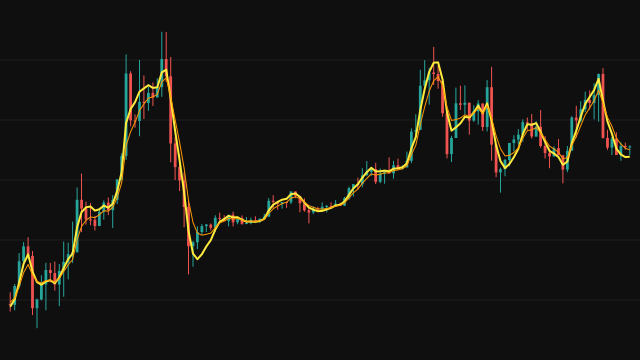
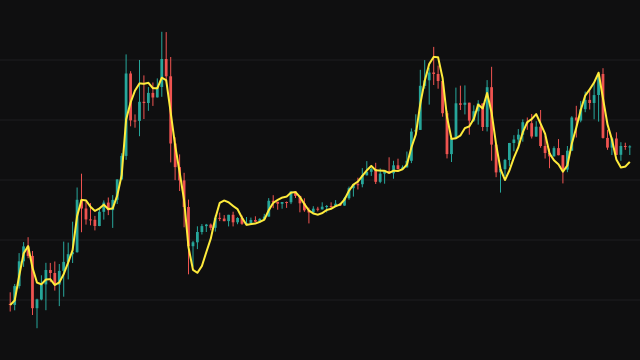
The Pascal Weighted Moving Average weights each bar of its window by a binomial coefficient. With p bars in the window the weights are one row of Pascal's triangle: the first is 1 and each next one is the previous times (p - k) / k. For a window of five that gives 1, 4, 6, 4, 1. The weighted sum of the source is divided by the sum of the weights.
The binomial weights form a bell centred on the middle of the window, very close to a Gaussian, so bars near the ends count for almost nothing and the middle bars dominate. The window grows with the data until it reaches period, so the line starts on the first bar. A missing price is left out with its weight.
How to read Pascal Weighted Moving Average (PWMA)
Read it as a very smooth trend line. Because the bell is narrow, the effective smoothing is shorter than the period suggests, and the line lags price by about half the window. A rising line with price above it describes an uptrend, and a falling line with price below it a downtrend.
Its slope is the useful part: turns in the line are clean and seldom reverse on a single bar. Until period bars exist the window is shorter, so the earliest values follow price more closely.
Settings
- Period
- How many bars the binomial bell spans. A longer period smooths more and lags more.
- Source
- The price series that is averaged, the close by default.
Frequently asked questions
Why do the bars at the ends hardly count?
Binomial coefficients grow quickly toward the middle of the row. In a 10-bar window the two end bars weigh 1 each while the middle ones weigh 126, so the ends barely move the result.
Is there an upper limit on the period?
Yes, 1000. The coefficients become too large to hold in a number much beyond that.
How is it different from a Gaussian average?
A binomial row is the whole-number cousin of a Gaussian bell. The two give very similar lines, but this one needs no width setting: the period fixes the shape.