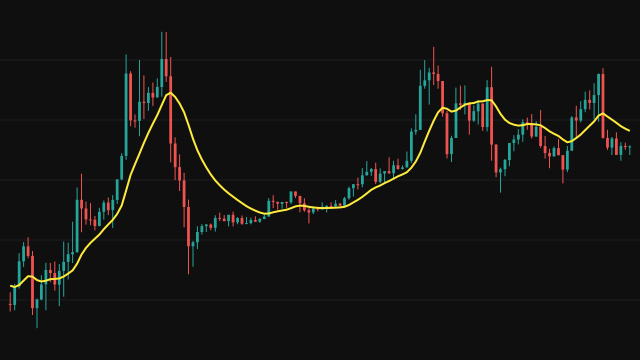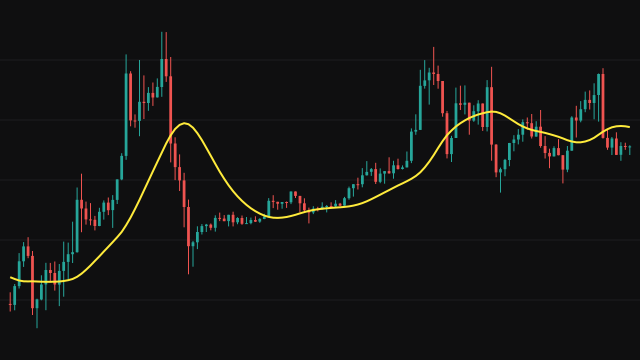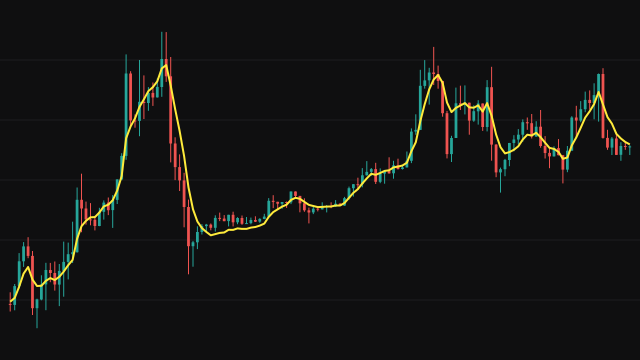
CRMA fits a third-degree polynomial to the prices in the window by least squares, with x counting bars back from the newest (x = 0 is this bar). The fit is found by solving the four normal equations with Gaussian elimination and partial pivoting, and the line is the curve's value at x = 0.
A straight-line fit lags when a trend is speeding up or slowing down. A cubic can bend, so it follows acceleration and deceleration more closely. The window grows from the first bar up to the period; with fewer than four bars a cubic cannot be fitted, and the line is the price itself. If the equations are singular the line also falls back to the price. A missing source value reads as zero.
How to read Cubic Regression Moving Average (CRMA)
Read CRMA as a fast, low-lag moving average. Compared with a linear regression or a simple average of the same length, it usually sits closer to price and turns sooner. The price of that speed is overshoot: at a sharp reversal a cubic can swing past price before settling.
Use a longer period to calm it down. A crossing of price and CRMA comes earlier than with slower averages, so confirm it with the slope of the line.
Settings
- Period
- Number of bars in the regression window, at least 4. A longer window gives a steadier fit.
- Source
- The series being fitted, usually the close.
Frequently asked questions
Why does it overshoot price at turns?
A cubic can bend sharply, so near a reversal the fitted curve can extend beyond the latest price. A longer period reduces the effect.
Why does it need at least four bars?
A cubic has four coefficients, so it needs at least four points to fit. Before four bars exist the line is the price itself.