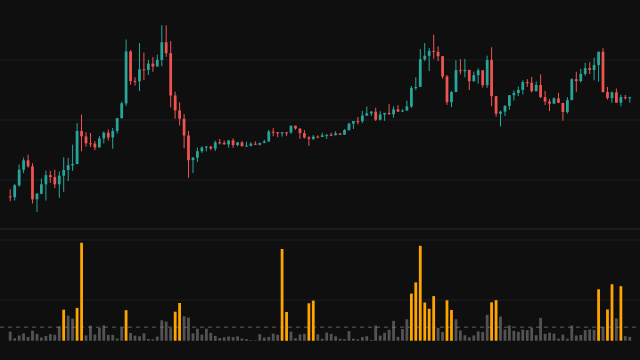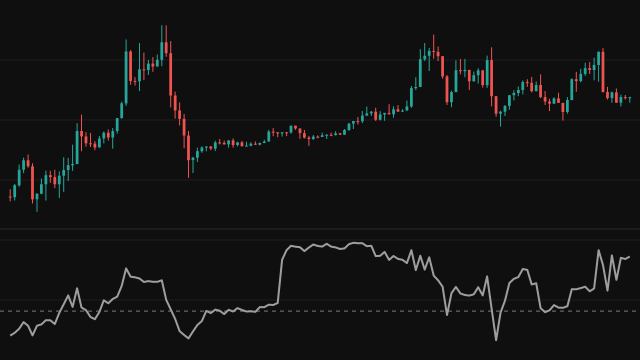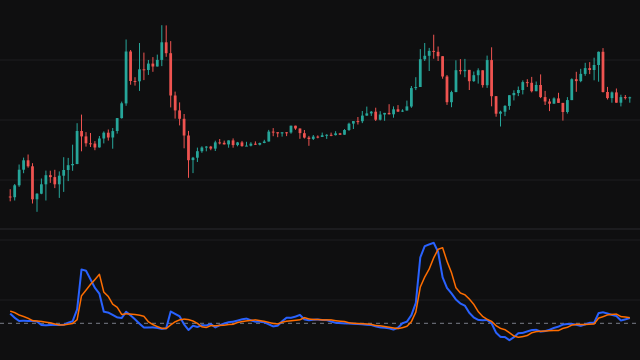
Finite Volume Elements, designed by Markos Katsanos, measures whether volume is flowing into or out of an instrument while ignoring bars that barely move. For each bar it computes a money flow figure: the distance of the close from the bar's midpoint, close - (high + low) / 2, plus the change in typical price, (high + low + close) / 3, from the previous bar.
When that flow is above a cutoff of 0.3 percent of the close, the bar's whole volume counts as buying; when it is below minus the cutoff, it counts as selling; in between, the bar counts as zero. FVE is the sum of the signed volume over the last 22 bars divided by the total volume of those bars, times 100, so it runs from minus 100 to plus 100. It is drawn as a line in its own pane with a dashed zero line, and the first value appears on bar 23 with the default period, one bar later than the window alone needs, because the first bar has no previous typical price.
How to read Finite Volume Elements (FVE)
A reading above zero means more volume traded on bars that closed strongly than on bars that closed weakly over the window, a sign of accumulation; below zero means distribution. The level matters as much as the sign: a reading near plus 100 means almost every active bar was a buying bar. A rising FVE while price drifts sideways or lower is a divergence that often comes before a move up, and a falling FVE under a rising price is a warning.
The cutoff makes quiet bars count for nothing, so on a very calm instrument most bars fall inside it and the line hugs zero. Lower the cutoff for such instruments, and raise it to ignore more noise on volatile ones. On instruments without volume the study has no answer.
Settings
- Period
- Bars of signed volume added up, and the bars whose total volume is the divisor. 22 is the published value, about a month of daily bars.
- Cutoff %
- How far, as a percentage of the close, the money flow must move before a bar's volume counts. 0.3 is the published value; 0 counts every bar whose money flow is not exactly zero.
Frequently asked questions
How is it different from on balance volume?
On balance volume adds or subtracts every bar's volume by the sign of the close to close change and keeps a running total. FVE also weighs where the close sits in the bar, ignores bars that move less than the cutoff, and reports a bounded percentage over a fixed window rather than a running total.
Why can it never pass 100?
The signed volume of each bar is at most that bar's volume, so the sum over the window cannot exceed the total volume of the window. Plus 100 means every bar in the window was a buying bar.
What happens on hourly bars?
The calculation is the same on any interval. A move of 0.3 percent is large for one hour on many instruments, so more bars fall inside the cutoff; a smaller cutoff keeps the line responsive on short intervals.
Is the cutoff ever based on volatility?
Katsanos later described a variant whose cutoff follows the instrument's recent volatility instead of a fixed percentage. This study uses the fixed percentage of the close from the original definition, which you can adjust with Cutoff %.