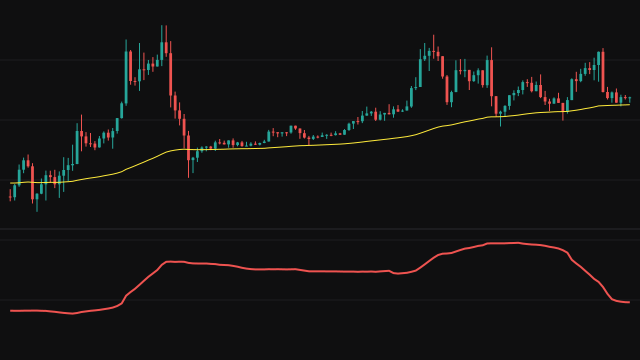
Mean Relative Absolute Error compares an actual series (the close by default) with a predicted series (the open by default). On every bar it divides the absolute gap between them by the absolute actual value, giving the error as a fraction of the level. The study plots the simple average of those fractions over the last Length bars.
When the actual value is effectively zero the bar contributes zero rather than an infinite ratio. An absent actual value reads as 1 in the denominator and as 0 in the gap, and an absent predicted value reads as 0.
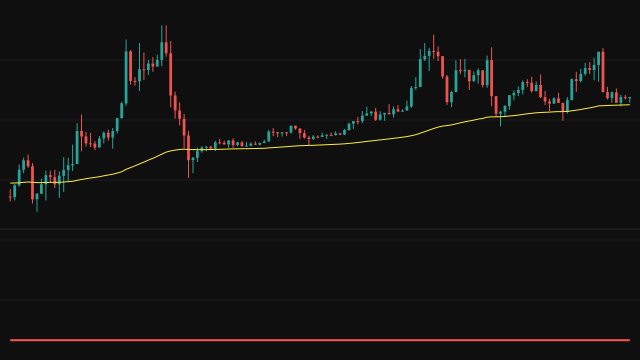
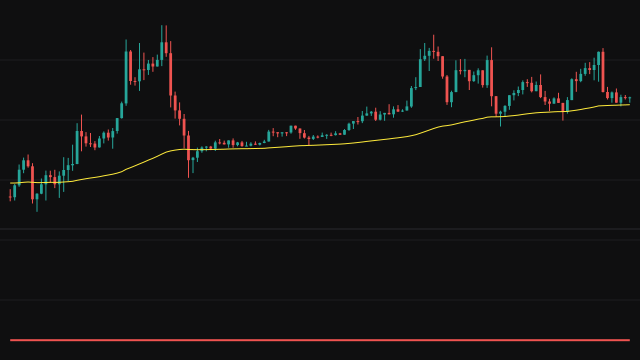
The pane shows a dotted line at 0, labelled Perfect, and a dotted line at 1, an error as large as the level itself.
How to read Mean Relative Absolute Error
A reading of 0.003 means the predicted series was typically 0.3 percent away from the actual one over the window. Zero would mean a perfect match on every bar, and 1 would mean the typical miss was as large as the actual value. With the default inputs the reading is the average bar body as a fraction of the close, a scale-free measure of how much price moves inside each bar.
Because it is a ratio, the reading can be compared between instruments at different price levels. The line has no value until Length bars have passed.
Settings
- Length
- How many bars the relative errors are averaged over. A longer window gives a smoother line.
- Actual
- The series treated as the outcome and used as the base of each ratio. The close by default.
- Predicted
- The series treated as the forecast of the actual series. The open by default.
Frequently asked questions
What do the two dotted lines mean?
The line at 0 marks a perfect forecast. The line at 1 marks an average error as large as the actual value itself, which on a price chart would be an enormous miss.
Is this a percentage?
It is a fraction. Multiply by 100 to read it as a percentage, so 0.01 is a one percent average error.
Why does a zero actual value add nothing?
Dividing by zero has no answer, so a bar whose actual value is effectively zero contributes an error of zero instead.