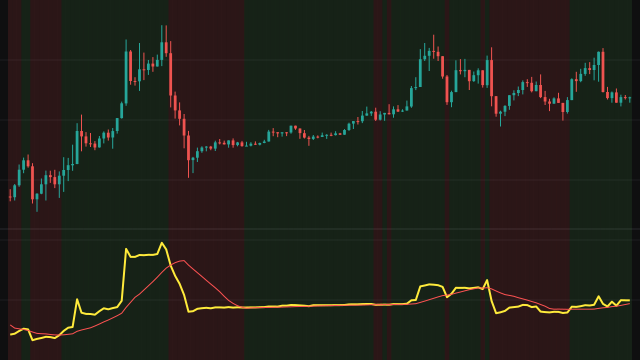
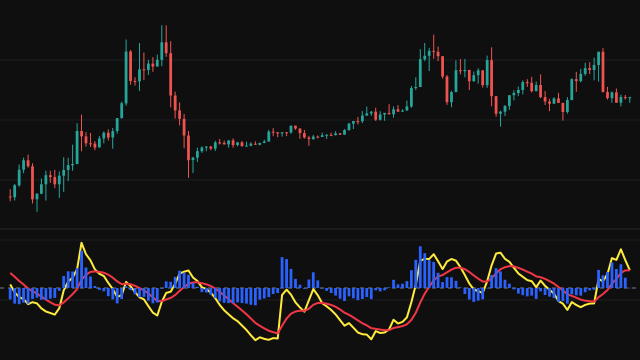
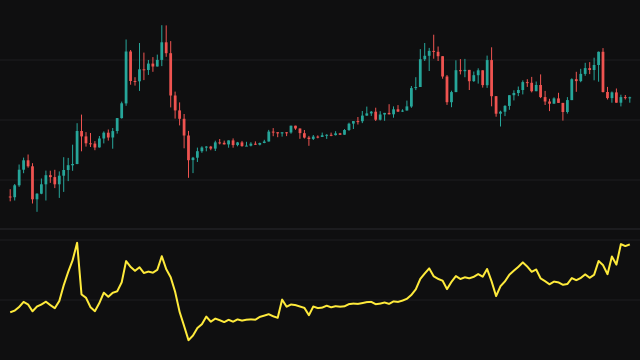
Price Volume Rank sorts each bar into one of five cases by comparing its price and volume with the previous bar. A rank of 1 means price rose and volume rose. A rank of 2 means price rose while volume fell or stayed the same. A rank of 3 means price fell and volume fell. A rank of 4 means price fell while volume rose or stayed the same. A rank of 0 means price was unchanged, whatever the volume did.
The price compared is the Price Source setting, the close by default, and a missing volume reads as zero. The first bar compares with itself, so it ranks 0. The result is drawn as a step line, so each bar's class shows as a flat segment.
How to read Price Volume Rank (PVR)
Ranks 1 and 3 are the confirmed cases, where volume moved the same way as price: rising price on rising volume, falling price on falling volume. Ranks 2 and 4 are the divergent cases. A run of 1s suggests a well supported advance, while a run of 2s suggests the advance is happening on thinning volume.
The rank is a single-bar classification with no smoothing, so it changes often. It is most useful read as a pattern over several bars, or smoothed with an average of your own, rather than acting on any one bar.
Settings
- Price Source
- The price compared with the previous bar to decide whether price rose, fell or was unchanged, the close by default.
Frequently asked questions
Which ranks are up bars and which are down bars?
Ranks 1 and 2 are bars where price rose, ranks 3 and 4 bars where it fell. Within each pair the rank only tells you whether volume moved the same way as price (1 and 3) or the other way (2 and 4).
Why is the first bar ranked 0?
There is no earlier bar, so it compares with itself and its price is unchanged.