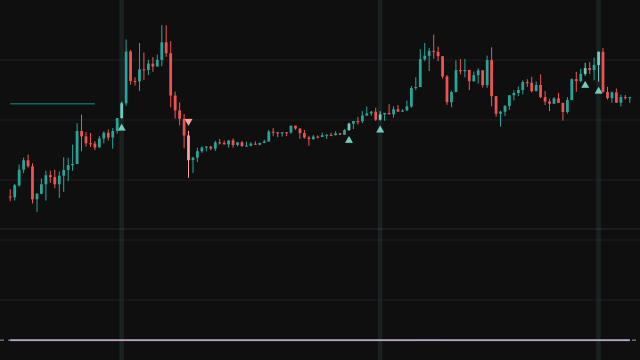
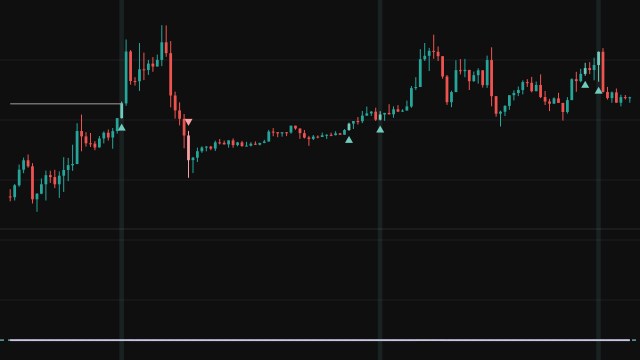
The study follows the market's structure as a pair of levels: a structure high and a structure low, each anchored at the bar that set it. When price breaks one of them a line is drawn along the broken level, from the bar that set it to the breaking bar, and labelled BOS (break of structure) when the break continues the current direction or CHoCH (change of character) when it reverses it. By default a break needs a close beyond the level; with the body option off a wick is enough. A break in the current direction must come after three bars that held, all later than the bar that set the level, while a break against it counts at once.
After a break down, the new structure runs from the break bar's low up to the highest swing of the last 10 bars; after a break up, from the break bar's high down to the lowest swing. The swing is the furthest back local peak (or trough) of those bars that is no older than their extreme. Between breaks a new high (in a rising or undecided structure) or a new low (in a falling or undecided one) moves the level, but with the body option on only while the level was set within the last three bars. The current structure is drawn in blue with five Fibonacci levels (0.786, 0.705, 0.618, 0.5 and 0.382 by default). A level of v sits v times the range back from the newest extreme: below the structure high after a break up, above the structure low after a break down. Each is labelled with its level and price.
A fair value gap is read across three bars: a bullish gap where the low one bar back is above the high three bars back, and a bearish gap where the high one bar back is below the low three bars back. Each gap is a box with an "FVG" label that extends to the newest bar. It turns grey once price trades into it, can shrink to the part not yet traded, and is deleted when price fills it completely.
How to read SMC Structures and FVG
Read the labels as the story of the trend: a run of BOS lines in one direction is a trend extending, and a CHoCH is the first break the other way. The two blue lines are the range price is working in now, and the Fibonacci levels inside it are the retracement zones that range offers, with 0.5 the midpoint and the higher levels closer to where the swing started.
Green and red boxes are gaps price has not yet traded back into; grey ones have been partly filled, and a gap disappears once it is filled completely. The structure is decided bar by bar from closed bars, so a level can move while it is recent, and the swing bar is chosen from only the last 10 bars, which keeps the study quick to react but makes it sensitive to noise on low timeframes.
Settings
- Display FVG
- Draw the fair value gap boxes and their labels. Off, no gaps are drawn or tracked.
- Bullish FVG Color
- Fill of a bullish gap that price has not traded into.
- Bearish FVG Color
- Fill of a bearish gap that price has not traded into.
- Mitigated FVG Color
- Fill a gap takes once price has traded into it without filling it.
- Number of FVG to show
- How many gaps are kept. The study holds one more than this number and deletes the oldest beyond it.
- Reduce mitigated FVG
- Shrink a gap to the part price has not yet traded into, instead of keeping its original size.
- Break with candle's body
- On, a level breaks only on a close beyond it. Off, a wick beyond it is enough, which gives more breaks.
- Display current structure
- Draw the current structure high and low and the Fibonacci levels inside them.
- Bullish BOS Color
- Colour of a BOS line and label on a break up.
- Bearish BOS Color
- Colour of a BOS line and label on a break down.
- BOS Style
- Solid, dotted or dashed BOS lines.
- BOS Width
- Thickness of the BOS lines, 1 to 5.
- Bullish CHoCH Color
- Colour of a CHoCH line and label on a break up.
- Bearish CHoCH Color
- Colour of a CHoCH line and label on a break down.
- CHoCH Style
- Solid, dotted or dashed CHoCH lines.
- CHoCH Width
- Thickness of the CHoCH lines, 1 to 5.
- Current structure Color
- Colour of the two lines that mark the current structure high and low.
- Current structure Style
- Solid, dotted or dashed lines for the current structure.
- Current structure Width
- Thickness of the current structure lines, 1 to 5.
- Number of break to show
- How many BOS and CHoCH lines are kept, with their labels; the oldest is deleted beyond it.
- Fibonacci 1
- Draw the first Fibonacci level of the current structure.
- Fibonacci 1 Level
- The first level as a fraction of the structure's range, 0.786 by default.
- Fibonacci 1 Color
- Colour of the first level's line and label.
- Fibonacci 1 Style
- Solid, dotted or dashed line for the first level.
- Fibonacci 1 Width
- Thickness of the first level's line, 1 to 5.
- Fibonacci 2
- Draw the second Fibonacci level of the current structure.
- Fibonacci 2 Level
- The second level as a fraction of the structure's range, 0.705 by default.
- Fibonacci 2 Color
- Colour of the second level's line and label.
- Fibonacci 2 Style
- Solid, dotted or dashed line for the second level.
- Fibonacci 2 Width
- Thickness of the second level's line, 1 to 5.
- Fibonacci 3
- Draw the third Fibonacci level of the current structure.
- Fibonacci 3 Level
- The third level as a fraction of the structure's range, 0.618 by default.
- Fibonacci 3 Color
- Colour of the third level's line and label.
- Fibonacci 3 Style
- Solid, dotted or dashed line for the third level.
- Fibonacci 3 Width
- Thickness of the third level's line, 1 to 5.
- Fibonacci 4
- Draw the fourth Fibonacci level of the current structure.
- Fibonacci 4 Level
- The fourth level as a fraction of the structure's range, 0.5 by default.
- Fibonacci 4 Color
- Colour of the fourth level's line and label.
- Fibonacci 4 Style
- Solid, dotted or dashed line for the fourth level.
- Fibonacci 4 Width
- Thickness of the fourth level's line, 1 to 5.
- Fibonacci 5
- Draw the fifth Fibonacci level of the current structure.
- Fibonacci 5 Level
- The fifth level as a fraction of the structure's range, 0.382 by default.
- Fibonacci 5 Color
- Colour of the fifth level's line and label.
- Fibonacci 5 Style
- Solid, dotted or dashed line for the fifth level.
- Fibonacci 5 Width
- Thickness of the fifth level's line, 1 to 5.
Frequently asked questions
What is the difference between BOS and CHoCH here?
Both mark a broken structure level. BOS is a break in the direction of the last break, so the trend continues; CHoCH is a break against it, and the first break on the chart is always a CHoCH.
Why does a fair value gap use the bars three back and one back?
The gap is read on the bar after the three-bar pattern completes, so the pattern's bars are one, two and three bars back. The box spans the middle bar and the bar after it, then extends to the newest bar while the gap stays open.
What do the Fibonacci labels show?
Each label writes the level and its price with two decimals, for example 0.618(64250.50), and sits 20 bars to the right of the newest bar. After a break up each level is measured down from the structure high, after a break down up from the structure low.
Which alerts does the study raise?
BOS on a bar with a break of structure, CHOCH on a change of character, and FVG has been mitigated the first time price trades into a gap.