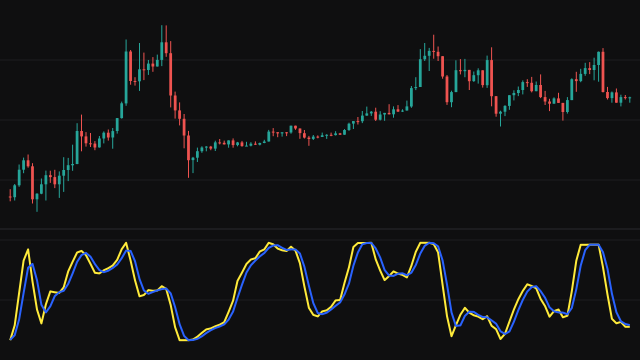
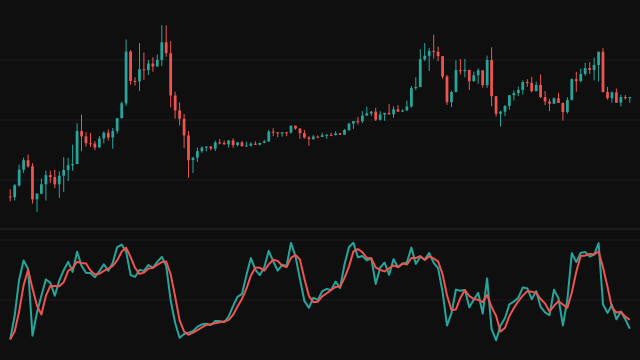
The fast stochastic places the close inside the range of recent prices. It finds the lowest low and the highest high of the last K Length bars and works out how far up that range the close sits, from 0 at the low to 100 at the high. That raw reading is the Fast %K line, with no smoothing applied. When the range is flat the line reads 0.
The Fast %D line is the simple mean of %K over the last D Length bars.
Both windows use the bars seen so far until they are full, so the two lines answer from the first bar rather than waiting out a warmup. A missing high, low or close is read as 0.
How to read Stochastic Fast (STOCHF)
High readings mean the close is near the top of its recent range, low readings near the bottom. Above 80 is usually read as overbought and below 20 as oversold, but in a trend the line can stay in those zones for a long time. A cross of %K above %D is an early sign of an upturn, and a cross below of a downturn.
With no smoothing on %K the fast stochastic is jumpy and gives many crosses, most of them noise in a sideways market. Many traders prefer to read it alongside a trend tool, or to use the smoother stochastic for signals and the fast one for timing.
Settings
- K Length
- How many bars the high-low range covers. A shorter window makes %K more sensitive to every bar.
- D Length
- How many %K readings the signal line averages. A longer average gives a smoother, slower %D.
Frequently asked questions
How is this different from the slow stochastic?
Here %K is the raw position of the close in its range, with no smoothing. The slow version smooths that reading first, so its lines move less and cross less often.
Why does %K read 0 on some bars?
When the highest high and the lowest low of the window are equal, which means every bar in it traded at one price, the range is zero and the position cannot be computed, so the line reads 0.
Does it need a warmup?
No. Until a full window exists, the range and the average use the bars seen so far, so both lines start on the first bar.