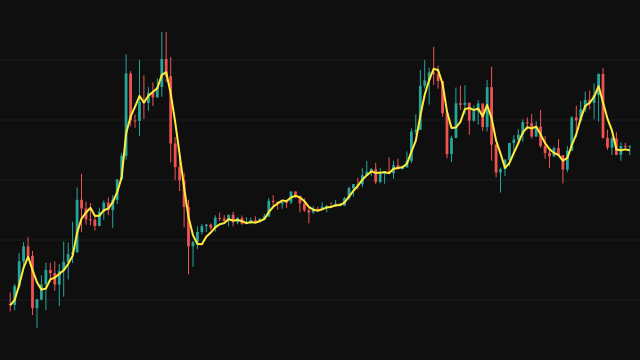
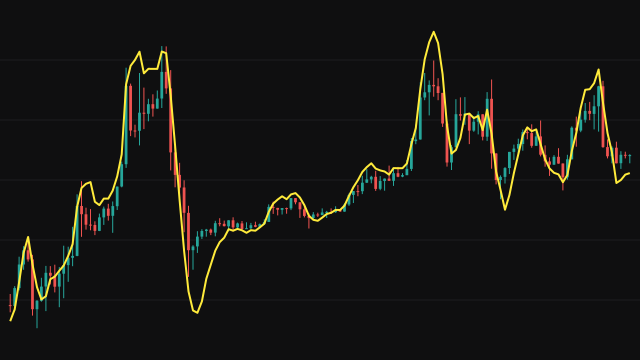
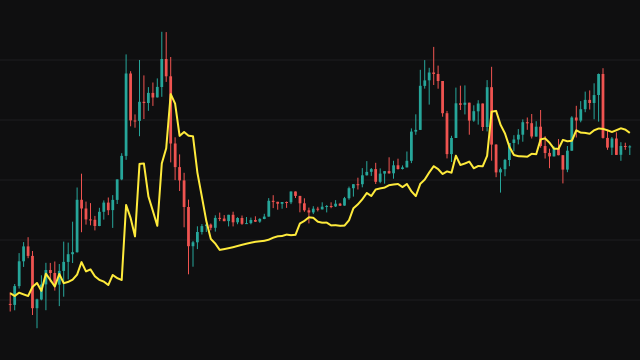
Zero-Lag Triple EMA corrects the price for lag and then smooths it through three exponential averages. The de-lagged price is 2 * price - price lag bars ago, with the lag half the period minus a half, rounded down, and at least one bar. Until lag bars exist, the first price of the chart stands in for the older one.
The first average has weight a1 = 2 / (period + 1). The second and third are faster: each weight is the one before multiplied by the cube root of 1 / a1, so the second is a1 ^ (2/3) and the third a1 ^ (1/3): about 0.18, 0.32 and 0.57 at the default period of 10. All three start from zero, and while the zero start still carries weight e each stage is multiplied by 1 / (1 - e). The line is 3 * first - 3 * second + third, the triple average combination that cancels most of the lag of the chain.
How to read Zero-Lag Triple EMA (ZLTEMA)
Read it as a very fast moving average on price. A rising line with price above it describes an uptrend, a falling line with price below it a downtrend. Its turns come earlier than those of an exponential average of the same period, which is useful for timing but also means it reacts to noise that a slower line would ignore.
It overshoots price after sharp moves and can cross price many times in a range. It is most useful in trending conditions, or paired with a slower average that sets the direction.
Settings
- Period
- Sets the first stage's weight as 2 / (period + 1), from which the faster second and third weights follow, and the lag of the correction as (period - 1) / 2, rounded down and at least 1.
- Source
- The price series the average follows, the close by default.
Frequently asked questions
Why are the second and third stages faster?
Each weight is the one before multiplied by the cube root of 1 / a1, so the second stage uses a1 ^ (2/3) and the third a1 ^ (1/3), about 0.32 and 0.57 at the default period of 10. Heavier weights keep the extra stages from adding as much lag as two more averages of the first weight would.
How does it compare with the double version?
It adds a third average and combines the three as 3 times the first minus 3 times the second plus the third. That cancels more lag, at the cost of more overshoot.
What stands in for the older price at the start?
Until enough bars exist, the first price of the chart is used as the older price, so the correction starts small instead of jumping.