Lot Size, Settlement and the Real Risks
The practical mechanics and the honest dangers. Learn the lot size (so you know what one option really costs), how Indian options settle, and the risks that catch new option traders.
- ·Lot size and true cost
- ·Cash settlement in India
- ·Expiry-day behaviour
- ·The risk of total loss for buyers
- ·Assignment risk for sellers
- ·A beginner's safety checklist
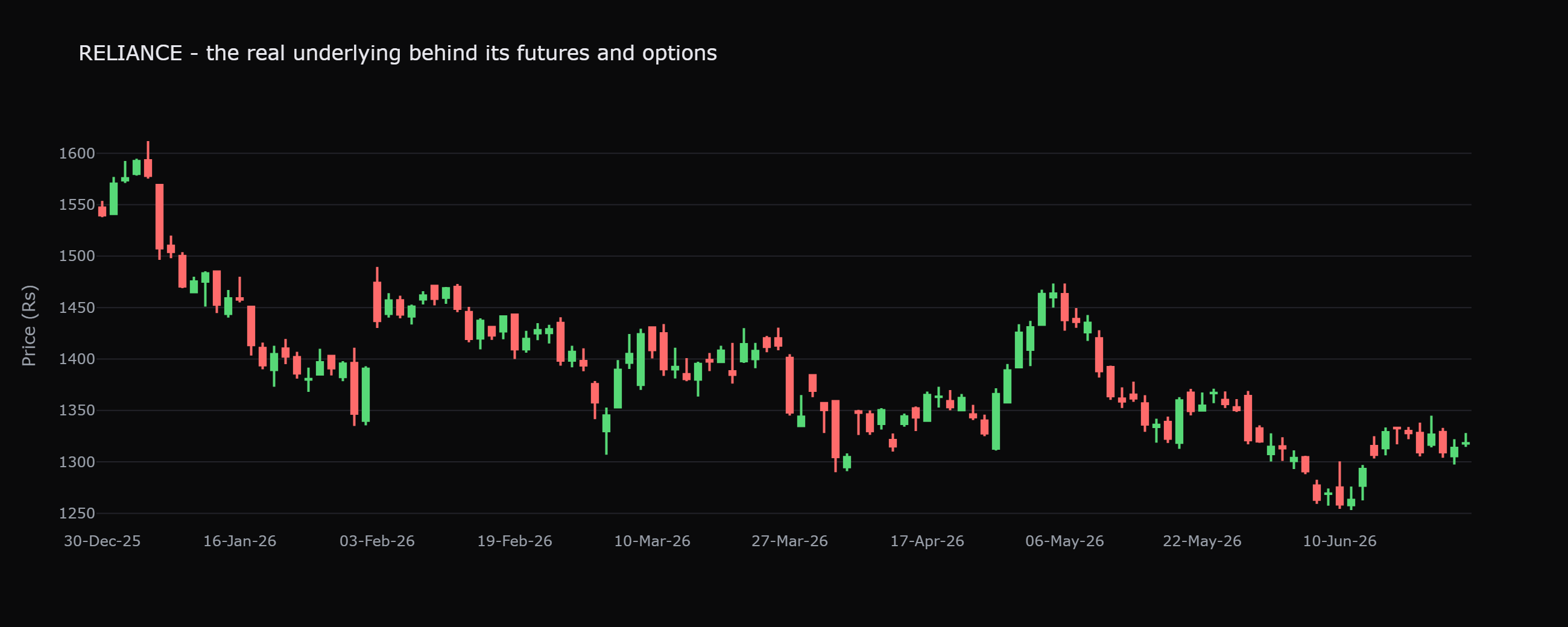
We have spent thirteen chapters learning what options are and how their prices behave. This final chapter is about the plumbing and the dangers, the things that decide whether you actually keep your money. How big is a lot, and what does a trade really cost? What happens on expiry day when the option finally settles? And what are the honest risks, the ones that can genuinely hurt you, that no amount of clever strategy removes? These are not glamorous topics, but they are where beginners get caught. A trader who understands the payoff diagram but not the lot size, or who understands the Greeks but not what happens at expiry, is still flying blind. Let us close the course by grounding everything in the real RELIANCE chart and then walking out with a short safety checklist you can actually use.
Lot size and the true cost of a trade
The most important practical fact in Indian options is that you never trade a single share's worth. Options trade in fixed bundles called lots, and for RELIANCE one lot is 500 shares. Every premium you see quoted is per share, but the money that actually leaves or enters your account is per lot, which means you multiply by 500.
This is where the numbers get real. The RELIANCE 1320 call is quoted at about Rs 31 per share. That sounds small, almost trivial. But one lot is 500 shares, so the real cost is 31 times 500, which is about Rs 15,590 for a single lot. That is the cheque you write to buy one call, and on a long option it is also the most you can lose.
The lot multiplier cuts both ways, and beginners feel it most on the loss side.
- Every one rupee move in the premium is worth Rs 500 to your position, because you hold 500 shares' worth.
- A premium that drops from Rs 31 to Rs 15 has not lost you 16 rupees. It has lost you about Rs 8,000, because 16 times 500 is 8,000.
- Buying two lots instead of one doubles everything. The cost, the risk and the reward all scale straight up with the number of lots.
Lot sizes differ across instruments, so you must always check the one you are trading. RELIANCE is 500. The common index lots are different again: NIFTY is 65, BANKNIFTY is 30, FINNIFTY is 60 and MIDCPNIFTY is 120. The premium per share might look similar across them, but the cost per lot depends entirely on the multiplier.
Options trade in lots, not single shares. One RELIANCE lot is 500 shares. A premium of about Rs 31 a share is about Rs 15,590 a lot, and every one rupee move in the premium is worth Rs 500 to you. Always multiply the per share premium by the lot size to see the real money at stake.
How Indian options settle
When an option reaches expiry, it has to be settled, and the way that happens depends on what the option is written on. This is a detail many beginners get wrong, so let us be accurate rather than tidy.
- Index options, such as those on NIFTY and BANKNIFTY, are cash-settled. There are no shares to deliver, because you cannot hold an index. At expiry the exchange simply pays the in-the-money value in cash. If you held a call that finished 20 points in-the-money, you receive that 20 points times the lot size in cash, and nothing physically changes hands.
- Single-stock options, such as those on RELIANCE, are physically settled in India. If you hold a RELIANCE option to expiry and it finishes in-the-money, it converts into an actual delivery of shares. A call buyer who holds to expiry takes delivery of 500 RELIANCE shares at the strike, and the seller must deliver them. A put works the mirror way.
That difference matters enormously in practice. Physical settlement means that holding a single-stock option to expiry can suddenly require you to pay for, or deliver, 500 full shares of RELIANCE, which at 1320 is a position worth about Rs 6,60,000, far more than the small premium you started with. That is not a risk most beginners intend to take on.
The practical rule that follows is simple and worth memorising. Most traders square off before expiry. They close the option position in the market a day or two before 28 July rather than letting it settle, so they realise their profit or loss in cash and avoid the delivery obligations entirely. Letting a single-stock option run into expiry is for people who genuinely want, and can fund, the underlying shares.
A RELIANCE option is settled by physical delivery, not cash. If you hold an in-the-money single-stock option to expiry, it can turn into an obligation to take or deliver 500 actual shares, a position worth several lakh rupees. Unless you truly intend that, close the position before expiry day.
What happens on expiry day
For NSE options, which is where RELIANCE, NIFTY and BANKNIFTY trade, expiry day falls on a Tuesday, the last Tuesday of the month for monthly contracts and every Tuesday for the index weeklies. The BSE products such as the SENSEX expire on a Thursday instead. Knowing your exact expiry day matters, because that is the deadline by which all the behaviour below plays out.
Expiry day is when everything we have discussed comes to a head, and it behaves in a way that is brutal but logical. On the final day, time value is gone. There is no future left to hope for, so the hope premium has fully melted, and the option is worth nothing more than its intrinsic value, its pure here-and-now worth.
That has a stark consequence for out-of-the-money options.
- An out-of-the-money option expires worthless. If RELIANCE closes at 1315 on 28 July, the 1320 call has no intrinsic value, no time value left to fall back on, and it simply dies at zero. Every rupee of the Rs 15,590 a buyer paid is gone.
- An in-the-money option settles for its intrinsic value. If RELIANCE closes at 1360, the 1320 call is worth 40 rupees a share of intrinsic value, about Rs 20,000 a lot, and that is what settles.
- An at-the-money option sitting right at the strike is a coin toss that usually ends with little or nothing, because there is no intrinsic value and no time left to gain any.
Here is how the 1320 call settles at a few possible closing prices on 28 July, with the premium long since paid.
| RELIANCE close on 28 July | 1320 call intrinsic value per share | The call lot settles for | Buyer's result on Rs 15,590 paid |
|---|---|---|---|
| 1300 | Nothing, expires worthless | About zero | Full loss, about Rs 15,590 |
| 1320 | Nothing, right at the strike | About zero | Full loss, about Rs 15,590 |
| 1351 | 31 rupees, the breakeven | About Rs 15,500 | Roughly back to even |
| 1380 | 60 rupees | About Rs 30,000 | Profit of about Rs 14,400 |
This is the final, unsentimental face of time decay. All through the option's life the time value was leaking away, and on expiry day the last of it is gone. The option keeps only what it has genuinely earned by where RELIANCE actually finished, and not a paisa more.
Two beginners both buy the 1320 call for about Rs 15,590, expecting a rally. RELIANCE closes at 1335 on 28 July. The call is 15 rupees in-the-money, worth about Rs 7,500 a lot. Both were right that the stock rose, yet both still lost about Rs 8,000, because 1335 is below the breakeven of 1351. Being right on direction is not enough. The stock has to clear the strike plus the premium.
The risks you must respect
Everything in this course comes down to two honest dangers, one for each side of the trade. Neither can be removed by cleverness. They can only be respected and sized for.
The buyer's danger is total loss. When you buy an option, the entire premium is at risk, and losing all of it is the normal outcome, not the rare one. Most bought options, especially out-of-the-money ones, expire worthless. The comfort is that the loss is capped: you can never lose more than the Rs 15,590 you put in. The danger is that losing the full amount happens often, so you must only ever buy with money you can afford to lose completely.
The seller's danger is assignment and a large or unlimited loss. When you sell an option, you are paid the premium upfront but you carry an obligation. If the option finishes in-the-money, you are assigned, meaning the obligation comes due. On a RELIANCE short call you must deliver 500 shares; on a short put you must buy 500 shares at the strike even if they have crashed. The loss on a short call is unlimited as the stock rises, and the loss on a short put can run to several lakh rupees as the stock falls. The premium you collect is small against the tail you carry, which is why selling demands margin, a plan and respect.
For buyers, the normal outcome of a bought option is total loss of the premium. For sellers, assignment can turn a small collected premium into an obligation worth several lakh rupees. Both are real. Buy only what you can lose entirely, and sell only what you can fund and have planned to exit.
A beginner safety checklist
You now know enough to be dangerous, which means you now need the discipline to be safe. Before you place any real options trade, walk this short checklist. It is the distilled caution of the whole course.
- Start in sandbox trading (analyzer mode in OpenAlgo). Rehearse every trade without real money first, and watch how the premium decays, reacts and settles before you risk a single rupee.
- Know your lot size and your real cost. Multiply the per share premium by the lot. For RELIANCE that is times 500, so about Rs 15,590 for the 1320 option. Never size a trade off the per share number alone.
- Know your maximum loss before you enter. If you are buying, it is the full premium and you should assume you will lose it. If you are selling, write down the large tail and the margin, and decide the price at which you will exit.
- Prefer buying while you learn. Capped, known risk is the right teacher for a beginner. Treat the premium as money you can afford to lose entirely.
- Avoid buying just before known events. Implied volatility is inflated then, and the crush after can lose you money even when you are right on direction.
- Square off before expiry unless you truly want the shares. A RELIANCE option settles by physical delivery, so close it in the market rather than letting an obligation for 500 shares land on you.
- Size small and never risk money you need. No single options trade should be able to hurt your financial life. If a loss would, the position is too big.
The traders who last are not the ones who find the cleverest strategy. They are the ones who respect lot size, define their loss before entering, rehearse in sandbox trading, and never let a single trade threaten them. Discipline outlives every clever idea.
That is the course. You started not knowing what a call or a put was, and you can now read a premium, split it into intrinsic and time value, understand the Greeks and implied volatility, read every single-leg payoff, and weigh the buyer's and seller's sides honestly. The strategies that combine these pieces come next, but the foundation is set. Trade small, stay honest with yourself about the risks, rehearse before you commit real money, and let the discipline in this checklist outlast every tip you will ever hear.