
Premium, Strike and Expiry
Three numbers define every option. Learn the premium you pay, the strike price you lock in, and the expiry date it all ends on, with a real RELIANCE option symbol.
- ·The premium (the price of the option)
- ·The strike price
- ·The expiry date
- ·Reading an option symbol
- ·Per share vs per lot
- ·How the three interact
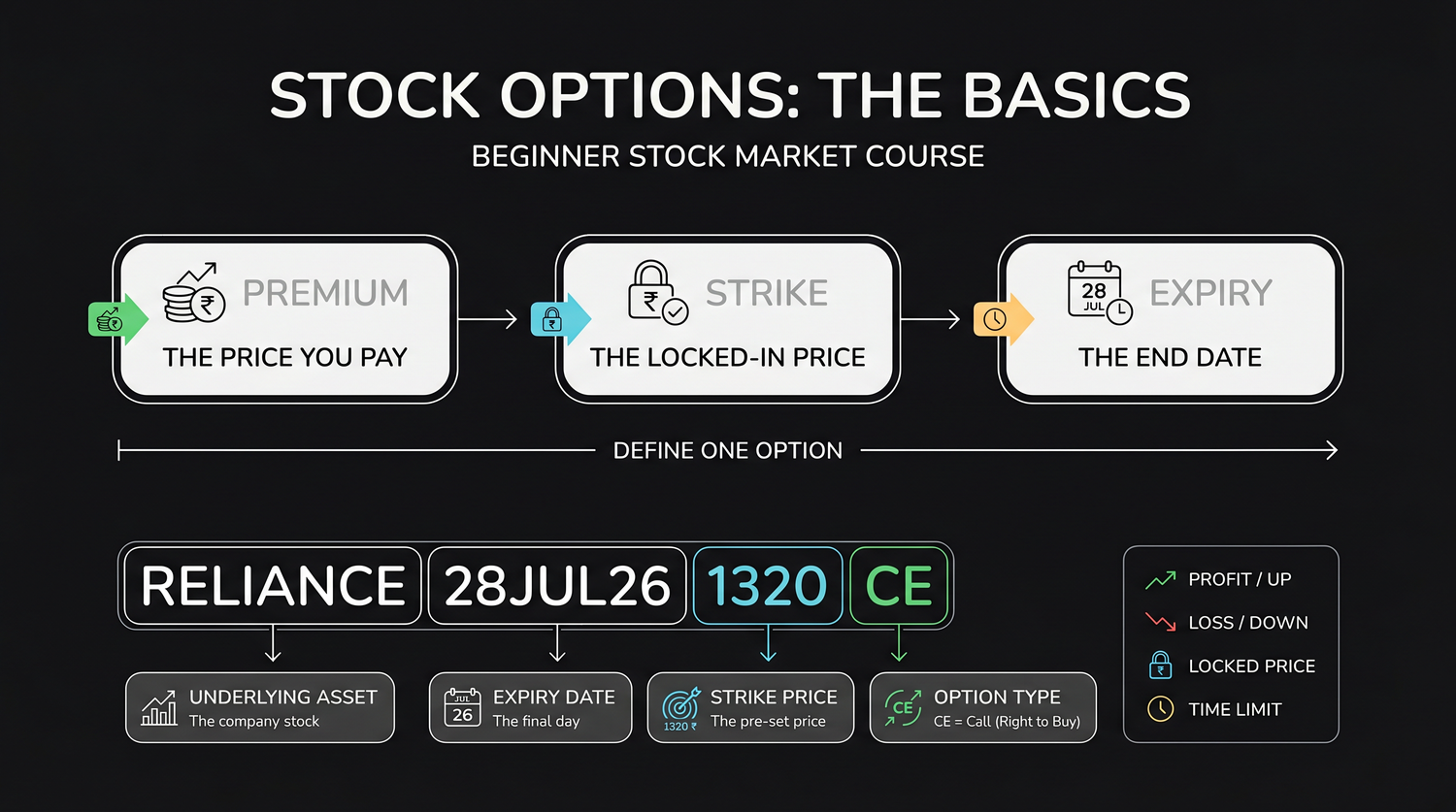
Every option ever traded, on any stock, in any market, is pinned down by just three numbers. Get these three and you can read any contract, compare any two options, and understand any quote on a screen. They are the premium you pay, the strike you lock, and the expiry by which you must decide. You met all three in passing already, in the story of the flat and the token. Now we make them precise, because a fuzzy grasp of these three is where most beginner mistakes begin. By the end of this chapter you will be able to take a real RELIANCE option symbol and read it the way you read a date.
Premium: the price of the right
The premium is the price you pay to hold the option. It is the token money from the flat story, the cost of the choice. For a buyer, the premium is also the most you can ever lose, which is the single most reassuring fact in all of options.
A premium is always quoted per share, but you pay it per lot. This is the catch that surprises every newcomer, so let us nail it now. In our running example the RELIANCE 1320 call carries a premium of about Rs 31 per share. One RELIANCE contract is a fixed lot of 500 shares. So the actual cash that leaves your account for one lot is 31 rupees times 500, which is about Rs 15,590.
- The screen shows Rs 31. That is per share.
- Your real outlay is Rs 15,590. That is per lot, and it is what you can lose.
A premium is not a fixed sticker price. It moves second by second as the stock moves, as expiry approaches, and as the market's expectation of movement changes. We devote a whole later chapter to what makes a premium rise and fall. For now, hold the core meaning: the premium is what you pay, and for a buyer it is the ceiling on the loss.
The premium is the price of the option. It is quoted per share but paid per lot. About Rs 31 a share for the RELIANCE 1320 option means about Rs 15,590 for one lot of 500 shares, and that is the buyer's maximum loss.
Strike: the locked price
The strike, also called the strike price or exercise price, is the price the contract lets you transact at. For a call it is the price you may buy at. For a put it is the price you may sell at. It is the fifty lakh in the flat story, the figure you fixed today and can rely on later whatever the market does.
In our example the strike is 1320. RELIANCE closed at Rs 1,318, so the 1320 strike sits right next to the current price. That nearness is not an accident; the strike closest to the current price is the one most beginners start with, and there is a name for it, which we meet in the moneyness chapter.
The strike never changes for the life of the contract. The stock wanders up and down, but 1320 stays 1320. The whole value of the option comes from the gap between where the stock ends up and that fixed strike.
- A 1320 call is worth using only if RELIANCE finishes above 1320, because then your locked buy price beats the market.
- A 1320 put is worth using only if RELIANCE finishes below 1320, because then your locked sell price beats the market.
There is a whole ladder of strikes available, not just 1320. You can buy the right to deal at 1300, 1340, 1360 and many more. Each strike is a different option with a different premium, because each represents a different deal. The strike you choose expresses how aggressive or cautious your view is.
A strike far above the current price is cheaper, because it needs a bigger move to pay off. A strike near the current price costs more, because it is closer to being useful. The premium always reflects how good a deal the strike is right now.
Expiry: the deadline
The expiry is the date the option dies. After it, the right simply vanishes. It is the three-month window in the flat story, the deadline by which you must decide to act or walk away.
In our example the expiry is 28 July 2026. With the example dated 25 June 2026, that is about 32 days away. The option lives for those 32 days and not a moment longer. On expiry day, the contract is settled and gone.
NSE options, which is where RELIANCE, NIFTY and BANKNIFTY trade, now settle on a Tuesday, and 28 July 2026 is the last Tuesday of that month, the monthly expiry. The BSE derivatives such as the SENSEX settle on a Thursday instead, but every example in this course uses an NSE instrument, so our expiries always land on a Tuesday.
Time is not a neutral backdrop here. It is one of the forces that move the premium, and for a buyer it works against you. With 32 days to run, there is plenty of time for RELIANCE to move your way, and the premium reflects that hope. As the days tick down, that hope shrinks, and a part of the premium called time-value melts away. The closer to 28 July, the faster it melts. A whole later chapter is given to this slow bleed, because it is the quiet enemy of every option buyer.
Time is on the seller's side, not the buyer's. Every day that passes with the stock going nowhere, a part of the premium you paid evaporates. An option is one of the few things you can buy that is worth less tomorrow simply because tomorrow has arrived.
Reading a real RELIANCE symbol
Indian option symbols pack all of this into one tidy string. Here is our call:
RELIANCE28JUL261320CE
It looks like a jumble until you learn the pattern, which is always the same: base name, then expiry date, then strike, then type. Break it at the seams.
- RELIANCE is the base, the underlying stock the option is written on.
- 28JUL26 is the expiry date, the 28th of July 2026, written as day, month, year.
- 1320 is the strike, the locked price.
- CE is the type, where CE means a call. The matching put would end in PE.
So the whole symbol reads as: the RELIANCE call that lets you buy at 1320 until the 28th of July 2026. The put version, RELIANCE28JUL261320PE, reads identically except it lets you sell at 1320. Same base, same date, same strike, only the last two letters flip the meaning from buy to sell.
Once you see the four parts, every option symbol becomes readable. The pattern never changes. Find the name, find the date, find the strike, find the CE or PE, and you have the whole contract.
How the three numbers interact
The premium, the strike and the expiry are not three separate facts. They pull on each other, and seeing how is what turns book knowledge into real understanding.
- Move the strike closer to the current price and the premium rises, because the option is closer to being worth using. Move it further away and the premium falls.
- Stretch the expiry further out and the premium rises, because more time means more chance for the stock to move your way. Shorten it and the premium falls.
- The premium is the market's running price tag on the deal that the strike and expiry describe. It is the one number that moves all the time; the strike and expiry are fixed for the life of the contract.
Think of it as a simple balance. The strike and expiry set the terms of the deal. The premium is what those terms are worth at this moment. When you choose an option, you are really choosing a strike and an expiry that match your view, and then paying whatever premium the market asks for that combination.
The RELIANCE 1320 call expiring 28 July 2026 costs about Rs 31 a share with 32 days left. A 1320 call expiring much sooner would cost less, because there is less time to be right. A strike of 1280, deeper toward being useful, would cost more. Same stock, different terms, different price.
What to carry forward
You can now read any option in the market, because every option is just these three numbers wrapped around an underlying.
- The premium is the price you pay, quoted per share, paid per lot, about Rs 31 a share and Rs 15,590 a lot here, and it is the buyer's maximum loss.
- The strike is the locked price, 1320 in our example, fixed for the whole life of the contract.
- The expiry is the deadline, 28 July 2026, about 32 days out, after which the right disappears.
- A symbol like
RELIANCE28JUL261320CEsimply stitches the base, date, strike and type together in that order.
Next we look closely at the one feature that makes options special among all financial instruments: the right, not the obligation. We will see exactly why a buyer can sleep easily with a capped loss, and why a seller is willing to take the other side and collect the premium for doing so.
The strike and expiry are fixed the moment the contract is created. Only the premium changes through the day. So when traders say an option "went up" or "went down", they are always talking about its premium, never its strike.