
Calls and Puts: The Two Building Blocks
Every option strategy ever built is made from just two pieces. Learn the call (the right to buy) and the put (the right to sell), and a simple way to never mix them up again.
- ·The call: a right to buy
- ·The put: a right to sell
- ·A way to remember which is which
- ·When you would want each
- ·Calls rise, puts fall
- ·Combining them later
Options look complicated from the outside because of the strange names and the wall of numbers on a trading screen. The truth is gentler. There are only two kinds of option in the whole market, the call and the put, and everything else is built from these two bricks. Strangle, straddle, spread, condor, every fancy name you will ever read about is just a handful of calls and puts stacked together. So if you truly understand these two building blocks, you understand the raw material of every strategy. This chapter makes sure you never confuse them again.
The call: the right to buy
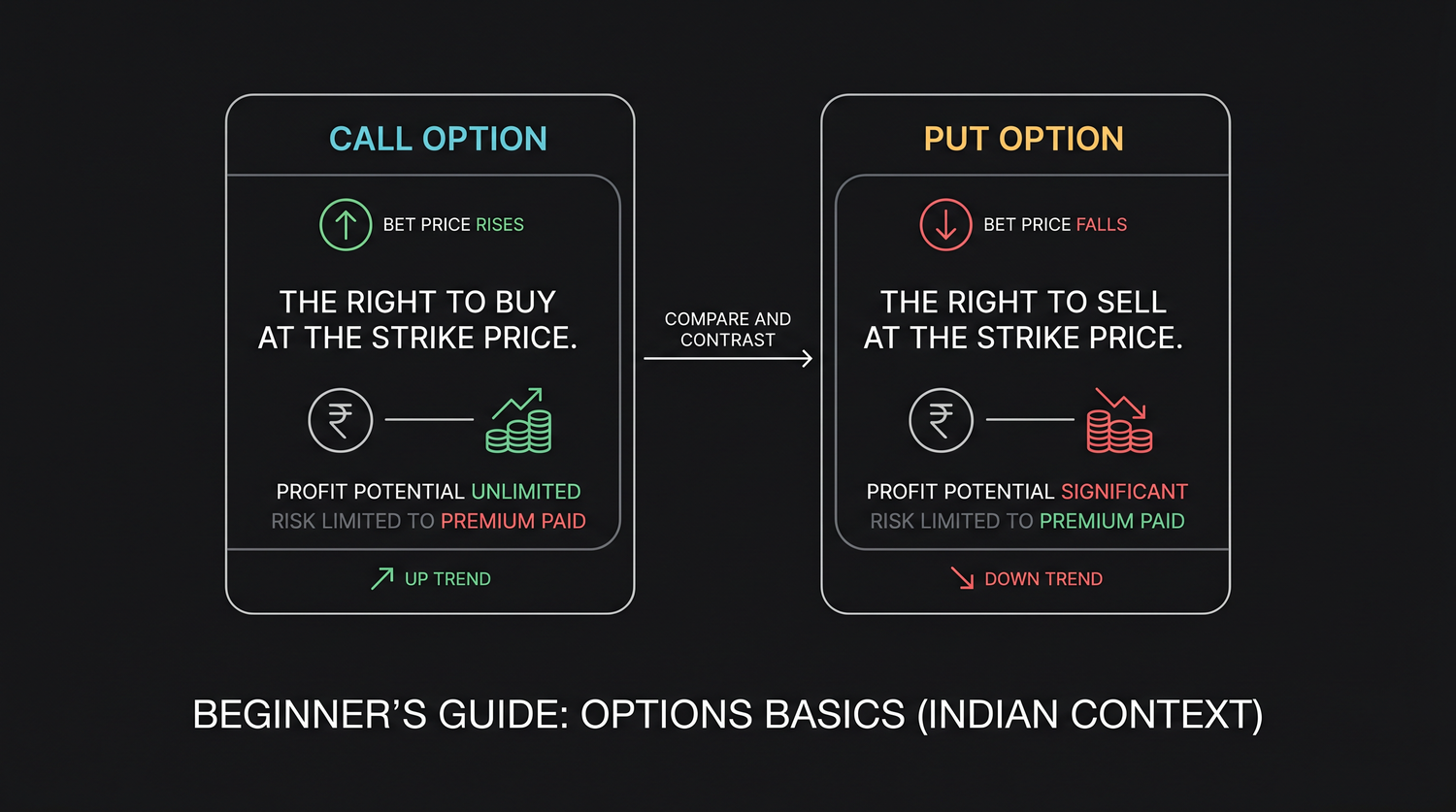
A call is the right, but not the duty, to buy the underlying at the strike price at expiry. You hold a call when you want the price to go up.
Walk through it with RELIANCE. The stock closed at Rs 1,318 on 25 June 2026. Suppose you buy the 1320 call, written in full as RELIANCE28JUL261320CE, for a premium of about Rs 31 per share. You now hold the right to buy RELIANCE at 1320 at expiry on 28 July 2026, no matter how high the stock climbs by then.
- If RELIANCE rallies to 1400, your right to buy at 1320 is valuable. You can buy at 1320 and the market is paying 1400, a clear gain on each share.
- If RELIANCE drifts down to 1280, your right to buy at 1320 is worthless, because nobody pays 1320 for something worth 1280. You let the call expire and you lose only the premium you paid.
That asymmetry is the heart of a call. Your gain rises as the stock rises, while your loss is capped at the premium no matter how far the stock falls. A call buyer is paying for upside while fencing off the downside.
A call is the right to buy at the strike. You buy calls when you expect the price to rise. Your profit grows with the stock, and your loss is limited to the premium.
The put: the right to sell
A put is the right, but not the duty, to sell the underlying at the strike price at expiry. You hold a put when you want the price to go down, or when you want to protect something you already own.
Same RELIANCE example, the other direction. Suppose you buy the 1320 put, written RELIANCE28JUL261320PE, again for a premium of about Rs 31 per share. You now hold the right to sell RELIANCE at 1320 at expiry on 28 July 2026, no matter how low the stock sinks by then.
- If RELIANCE falls to 1250, your right to sell at 1320 is valuable. The market is only worth 1250, but you can still sell at 1320, a clear gain on each share.
- If RELIANCE rises to 1360, your right to sell at 1320 is worthless, because you would rather sell into the open market at 1360. You let the put expire and you lose only the premium.
A put is the mirror image of a call. The call buyer profits when the stock rises; the put buyer profits when the stock falls. Both have the same comfort, a loss capped at the premium.
Same stock, same strike, same expiry, same premium of about Rs 31 a share. The 1320 call pays off if RELIANCE climbs above the strike. The 1320 put pays off if RELIANCE drops below it. The only thing you have chosen is direction.
Indian exchange-traded options are European style. The buyer's right is settled at expiry, not exercised early. Before expiry you do not exercise to take a profit; you simply close the position in the market by selling the option you bought, or buying back the one you sold. So "at expiry" describes when the right is settled, while you remain free to trade in and out of the option itself at any time before then.
A memory aid you will never forget
Beginners mix up calls and puts constantly, usually in the heat of a fast market when it matters most. Pin down one of these aids and the confusion ends.
- Think of the words. You call up a friend, so a call is your bet that the price goes up. You put down a parcel, so a put is your bet that the price goes down. Call up, put down.
- Think of the action. A call lets you call the shares in, to buy them. A put lets you put the shares away, to sell them off.
- Think of the symbol. CE ends the call symbol, PE ends the put symbol. C for call, P for put, and the buying or selling follows from there.
Use whichever sticks. Most traders settle on call up, put down within a day and never look back.
When would you want each?
Knowing the definitions is one thing. Knowing when to reach for each is what makes them useful. Here is the plain-language guide.
You buy a call when:
- You believe the underlying will rise meaningfully before expiry.
- You want exposure to that rise without paying the full price of the shares.
- You want your risk fixed and known in advance, capped at the premium.
You buy a put when:
- You believe the underlying will fall meaningfully before expiry.
- You already own the shares and want insurance against a drop, the way you insure a car you still drive.
- You want a defined, capped cost for that protection.
Notice that both reasons under each type come back to the same two motives we met in the first chapter: backing a directional view cheaply, and buying protection. A call backs an up view or insures a short position. A put backs a down view or insures shares you hold. Two tools, four common jobs.
It also helps to see the symmetry in plain numbers. Both the RELIANCE 1320 call and the 1320 put cost about the same premium, around Rs 31 a share, when the stock sits right between them at 1,318. That is no coincidence. With the strike balanced near the current price, the market judges an up move and a down move to be roughly as likely over the next 32 days, so it charges a similar price for each right. Choosing the call over the put is therefore a pure statement of direction, not of value. You are not picking the cheaper ticket; you are picking which way you think RELIANCE travels before 28 July.
You do not have to predict direction with a crystal ball to use options well. You only need a view, plus an honest sense of how far and how fast the move might come, because the premium you pay already prices in some expected movement.
Two bricks, every building
It is worth repeating why these two pieces matter so much. Every option position in existence is some combination of buying calls, selling calls, buying puts and selling puts. That is the entire toolbox. When you later read about a strategy with an intimidating name, you can always take it apart into these four basic actions and understand it.
- A protective position is shares plus a put.
- A position that profits from a big move in either direction is a call plus a put.
- A position that earns a premium in a quiet market is a sold call or a sold put.
You will meet all of these properly in the strategies course that follows this one. The point here is that you are not learning dozens of unrelated things. You are learning two, the call and the put, and then learning how to arrange them. Master the bricks and the buildings come easily.
Buying a call or a put is the easiest trade to place and the easiest way to lose money slowly. The stock has to move enough, and soon enough, to beat the premium you paid, while time quietly works against you. Most buyers of cheap, far-away options lose. We will study exactly why in later chapters, so you go in with open eyes.
What to carry forward
You now hold the two building blocks of the entire options world.
- A call is the right to buy at the strike. Buy calls when you expect the price to rise. CE marks a call.
- A put is the right to sell at the strike. Buy puts when you expect the price to fall, or to insure shares you own. PE marks a put.
- Both cap the buyer's loss at the premium, about Rs 31 a share for the RELIANCE 1320 options in our running example.
- Call up, put down. Let that little rhyme settle the direction every time.
In the next chapter we slow down and look hard at the three numbers that define any option: the premium you pay, the strike you lock, and the expiry by which you must decide. You have already met all three. Now we make them precise, and we read a real RELIANCE symbol apart piece by piece.
Indian stock options are settled in cash against the underlying, and each contract covers a fixed lot, 500 shares for RELIANCE. So a premium quoted as about Rs 31 per share is paid as about Rs 15,590 for one lot of the call or the put. Keep that per-share against per-lot distinction in mind; it trips up almost every beginner once.