
Buying a Call (Long Call)
The most intuitive option trade. Learn the long call payoff on a real RELIANCE example: limited loss (the premium), a breakeven above the strike, and unlimited upside.
- ·When you buy a call
- ·Limited loss, the premium
- ·The breakeven point
- ·Unlimited upside
- ·Reading the real payoff
- ·Why most call buyers still lose
Of every trade in the options world, buying a call is the one beginners reach for first, and for good reason. It matches how we already think. You believe RELIANCE is going up, so you want a way to profit from the rise without putting down the full price of the shares. A long call, which simply means a call option you have bought, does exactly that. You pay a small premium today for the right to buy RELIANCE at a fixed price, and if the stock climbs, your option climbs with it. Your loss can never be more than the premium you paid, while your gain has no ceiling. That asymmetry is genuinely beautiful. It is also a trap if you do not understand the catch, and this chapter shows you both the beauty and the catch using the real RELIANCE payoff.
What you actually own
When you buy the RELIANCE 1320 call expiring 28 July, you pay about Rs 31 per share. Because one lot of RELIANCE is 500 shares, that single lot costs you about Rs 15,590. The symbol on your screen reads RELIANCE28JUL261320CE, where CE marks it as a call.
That Rs 15,590 buys you the right, but never the obligation, to buy 500 shares of RELIANCE at 1320 at expiry. If RELIANCE is above 1320 at expiry, that right is settled in your favour and captures the difference, and before expiry you can also exit at any time by selling the option back in the market. If RELIANCE sinks, you simply let the option expire and walk away. The most you can lose is the Rs 15,590 you paid. Nobody can ask you for a single rupee more. That capped downside is the whole appeal of buying options rather than buying the shares outright.
A long call is the bought right to buy at the strike. You pay the premium upfront, your maximum loss is that premium, and your upside grows the higher the stock climbs. Limited risk, large reward, but you must pay for the privilege.
Reading the real payoff
The diagram below is the genuine payoff for this trade, built from OpenAlgo's strategy maths on RELIANCE at spot Rs 1,318, strike 1320, lot 500, about 32 days to expiry, with the modelled premium near Rs 31 a share. The solid line is what the position is worth at expiry on 28 July. The dotted cyan line is what it is worth today, before time decay has done its work. Let us walk the solid line from left to right.
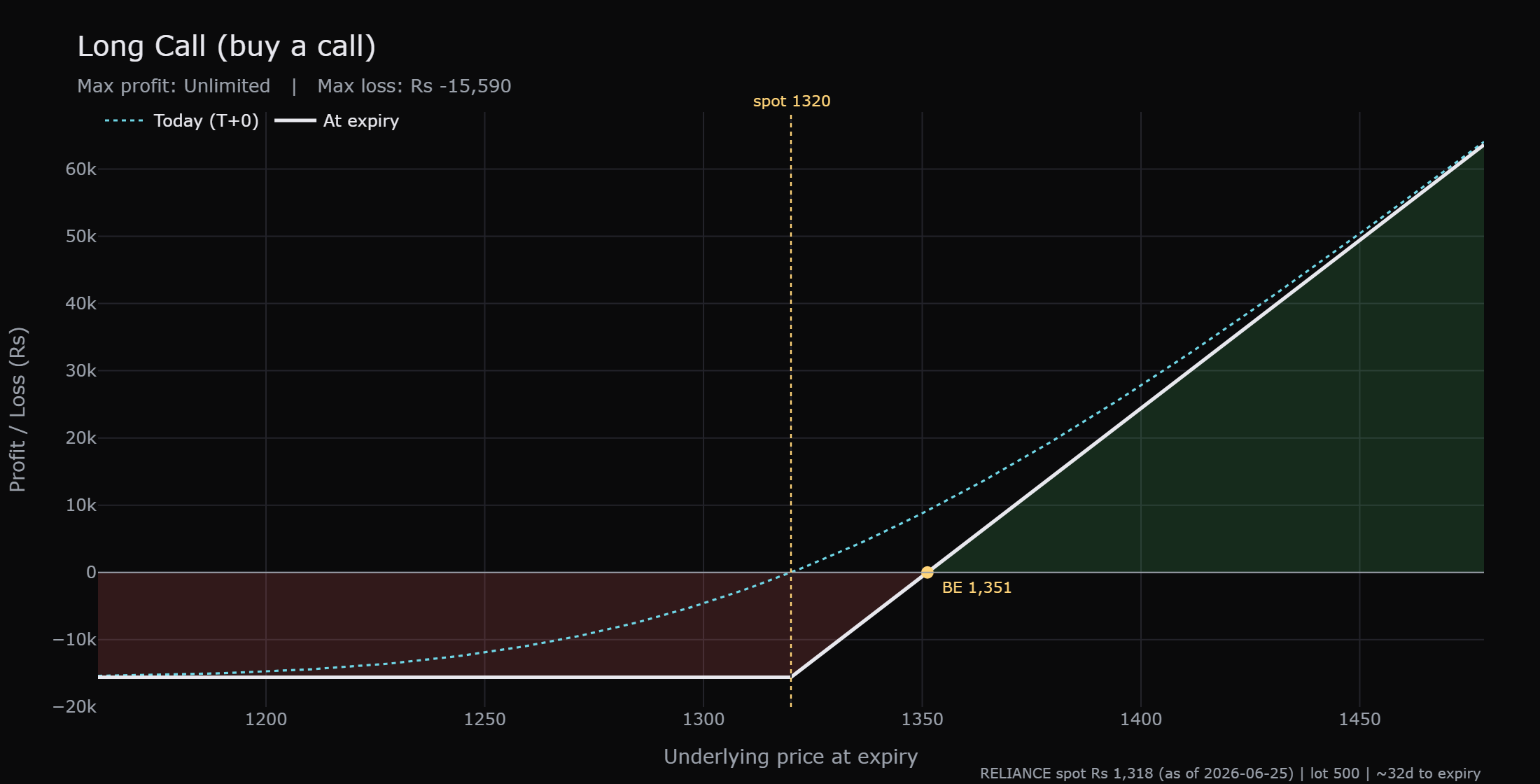
On the left, the line is flat. For any expiry price below the strike of 1320, the call finishes out-of-the-money and worthless. You lose the whole premium, about Rs 15,590, and the loss does not get worse no matter how far RELIANCE falls. Whether the stock ends at 1300 or crashes to 1100, your loss is the same Rs 15,590. This flat floor is the capped risk in action.
In the middle, the line hinges and starts to rise. Once RELIANCE pushes above 1320, the call gains intrinsic value rupee for rupee. But you are not in profit yet, because you still have to earn back the premium you paid. The line crosses zero at the breakeven price of 1351, which is the strike of 1320 plus the Rs 31 premium per share. At exactly 1351 your gains on the right to buy cancel out the premium you spent, and you finish flat.
On the right, the line keeps climbing with no ceiling. Above 1351 you are in real profit, and every further rupee RELIANCE gains adds Rs 500 to your position, because you control 500 shares. If RELIANCE finishes at 1400, you are up roughly 49 rupees a share above breakeven, around Rs 24,500. If it runs to 1450, the profit keeps growing. This is the famous unlimited upside. There is no point at which the line stops rising.
Three endings for the 1320 call. RELIANCE at 1310 on expiry: the call is worthless, loss about Rs 15,590, the most you can lose. RELIANCE at 1351: you break even, near zero profit or loss. RELIANCE at 1400: profit of roughly Rs 24,500, and it would keep growing if the stock ran higher.
The catch nobody puts on the poster
Read only the headline, limited risk and unlimited reward, and buying calls sounds like a one-way bet. It is not, and being honest about why is the most useful thing this chapter can give you. Most call buyers lose money. Here is the chain of reasons.
First, the stock must clear the breakeven, not just the strike. It is not enough for RELIANCE to nudge above 1320. It has to climb past 1351 before expiry just for you to get your money back. Every rupee of premium you paid is a hurdle the stock must jump before you see a single rupee of profit.
Second, time decay is grinding against you the whole time. Recall that the entire Rs 31 of this at-the-money call is time value, pure hope with no intrinsic value underneath, because the spot of 1318 is below the strike of 1320. That time value melts a little every day and melts fastest in the final week. So you are not just waiting for the stock to rise; you are racing it against a shrinking clock. The dotted today line in the diagram sits above the solid expiry line precisely because the option still holds time value now that it will have lost by 28 July.
Third, the stock must move enough and soon enough. A small, slow drift higher is not enough. RELIANCE could rise from 1318 to 1345, a real and respectable gain for the shareholder, and the call buyer would still lose money, because 1345 is below the 1351 breakeven and time value has bled away in the meantime. You can be right on direction and still lose. That is the hard truth that the clean payoff diagram does not show in words.
You can be correct that RELIANCE will rise and still lose money on a long call. The stock must clear 1351 by expiry, and it must do so before time decay eats your premium. Buying out-of-the-money calls and hoping for a big move is how most option buyers slowly hand over their capital.
When a long call makes sense
None of this means never buy a call. It means buy one with clear eyes. A long call is a sensible tool when a few things line up.
- You have a genuine reason to expect a sizeable move, soon. A long call rewards a move that is large and reasonably quick, not a slow grind. Vague optimism is not enough to beat the breakeven and the clock.
- You want defined, capped risk. The Rs 15,590 is the most you can lose, known in advance. For a trader who cannot stomach the open-ended risk of other positions, that hard cap is genuinely valuable.
- You are using a small, affordable slice of capital. Because the whole premium can go to zero, never bet money on a single call that you cannot afford to lose entirely. Treat each long call as money fully at risk.
Give yourself room on two fronts. Buy enough time so the move has a chance to happen before decay bites, and respect the breakeven, not just the strike. A call that needs a miracle by Friday is usually a donation, not a trade.
Practising without real money
Before you commit real capital, you can rehearse the whole trade in sandbox trading (analyzer mode in OpenAlgo). You place the same RELIANCE 1320 call, watch how the premium reacts as the stock moves, and feel time decay nibble at it day by day, all without risking a rupee. There is no faster way to turn the payoff diagram in this chapter from a picture into an instinct.
The long call payoff is the cleanest shape in options. A flat capped loss to the left, a hinge at the strike, a breakeven at strike plus premium, and an open-ended climb to the right. Master reading this one curve and every other single-leg payoff, including the put we meet next, will read like a variation on a theme you already know.
So the long call gives you a capped, known loss of about Rs 15,590, a breakeven at 1351, and a genuinely unlimited upside above it. That is a fine deal when a large move is truly likely and you have bought yourself enough time. It is a quiet money loser when you buy on vague hope and let the clock run. Hold both of those truths together and you are already thinking like a trader rather than a gambler. Next we turn the whole picture upside down and buy a put, the mirror image, for when you expect RELIANCE to fall.