
What Is an Option?
An option is the right, but not the duty, to buy or sell at a set price by a set date. Learn that one idea with a simple real-life analogy before any market jargon arrives.
- ·A right, not an obligation
- ·The token-money analogy
- ·Underlying, strike and expiry
- ·Why someone pays for the right
- ·Options vs futures in one line
- ·The two basic types
Imagine you walk into a sale and find something you might want, but you are not quite ready to buy. So you ask the seller a small favour. You hand over a little money today to lock the price, and you promise nothing in return except that small payment. If you come back and buy, the price is already fixed. If you change your mind, you simply walk away and you lose only that little payment you handed over. That small, one-sided deal is the whole idea behind an option. Once you see it in everyday terms, the jargon of calls, puts and premiums stops being scary and starts making sense.
An option is a right, not a duty
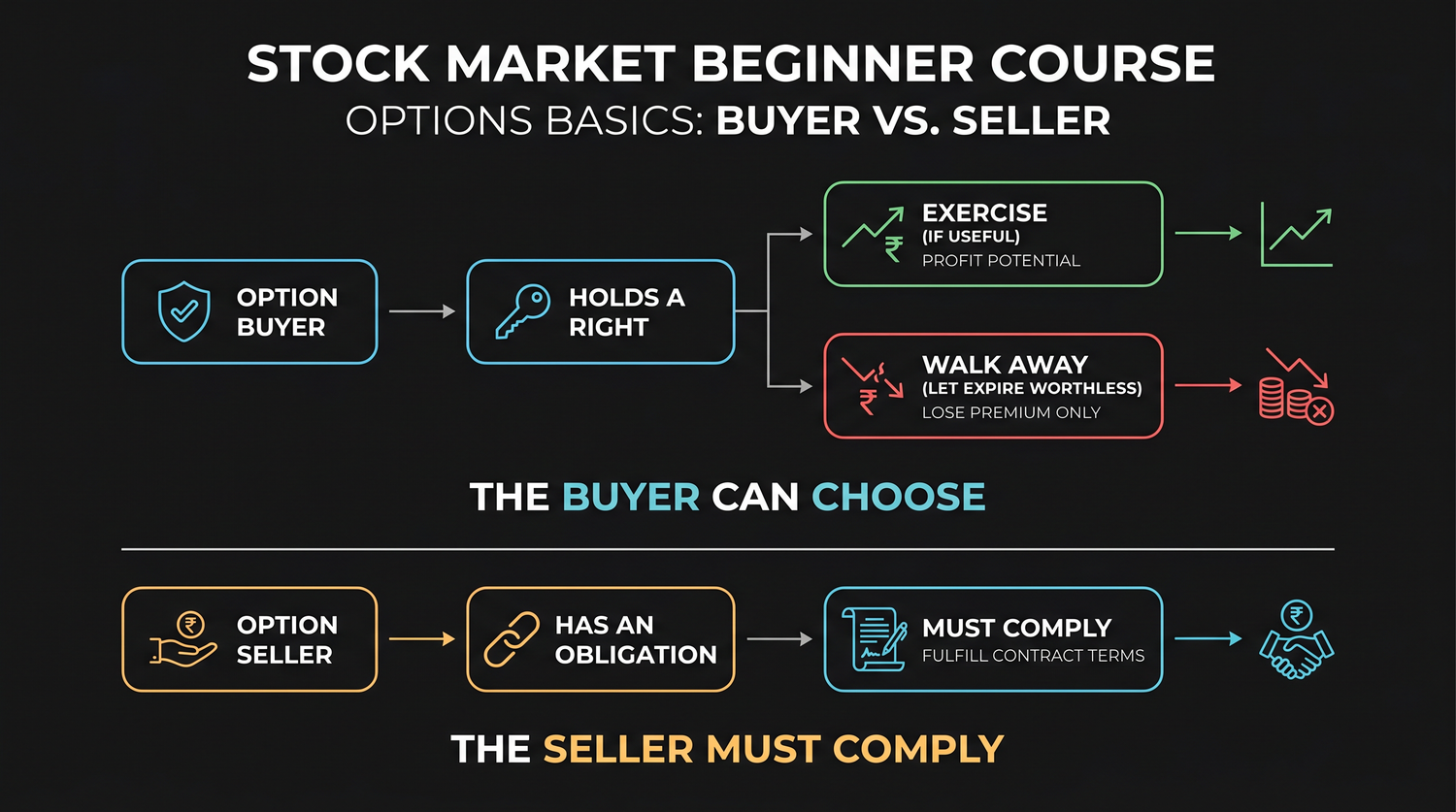
An option is a contract that gives you the right, but not the obligation, to buy or sell something at a price you fix today, settled on a future expiry date you also fix today. Read that sentence twice, because the two small words "not the obligation" carry the entire meaning. You hold a choice. You are never forced to act.
Compare that with most agreements you know. If you sign to buy a flat, you must complete the purchase or lose your deposit and face trouble. An option flips this. You pay a small amount up front and, in return, you get to decide later whether the deal is worth doing. If it is, you act. If it is not, you let the contract lapse and the only money you have spent is that small up-front payment.
That small payment has a name. It is the premium, the price of holding the right. The premium is what the option costs you, and for a buyer it is also the most you can ever lose. We will return to that idea again and again, because it is the single most important comfort that options give a buyer.
An option is a right, not a duty. You pay a small premium today to lock a price, and you are free to walk away later. The premium is the most a buyer can lose.
The token-money story
Here is the cleanest way to feel it. Suppose you find a flat priced at fifty lakh rupees. You like it, but you need three months to arrange the money and to be sure. You ask the builder for a deal. You pay one lakh rupees today as a token. In exchange, the builder agrees to sell you that exact flat for fifty lakh rupees any time in the next three months, no matter what happens to property prices.
Now play out the two endings.
- Prices rise. Three months later the same flat is worth sixty lakh. You use your locked price, pay fifty lakh, and own a flat worth sixty. Your one lakh token bought you a ten lakh head start.
- Prices fall, or you simply change your mind. The flat is now worth forty-five lakh, or your plans changed. You walk away. You lose your one lakh token and nothing more. You were never forced to buy.
That token is the premium. The fifty lakh locked price is the strike, the price the contract lets you transact at. The three-month window is the expiry, the deadline after which the right disappears. And the flat itself is the underlying, the actual thing the option is written on.
Every option you will ever meet has these same three numbers attached to it: a premium you pay, a strike you lock, and an expiry by which you must decide. Learn to spot those three and you can read any option.
RELIANCE closed at Rs 1,318 on 25 June 2026. Suppose you buy the right to purchase RELIANCE at a strike of 1320 at expiry on 28 July 2026. That right currently costs a premium of about Rs 31 per share. The underlying is RELIANCE, the strike is 1320, and the expiry is 28 July 2026.
Why would anyone pay for a right?
A fair question. Why hand over money for a choice you might never use? Two reasons, and they cover almost everyone who trades options.
The first reason is leverage on a view. If you believe RELIANCE will climb over the next month, you could buy the shares outright, which ties up a large sum. Or you could pay a small premium for the right to buy at 1320, and enjoy much of the gain if you are right, while risking only that premium if you are wrong. A small, fixed, known risk in exchange for a large, uncertain reward is an attractive shape to many traders.
The second reason is protection, often called insurance. If you already own RELIANCE shares and you are nervous about a fall, you can pay a premium for the right to sell at a fixed price. If the stock crashes, your right to sell at the higher locked price softens the blow. You paid a small premium for peace of mind, exactly the way you pay for any insurance.
So the premium is not wasted money. It buys you either a cheap way to back a view, or a cushion against a loss. Whether it turns out to be worth it depends on what the underlying does before expiry.
The comfort of capped risk does not mean options are easy money. Most option buyers lose, because the underlying must move enough, and in time, before the right is worth more than the premium paid. We will be honest about this throughout the course.
Options against futures, in one line
You may have heard of futures. The difference is simple and worth fixing early. A future is an agreement that obliges both sides to transact at a set price on a set date. There is no choice. If the price moves against you, you are still bound to the deal and your loss can be large.
An option gives one side a choice. A future obliges, an option lets you choose. That single difference is why a futures buyer can lose far more than they put in, while an option buyer can lose only the premium. The choice is exactly what you are paying for.
Put another way, a future is a firm handshake that both sides must honour whatever happens. An option is more like a deposit on a deal you may or may not complete. Both instruments let you take a view on a stock without owning it outright, but only the option hands you the escape route of walking away. That escape route is never free; its price is the premium, and the whole rest of this course is really about understanding what that small payment buys you and when it is worth paying.
The two basic types: call and put
Options come in just two flavours, and every strategy in the world is built from these two pieces.
- A call is the right to buy the underlying at the strike. You buy a call when you think the price will go up, the way the flat buyer wanted prices to rise after locking fifty lakh.
- A put is the right to sell the underlying at the strike. You buy a put when you think the price will go down, or when you want insurance on something you already own.
That is the whole alphabet. Call to buy, put to sell. The next chapter takes these two apart in detail and gives you a memory aid so you never mix them up. For now, hold the core picture in your mind.
In the Indian market these two types appear in the option symbol itself. The letters CE stand for a call and PE stand for a put. So RELIANCE28JUL261320CE is the RELIANCE 1320 call expiring 28 July 2026, and RELIANCE28JUL261320PE is the matching put. You can already read most of that symbol: the base name, the date, the strike, and the type.
When you see CE think call, the right to buy. When you see PE think put, the right to sell. That one habit will save you from costly mix-ups later.
What to carry forward
You now hold the foundation that the rest of the course builds on. An option is the right, not the duty, to buy or sell an underlying at a fixed strike by a fixed expiry, bought for a premium that is the buyer's maximum loss. There are exactly two types, the call to buy and the put to sell. A future obliges; an option lets you choose.
Keep the flat-token story handy. Almost every confusing thing about options becomes clear when you ask the simple question behind that story: am I paying a small amount today to lock a price, with the freedom to walk away later? If yes, you are looking at an option, and you already understand what it is for.
One RELIANCE option contract covers a fixed lot of 500 shares. So a premium of about Rs 31 per share is paid as about Rs 15,590 for one lot. We will unpack premium, strike and expiry, and this per-share against per-lot point, in the chapters ahead.