
From Single Legs to Spreads, and Your Checklist
Where to go next, and how to be ready. Learn why spreads exist, the defined-risk idea and the difference between a debit and a credit spread (without the deep strategy work that lives in the strategies course), then a clear pre-trade checklist to run before every option trade.
- ·Why spreads exist
- ·The defined-risk idea
- ·Debit spread vs credit spread
- ·The bridge to real strategies
- ·Your pre-trade checklist
- ·Direction, strike, expiry, risk, exit
Look back at where you started. A few chapters ago the words call and put meant nothing to you. Now you can read a symbol like RELIANCE28JUL261320CE, split a Rs 31 premium into intrinsic value and time value, picture a long call breaking even at 1351, and respect exactly why a naked short option can hurt. That is real progress, and you earned it. This final chapter does two things. First, it builds a short bridge from the single options you have learned to the world of spreads, which is where the next course begins. Second, it hands you a plain pre-trade checklist to run before you ever place an order, so the discipline you have built here travels with you into every trade you make.
From one leg to two: why spreads exist
Every trade in this course has used a single option, one call or one put, bought or sold. Traders call each single option a leg. A spread is simply two legs combined into one position, chosen so they work together.
Why bother? Think back to selling options. A naked short call has unlimited risk above the strike, and a naked short put has very large risk as price falls. The premium you collect is capped, but the loss is not. That asymmetry is what makes naked selling dangerous for a beginner, and it is why a naked short index option blocks roughly Rs 1.5 to 1.8 lakh of margin for one lot.
A spread fixes exactly this problem. You sell one option to collect premium, and at the same time you buy another option further away to act as a backstop. The option you buy caps the loss of the option you sold. Your undefined risk becomes a defined-risk position: a known, fixed maximum loss that cannot grow no matter how far the market runs. Because the risk is capped, the margin needed drops sharply too.
A spread combines two legs so the bought option caps the risk of the sold option. An undefined-risk trade becomes a defined-risk one, with a maximum loss you know before you enter.
That single idea, capping risk with a second leg, is the foundation of almost every option strategy you will ever meet.
Debit spreads and credit spreads
Spreads come in two broad flavours, and the difference is simply whether money flows into your account or out of it when you open the trade.
A debit spread is one where you pay to enter. You buy one option and sell another that is cheaper, so the premium you collect from the sold leg only partly offsets the premium you pay for the bought leg. You are left paying a net amount, the debit. In return, both your cost and your profit are capped. You spend less than buying the option alone, and time decay hurts you less, but you also give up the unlimited upside. You trade a smaller, cheaper, calmer bet for a ceiling on the reward.
A credit spread is the mirror. You receive money to enter. You sell one option and buy a cheaper one further away for protection, so you keep a net premium, the credit. You profit if price behaves the way you expected, often simply by staying on the right side of your sold strike, and time decay works in your favour. Your maximum profit is the credit you collected, and your maximum loss is capped by the protective leg you bought.
The table below sketches the contrast without going any deeper, because the full construction of named strategies belongs in the next course.
| Feature | Debit spread | Credit spread |
|---|---|---|
| Cash at entry | You pay a net premium | You receive a net premium |
| Maximum profit | Capped | Capped, equal to the credit received |
| Maximum loss | Capped, equal to the debit paid | Capped by the protective leg |
| Time decay | Works against you, but gently | Works in your favour |
| You want price to | Move your way | Behave, often just not move against you |
Both kinds of spread share one beautiful property. The maximum loss is fixed and known the moment you open the position. That is the whole reason a beginner eventually graduates from single legs to spreads.
This is where the Options Basics course hands you over. The next course, the /options-strategies course, takes these two ideas and builds the named structures from them, the verticals, the straddles, the iron condors and more, leg by leg. You now have everything you need to start it. You can read a chain, price a leg, picture a payoff, and understand why a second leg caps risk. Do not try to run those structures yet. Just know that the door is open and you are ready to walk through it.
Before you trade any real spread, build it first in sandbox trading (analyzer mode in OpenAlgo) and watch how the two legs behave together. Seeing the combined payoff once teaches more than reading about it ten times.
The pre-trade checklist
Knowledge is not the thing that protects your money. Discipline is. The traders who survive are not the ones with the cleverest view, they are the ones who run the same boring checks before every single trade. Here is a beginner's pre-trade checklist. Run through all of it before you place any option order, single leg or spread.
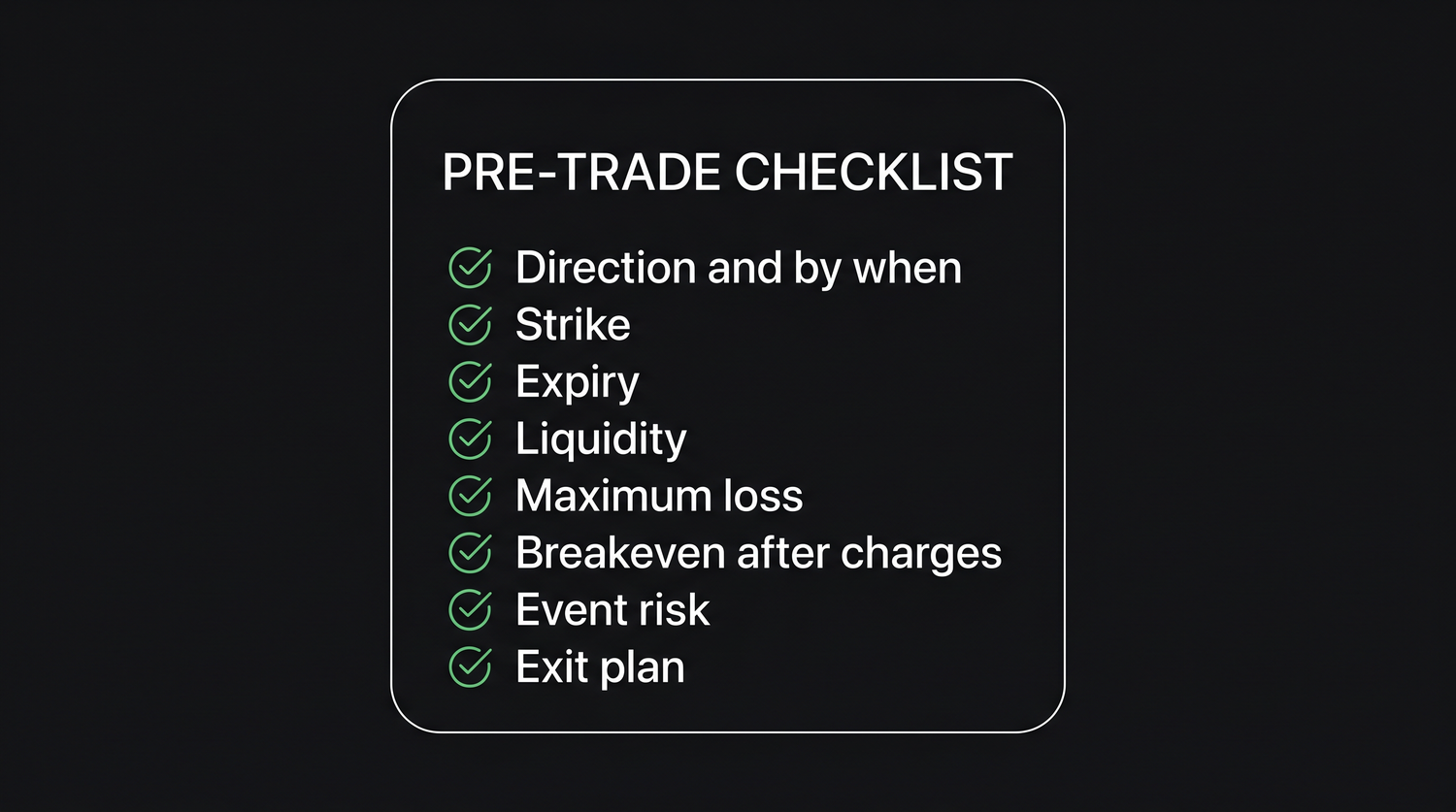
| Check | The question to answer |
|---|---|
| Direction | What do I expect, and by when? Up, down or flat, and by which date? |
| Strike | Which strike fits that view? In, at or out of the money, and why that one? |
| Expiry | Which expiry gives the move enough time without paying for time I do not need? |
| Liquidity | Is this strike liquid? A tight bid-ask spread, real volume and open interest? |
| Maximum loss | What is the most I can lose on this position, in rupees, if I am completely wrong? |
| Breakeven after charges | Where must the underlying be for me to break even once all charges are counted? |
| Event risk | Is a result, a policy meeting or a budget due before my expiry? What will it do to IV? |
| Exit plan | At what profit or loss do I get out, and what closes the trade no matter what? |
Walk each one honestly.
Direction is first because nothing else matters without it. You are not just guessing up or down, you are committing to a move and a deadline. The RELIANCE 1320 call only rewards you if the stock clears 1351 before 28 July. A view without a date is not a trade, it is a wish.
Strike follows from direction. A far-out-of-the-money strike is cheap because it is mostly hope, and most such options expire worthless. A nearer strike costs more but has a real chance. Pick the strike that matches your view, not the one that simply looks cheapest.
Expiry is the clock you are renting. A nearby expiry is cheap but decays fast and demands a quick move. A further expiry costs more but gives the move room to happen. Match the clock to your view, and never let an expiry quietly straddle a known event unless that event is the whole bet.
Liquidity is the check beginners skip and then regret. On an illiquid strike the bid-ask spread is wide, so you buy high and sell low, and that gap is a real cost paid the instant you enter. You also need real volume and open interest so you can get out when you want to, not only when the market lets you.
Maximum loss must be a number, not a feeling. For a bought option it is the full premium, about Rs 15,590 for one RELIANCE lot, every paisa of which can go to zero. For a spread it is the capped figure you worked out before entering. If you cannot say the rupee amount out loud, you are not ready to place the order.
If you do not know your maximum loss in rupees before you enter, you do not have a trade, you have a gamble. A long option can expire completely worthless, so size every position by what you can afford to lose, never by what you hope to make.
Breakeven after charges is the honest version of breakeven. The bare breakeven on the 1320 call is 1351, the strike plus the premium per share. But brokerage, STT, exchange transaction charges, 18 percent GST and stamp duty all push your real breakeven a little further away. A small trade that looks profitable on the premium alone can turn into a loss after charges, and the STT on an option you let get exercised is a particular trap. Count the charges before you celebrate.
Event risk is about timing more than direction. Before a known event, implied volatility expands and options get expensive. After it, the uncertainty resolves and IV crushes, collapsing the premium even if you guessed the direction right. Know what is due before your expiry, and never buy expensive premium into an event without understanding the crush waiting on the other side.
Exit plan is the check that closes the loop. Decide, before you enter, where you take profit and where you cut the loss. Write down the price or the rupee figure that ends the trade. The worst exits are the ones invented in the moment, especially the revenge trade on expiry day. A defined-risk structure helps here, because part of the exit is already built in.
A complete beginner's plan in one breath. I think RELIANCE drifts up over the next three weeks, so I buy one 1320 call for about Rs 15,590, my maximum loss is that Rs 15,590, my breakeven after charges is a little above 1351, there are no results due before 28 July, and I exit if the premium doubles or if it halves, whichever comes first. Every box ticked before the order goes in.
Where you started, and where you are now
Look at the distance you have covered. You began not knowing what an option was. You learned that a call is the right to buy and a put is the right to sell, that a premium splits into intrinsic value and time value, that time decay grinds buyers down while it quietly feeds sellers, and that the four Greeks describe how a premium really moves. You read a payoff diagram and understood why the at-expiry line and the today curve disagree. You saw why most buyers lose, why sellers post large margin, and how charges, liquidity and events silently decide outcomes. And now you can see why two legs can beat one.
That is a genuine education, not a tip sheet. It will not make every trade a winner, because nothing does. What it gives you is the ability to size your risk, read what you are actually buying, and walk away from a bad trade before it becomes a disaster.
The market rewards patience and punishes hurry. Trade small, know your maximum loss before you enter, run the checklist every time, and let discipline, not excitement, decide. The next course is waiting, and you are ready for it.
You have the foundation now. Build on it carefully, protect your capital first, and let the skill compound trade by trade. Welcome to the real start of your options journey.