
Choosing a Strategy and Managing It
A strategy is only as good as the view behind it. Learn how to match a strategy to bullish, bearish, neutral or big-move views using the metrics, size the position for survival, and manage or exit when you are wrong.
- ·Matching strategy to view
- ·Using POP and risk to reward
- ·Defined risk first for beginners
- ·Position sizing
- ·When to take profit
- ·Knowing when to walk away
You have spent this whole course meeting strategies one at a time, learning each by its payoff shape and its three numbers. Now comes the part that decides whether any of it makes you money: choosing the right one for the moment and managing it once it is on. A strategy is just a tool, and the best tool is the one that fits the job and the size of your account. This closing chapter pulls everything together. It maps your market view to a sensible structure, explains why you should start with defined risk, shows how to size a position so a single bad trade cannot end your trading, and lays out clear rules for taking profit, adjusting, and walking away. We finish with a checklist you can run before every trade.
Start with your view, then pick the shape
Every strategy in this course answers a different opinion about where NIFTY goes next. So the first question is never which strategy, it is what do you actually think will happen. Are you bullish, bearish, expecting calm, or bracing for a big move in either direction? Once that is honest and specific, the structure almost picks itself.
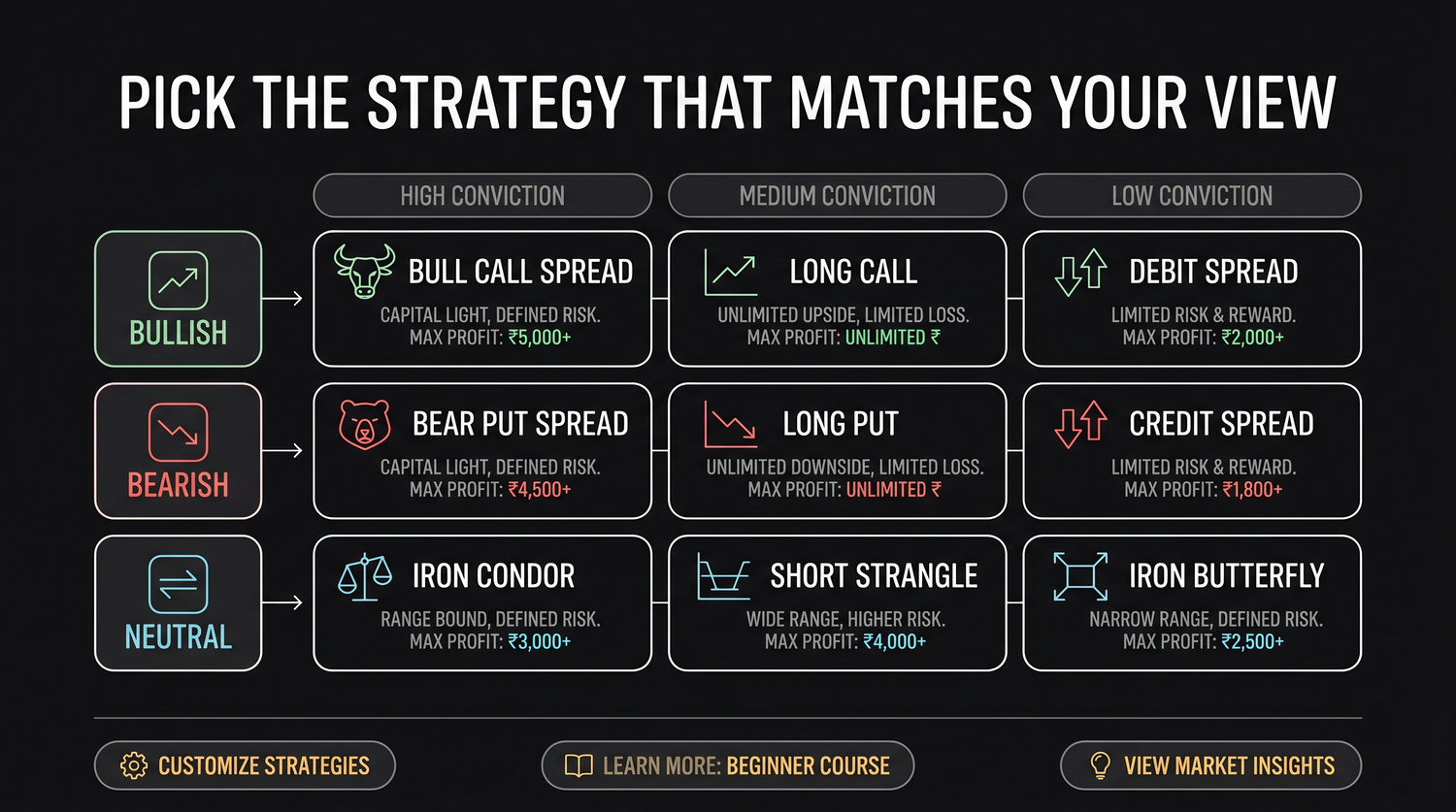
Here is the same idea as a table, using the real NIFTY numbers from across the course (spot 24,056, lot 65, 28 July 2026 expiry) so you can compare the three numbers side by side.
| Your view | Sensible structure | Breakeven(s) | Max profit | Max loss |
|---|---|---|---|---|
| Mildly bullish | Bull call spread | 24,106 | Rs 2,876 | Rs 3,624 |
| Bullish, want a credit | Bull put spread | 24,011 | Rs 2,506 | Rs 3,994 |
| Mildly bearish | Bear put spread | 24,011 | Rs 3,994 | Rs 2,506 |
| Bearish, want a credit | Bear call spread | 24,106 | Rs 3,624 | Rs 2,876 |
| Neutral, holds a range | Long iron condor (builder, range version) | 23,864 and 24,236 | Rs 5,616 | Rs 884 |
| Neutral, pins a strike | Long iron fly (builder, pin version) | 23,956 and 24,148 | Rs 6,130 | Rs 370 |
| Big move, either way | Long straddle | 23,329 and 24,771 | Unlimited | Rs 46,858 |
| Big move, cheaper | Long strangle | 23,323 and 24,777 | Unlimited | Rs 40,729 |
Read this table as a menu, not a ranking. A bull call spread is not better than an iron condor; they answer different views. The discipline is to let your honest opinion choose the row, rather than picking a strategy you like and then inventing a view to justify it. Remember too that the probability of profit, which you can read off the builder panel, is part of the choice: a high-credit iron condor with tight strikes wins less often than a wider one, so set your strikes to the odds you actually want.
A naming note. The builder labels these two neutral structures Long Iron Condor and Long Iron Fly. In its convention they are the range-bound, credit-style versions: you profit when NIFTY stays inside the wings (the condor) or pins the centre strike (the fly), and the bought outer legs cap the loss, which is why the table shows a small capped max loss and a larger max profit. Other platforms sometimes attach the long and short labels the opposite way, so never trust the name alone. Read the payoff shape and the probability of profit off the builder panel before you place the trade.
The order of decisions matters. First form a clear, specific view on NIFTY. Then choose the structure whose payoff shape rewards that exact view. Choosing the strategy first and bending your view to fit it is the most common way traders lose money on perfectly good structures.
Defined risk first, always
If you remember one rule from this entire course, make it this. Until you are experienced, trade defined-risk structures, the ones whose maximum loss is a fixed, known number printed on the chart before you ever enter.
Look back at the table. The bull call spread risks Rs 3,624 and not a rupee more. The iron condor risks Rs 884, the iron fly just Rs 370. Every one of those losses is capped, because a bought option somewhere caps it. You can lose your maximum, but you can never lose a surprise.
Contrast that with the structures this course flagged with warnings: the short straddle and short strangle, the call and put ratio spreads, the long and short synthetic future, the short put inside a jade lizard. Each of those carries an undefined or unlimited loss on at least one side, and the margin to match, often more than a lakh and a half for a single index lot. They can pay well and experienced traders use them, but a single violent move in NIFTY can cost many times the premium you collected. That is not where you should learn.
Strategies with unlimited or open-ended loss, short straddles and strangles, ratio spreads with a naked leg, synthetic futures, and bare short puts, can lose far more than you collect and have ended trading accounts in a single session. Master defined-risk structures, where the worst case is printed on the chart, before you go anywhere near them.
There is a second reason defined risk matters: it lets you size correctly, because you know the exact worst case in advance. You cannot size a position sensibly if you do not know how much it can lose, and undefined-risk trades hide that number from you.
Size every position to survive
The fastest way to fail is not picking wrong strategies. It is putting too much on one trade and being wiped out before your edge has time to work. Position sizing is survival.
The simple rule professionals use is to risk only a small slice of your account on any single trade, often one to two percent. With defined risk this is easy arithmetic, because your maximum loss is known.
- Suppose your account is Rs 5,00,000 and you cap risk at two percent, which is Rs 10,000 per trade.
- A bull call spread risks Rs 3,624 for one lot. That fits comfortably under your Rs 10,000 limit, and even two lots, risking Rs 7,248, would still be inside it.
- A long straddle risks Rs 46,858 for one lot. That is almost five times your Rs 10,000 limit, so a single lot is already far too big and you skip it or wait for a cheaper structure that fits.
The point is not the exact percentage. It is that your size flows from your maximum loss, not from how confident you feel. Confidence is the worst possible sizing input, because you feel most confident right before the trades that hurt most.
Work backwards from your loss limit. Decide the rupee amount you are willing to lose on the trade, then divide by the strategy's max loss per lot to get your number of lots. If the answer is less than one lot, the trade is too big for your account and you skip it. This one habit prevents most account-ending mistakes.
Manage the trade: profit, adjust, exit
A position is not finished when you open it. Decide your management rules before you enter, while you are calm, because once money is moving your judgement gets worse.
When to take profit. You do not need to hold a credit trade to expiry to win. Many traders close a defined-risk credit structure once it has captured a large part of its maximum profit, often around half to three quarters, rather than squeezing the last rupees while exposed to a reversal. Taking a good profit early frees your capital and removes risk you no longer need to carry. For a debit spread, the same idea applies: if the move you wanted has mostly happened and the position is near its max profit well before expiry, closing it locks in the win.
When to adjust. Adjusting means changing legs to repair a trade that has moved against you, the subject of the adjustments chapter, for example rolling an untested side of an iron condor closer to collect more credit, or moving a threatened short strike further away. Adjusting is a real skill, but it is also where traders get into trouble by throwing good money after bad. Prefer simple management over clever repairs. An adjustment that adds risk to rescue a loser is often worse than simply accepting the defined loss you signed up for.
When to exit. Exit when the reason for the trade is gone, when your view has changed, or when the position hits a loss level you set in advance. With defined risk you always have the option to do nothing and let the worst case play out, because it is capped, but exiting early to preserve capital is usually wiser than watching a trade grind to its full loss. Never widen your risk to avoid taking a loss; that is how a small defined loss turns into an undefined one.
Decide your exits before you enter. Write down the profit level where you will close, the loss level where you will stop, and the date by which you will be out regardless. A plan made in calm beats a decision made in panic every single time.
Your pre-trade checklist
Run this list before you place any strategy. If you cannot answer every line, the trade is not ready.
- View. Can I state in one plain sentence what I expect NIFTY to do and roughly by when?
- Shape. Does this structure's payoff actually reward that view, and have I looked at its chart?
- Three numbers. Do I know the breakeven, the maximum profit, and the maximum loss before I enter?
- Odds. Have I checked the probability of profit, and does the reward justify it?
- Defined risk. Is my worst case capped and known? If not, do I truly understand and accept an open-ended loss and its large margin?
- Size. Does my number of lots come from my loss limit, keeping risk to a small slice of my account?
- Exits. Have I written down where I take profit, where I cut the loss, and the date I am out?
- Rehearsal. Have I built it in the strategy builder and, if it is new to me, run it in sandbox trading (analyzer mode in OpenAlgo) first?
The traders who last are rarely the ones with the cleverest strategies. They are the ones who match a simple structure to a clear view, keep their risk defined, size small enough to survive a losing streak, and follow their own exit plan. Every tool in this course works inside that discipline and none of it works without it.
That is the whole craft in miniature. You now know the named structures, how to read any payoff by its shape and its nine numbers, and how to choose, size, and manage a trade with honest respect for its risk. Keep starting from defined-risk structures, keep your size small, and keep rehearsing in the strategy builder before real money is on the line. The strategies will always be there. Protecting your capital so you are still trading next year is the part that makes them matter.