
Short Straddle and Strangle: Betting on Calm
The opposite bet, that price stays pinned. Learn the short straddle and strangle, selling both sides to collect premium, the wide profit zone, the large margin, and the unlimited risk that demands respect.
- ·A range-bound view
- ·The short straddle
- ·The wider short strangle
- ·Collecting premium
- ·Unlimited risk and large margin
- ·Reading the real payoffs
In the last chapter you were the buyer, paying a rich premium and praying for a big move. Now stand on the other side of that very trade. Someone has to sell the straddle buyer their call and their put, take in that fat premium, and bet the opposite way, that NIFTY goes nowhere. That seller is you in this chapter. The short straddle and the short strangle are the income trades of the calm market. You collect the premium up front, and every quiet day pulls the position toward profit. The shape is seductive and the win rate is high. The danger is that you have inherited the buyer's unlimited reward as your own unlimited loss, and that one fact should govern everything you do here.
The one-line idea
A short straddle sells the at-the-money call and the at-the-money put together. A short strangle sells cheaper out-of-the-money strikes, a put below the market and a call above it. Either way you take in a net credit up front, and you keep it as long as NIFTY stays inside a band. You are selling the move that a straddle buyer is paying for, betting that the market will be calmer than the option premiums imply.
The credit is your maximum profit. The catch, and it is a serious one, is that both legs are naked. A short call has no ceiling above it, and a short put runs far down toward zero, so the loss is open-ended above and very large though bounded below.
A short straddle or strangle sells a call and a put together to collect premium from a quiet market. The credit is the most you can make, time decay works for you, and you win most months. But both sold legs are naked, the loss has no ceiling above and runs to a very large but bounded figure below, and the exchange blocks a large margin precisely because of that open tail.
The short straddle, rupee by rupee
Here is the short straddle on real NIFTY prices, captured 26 June 2026 with the index at 24,056 and the 28 July 2026 expiry about 32 days out. You sell the at-the-money 24,050 call and the at-the-money 24,050 put, collecting both premiums at once.
| Leg | Action | Strike | Premium per share | Cash flow per lot of 65 |
|---|---|---|---|---|
| 1 | Sell call | 24,050 | 425.8 received | Rs 27,677 in |
| 2 | Sell put | 24,050 | 295.1 received | Rs 19,182 in |
| Net credit | Rs 46,858 in |
You take in about 720.9 points a share across the two options, Rs 46,858 for one lot of 65, and it lands in your account the moment you open the trade. That credit is your maximum profit, kept in full only if NIFTY finishes exactly on 24,050, where both options you sold expire worthless and you owe nothing.
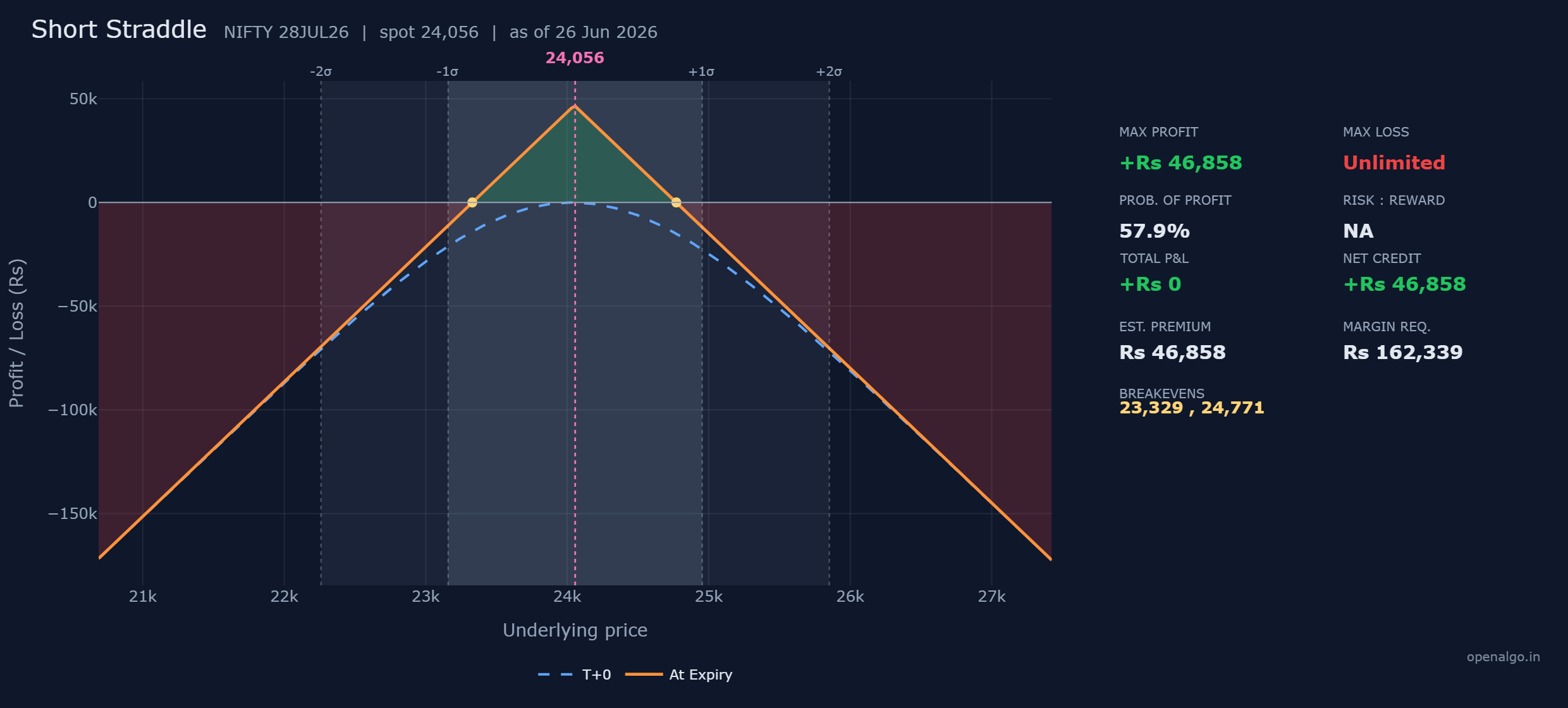
The three numbers of the short straddle
The total premium per share, 425.8 plus 295.1, is 720.9, the same figure that drove the long straddle, because you have simply taken the other side.
| Number | How it is built | This trade |
|---|---|---|
| Max profit | the net credit collected | Rs 46,858 |
| Max loss | open ended on a big move | Unlimited |
| Breakevens | strike minus, then plus, the total premium per share | 24,050 minus 720.9 equals 23,329; 24,050 plus 720.9 equals 24,771 |
NIFTY can wander anywhere inside the 1,442-point band between the breakevens and you still finish in the black. Beyond 24,771 the naked call costs you rupee for rupee with no ceiling, and below 23,329 the naked put behaves like an obligation to keep buying NIFTY all the way down.
A short straddle has a maximum profit of Rs 46,858 and a loss that is open-ended on both sides. You have sold a naked call, so a strong rally costs you without any ceiling above 24,771, and a naked put, so a crash costs you all the way down through 23,329 toward the floor where the index would reach zero. The upside loss is truly unlimited; the downside is bounded only by that floor, which on an index still means a figure so large it is ruinous for any practical purpose. This is two uncovered short legs stacked on the same strike, and a single gap, up or down, can erase many months of quiet credits in one morning.
Walking the short straddle outcomes at expiry
Settle the trade at five closing prices. A call is worth max(NIFTY minus 24,050, 0) at expiry, a put is worth max(24,050 minus NIFTY, 0), and your net is the credit of Rs 46,858 minus those two values times 65.
| NIFTY at expiry | 24,050 call you sold | 24,050 put you sold | Net profit or loss |
|---|---|---|---|
| 23,000 | worth 0 | worth 1,050 | minus Rs 21,392 |
| 23,329 | worth 0 | worth 721 | Rs 0 (breakeven) |
| 24,050 | worth 0 | worth 0 | plus Rs 46,858 (max profit) |
| 24,771 | worth 721 | worth 0 | Rs 0 (breakeven) |
| 25,300 | worth 1,250 | worth 0 | minus Rs 21,392 |
The single best place to land is dead centre, on the strike you sold, where you keep the whole credit. Walk outward and the profit shrinks, crosses zero at a breakeven, and then the loss falls away, with no ceiling above and a floor only at zero below. Notice that the table only reaches 25,300, where the loss is already Rs 21,392 and still growing. There is no last row, because on the upside there is no maximum at all.
The short strangle, rupee by rupee
The short straddle pays the most, but its breakevens sit uncomfortably close to spot. The short strangle buys a wider margin for error by selling out-of-the-money options instead. You sell the 23,950 put and the 24,150 call, leaving a cushion on each side before either leg comes alive.
| Leg | Action | Strike | Premium per share | Cash flow per lot of 65 |
|---|---|---|---|---|
| 1 | Sell put | 23,950 | 256.6 received | Rs 16,679 in |
| 2 | Sell call | 24,150 | 370.1 received | Rs 24,057 in |
| Net credit | Rs 40,729 in |
Because both legs are out of the money, each fetches less, so the net credit falls to Rs 40,729, about Rs 6,000 less than the straddle. In exchange you get a flat profit plateau in the middle rather than a single peak, and a wider safe zone before either side hurts you.
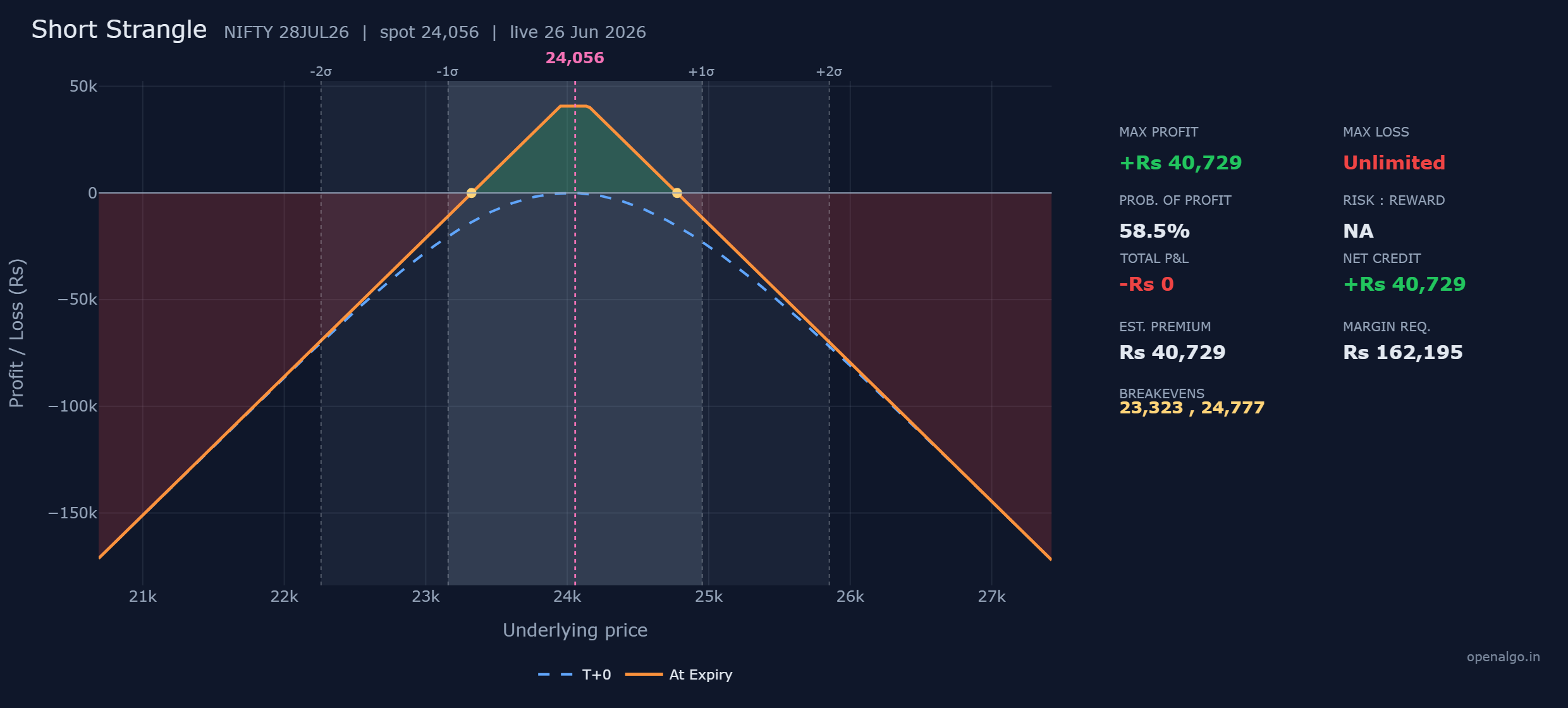
The three numbers of the short strangle
The total premium per share, 256.6 plus 370.1, is 626.7, and it sets the breakevens off the two strikes you sold.
| Number | How it is built | This trade |
|---|---|---|
| Max profit | the net credit collected | Rs 40,729 |
| Max loss | unlimited beyond the wings | Unlimited |
| Breakevens | lower strike minus, upper strike plus, the total premium per share | 23,950 minus 626.7 equals 23,323; 24,150 plus 626.7 equals 24,777 |
Between 23,950 and 24,150 you keep the entire credit, because both options expire worthless across that band. The breakevens, 23,323 and 24,777, sit wider than the straddle's, which is why this version feels safer. It is not. The wider zone only delays the danger, it does not cap it.
A short strangle has a maximum profit of Rs 40,729 and a maximum loss that is still open-ended. The wider breakevens make it feel safer and the higher probability of profit flatters it further, but both sold legs are naked. Above 24,777 the short call bleeds with no ceiling, and below 23,323 the short put runs down toward the floor at zero. A higher win rate on a trade that can lose without bound is not safety, it is a slower fuse.
Walking the short strangle outcomes at expiry
| NIFTY at expiry | 23,950 put you sold | 24,150 call you sold | Net profit or loss |
|---|---|---|---|
| 23,000 | worth 950 | worth 0 | minus Rs 21,021 |
| 23,323 | worth 627 | worth 0 | Rs 0 (breakeven) |
| 24,050 | worth 0 | worth 0 | plus Rs 40,729 (max profit) |
| 24,777 | worth 0 | worth 627 | Rs 0 (breakeven) |
| 25,300 | worth 0 | worth 1,150 | minus Rs 34,021 |
The inverted V of the straddle has flattened into a tabletop. The full credit is yours anywhere across the central band, then the line turns down outside the wings and falls away on both sides, with no ceiling above and a floor only at zero below. The plateau is the comfort, the falling tails are the danger, and the tails never stop.
Your odds
The probability of profit is 58 percent for the straddle and 59 percent for the strangle, both comfortably above half, because most months NIFTY does not travel 720 points either way. That high win rate is the whole seduction of selling premium, and it is also exactly what makes these trades dangerous to the unwary.
A 58 or 59 percent win rate means you will collect the credit again and again, building quiet confidence, and the rare loss that finally arrives can be many times larger than every gain before it. Always read the unlimited max loss next to that flattering probability, never alone. The market-implied odds also assume a single hold to expiry, but most sellers never wait that long: they take the trade off once a large part of the credit has decayed, or exit the moment NIFTY threatens a breakeven, accepting a small loss rather than risking an unlimited one. The exit plan matters more here than on any defined-risk trade in this course.
Margin
This is where the honest cost of selling naked shows up. The exchange blocks about Rs 162,339 for the short straddle and Rs 162,195 for the short strangle, made of a heavy SPAN component plus an exposure buffer, precisely because the loss is open ended. You are putting more than a lakh and a half of capital on the line to collect a few tens of thousands of rupees of premium.
That lets you judge the trade by its return on margin. The straddle collects Rs 46,858 against Rs 162,339 blocked, about 29 percent if it works. The strangle collects Rs 40,729 against Rs 162,195, about 25 percent. Those look rich, but the figure flatters a position whose downside is unlimited. A single bad month does not cost you 29 percent, it can cost a multiple of the whole margin.
Time decay is your ally
Look again at the blue dashed T+0 line sitting below the orange at-expiry peak near the centre of each chart. That gap is the time value still to melt, and as a seller you are paid by it. Every calm day the blue line lifts toward the orange one as the premium you collected decays in your favour. Time decay, the enemy of the buyer in the last chapter, is now your ally. The whole trade is a wager that decay arrives faster than any move that hurts you.
If you ever do sell premium this way, never hold a naked short straddle or strangle without a plan to cap the loss. The professional fix is to buy a cheaper, further out-of-the-money call and put as insurance, which turns the unlimited tails into known numbers and converts the trade into an iron fly or an iron condor. Those are the defined-risk versions of this exact idea, and they are where the next chapter goes. A beginner should learn the short straddle and strangle mainly to respect them, not to place them naked.
The two trades side by side
| Number | Short Straddle | Short Strangle |
|---|---|---|
| Max profit | Rs 46,858 | Rs 40,729 |
| Max loss | Unlimited | Unlimited |
| Breakevens | 23,329 and 24,771 | 23,323 and 24,777 |
| Probability of profit | 58 percent | 59 percent |
| Net credit | Rs 46,858 | Rs 40,729 |
| Margin required | Rs 162,339 | Rs 162,195 |
Read the columns and the bargain is clear. The straddle collects the larger credit with a tighter safe zone, the strangle collects less with more room to be wrong, and both win most of the time. They also share the one feature that should make a beginner pause: the loss has no limit and the margin is large. You collect a few thousand rupees while exposing yourself to a tail that can take far more than you ever took in.
You can rehearse both in sandbox trading (analyzer mode in OpenAlgo), selling the call and the put and watching the inverted V of the straddle spread into the tabletop of the strangle as you push the strikes apart. Slide the modelled price toward a breakeven and watch the falling tail keep going, the upside with no ceiling at all and the downside bounded only by zero. Feel both halves at once: the quiet daily pull of decay in your favour, and the open cliff on either side that one violent session can send you over. That tension, steady income against an uncapped tail, is what every premium seller lives with.
Key takeaways
- A short straddle sells the at-the-money call and put, a short strangle sells cheaper out-of-the-money strikes, and both collect a net credit that is the maximum profit.
- The straddle takes in Rs 46,858 with breakevens at 23,329 and 24,771; the strangle takes in Rs 40,729 with a wider safe zone of 23,323 to 24,777.
- The maximum loss is open-ended on both sides of each trade, truly unlimited on the upside and very large though bounded on the downside, because every sold leg is naked, and that is the fact that governs everything.
- The probability of profit is high, 58 and 59 percent, which is the seduction; a single rare loss can dwarf a long run of small wins.
- Margin is large, about Rs 1.62 lakh for each, and time decay works in your favour, but the rich-looking return on margin flatters a position with an open tail.
- A beginner should learn these to respect them, then fence the tails in. The next chapter turns this exact income shape into the defined-risk iron condor.