
Crypto Tax: The Flat 30 Percent and the 1 Percent TDS
Crypto has the harshest tax rules of any asset in India. Learn the flat 30 percent on gains, the 1 percent TDS on sales, the brutal rule that losses cannot be set off against anything, and how to report it in Schedule VDA.
- ·The flat 30 percent rate
- ·Only the cost is deductible
- ·The 1 percent TDS
- ·Losses cannot be set off
- ·No carry-forward of losses
- ·Reporting in Schedule VDA
A trader we will call Arjun had a busy year in crypto. One coin he bought worked out beautifully and he booked a healthy profit. Another coin he was sure about went the wrong way and he sold it at a loss. When tax season arrived he did the sum any equity investor would do: he netted the winner against the loser, expecting to pay tax only on what was left. Then he discovered that crypto does not work like shares at all. His loss was simply ignored, and he owed tax on the full profit of the winning coin as if the losing one had never happened.
This is the single hardest set of rules in Indian tax, and it applies to what the law calls Virtual Digital Assets, or VDAs, which is the formal name for crypto coins and tokens. The rules are not complicated, but they are unusually unforgiving, and the people who get hurt are almost always the ones who assumed crypto would be taxed like everything else they own.
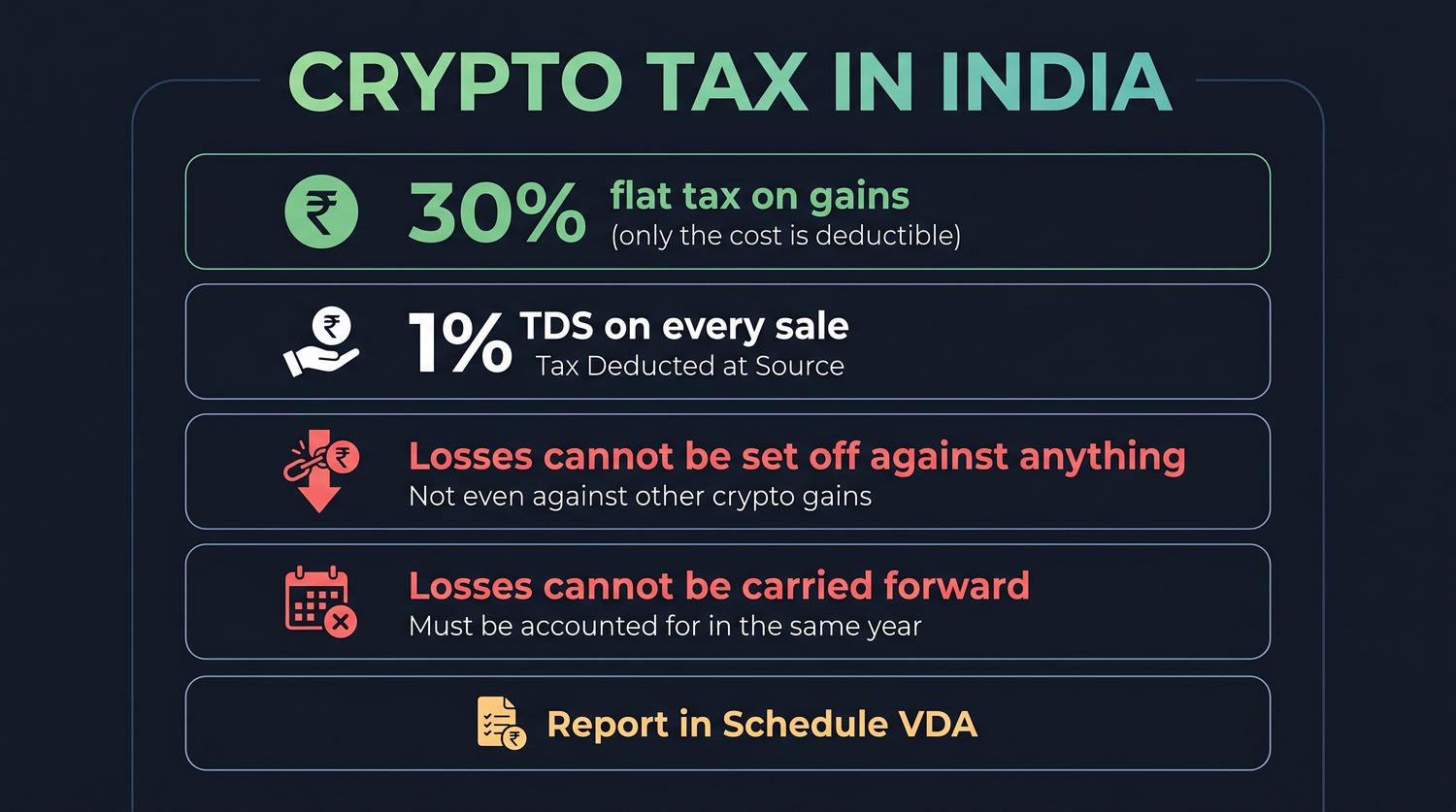
A flat 30 percent, whatever your slab
The first rule is the headline one. Gains on crypto are taxed at a flat 30%, plus surcharge where it applies and 4% Health and Education Cess on top, under Section 115BBH. Gain here is simply the sale price minus the cost price.
The word "flat" is important. With shares or salary, a small earner pays a low rate and only large incomes reach 30%. Crypto ignores all of that. Whether your total income is modest or large, the gain on a coin is taxed at 30%. There is no lower band for a beginner, and the slab system you may have learned in earlier chapters does not apply to this income at all.
Crypto gains are taxed at a flat 30% under Section 115BBH, plus cess, no matter how small your other income is. The slab rates that protect a low earner on salary or shares give you no relief here. The gain is the sale price minus the cost, and 30% of it goes in tax.
Only the cost is deductible
The second rule narrows what you can subtract before applying that 30%. When you compute the gain, the only thing you may deduct is the cost of acquisition, meaning what you actually paid for the coin. Nothing else is allowed.
That "nothing else" is strict. You cannot deduct exchange fees or transaction charges. You cannot deduct the cost of any infrastructure, software or electricity. You cannot deduct interest on money you borrowed to buy. With business income or even ordinary capital gains there are usually expenses you can net off, but here the door is closed. Cost price in, sale price out, and the difference is taxed.
A quick illustration shows the bite. Imagine you buy a coin for 1,00,000, pay 1,000 in fees on the way in, sell it later for 1,50,000, and pay another 1,000 in fees on the way out. Your true cash profit is 50,000 minus the 2,000 of fees, which is 48,000. But the taxable gain is still measured as 1,50,000 minus 1,00,000, equal to 50,000, and the 30% is charged on that full 50,000. The fees came out of your pocket but earned you no relief.
The practical effect is that your real, after-fee profit is smaller than the figure the tax is calculated on. If fees ate into your trade, the taxman still measures the gain from raw cost to raw sale and ignores those fees entirely. Build that into your expectations before you trade, not after.
The 1 percent TDS on every sale
The third rule is a deduction that happens at the moment of sale. A 1% TDS (Tax Deducted at Source) applies on the sale of a VDA under Section 194S. In simple terms, when a coin is sold, 1% of the sale value is held back and deposited against the seller's PAN. This kicks in above a small threshold, which is Rs 50,000 in a year for specified persons and Rs 10,000 for others.
This TDS is not an extra tax on top of the 30%. It is an advance instalment of your tax that you adjust when you file. If your final tax is higher, you pay the balance. If it is lower, you claim the difference back. Its real purpose is to give the department a clear trail of every crypto sale, which is worth remembering before assuming a trade is invisible.
The 1% TDS under Section 194S means the department sees your crypto sales whether or not you report them. It is a footprint left on every disposal above the threshold. Treat crypto as fully visible, reconcile the TDS that appears against your PAN, and report honestly. Assuming the activity is hidden is a costly error.
The harshest rule: losses go nowhere
Here is the rule that surprised Arjun, and it is the one that makes crypto genuinely punishing. A loss on a crypto trade cannot be set off against anything. Not against your salary, not against capital gains on shares, not against business income, and, most painfully, not even against gains on other crypto. On top of that, the loss cannot be carried forward to a future year either.
Sit with how unusual this is. In almost every other corner of tax, a loss has value: it reduces a matching gain now, or it waits in your return to shelter a gain later. A crypto loss has neither. It does not reduce this year's tax and it does not survive into next year. It simply disappears.
This is why crypto rewards caution in a way few assets do. A trader in shares can take a few losing positions knowing the losses at least soften the tax on the winners. A crypto trader gets no such cushion. Every losing trade is a clean, total loss with no tax benefit attached, so the discipline of sizing small and avoiding reckless bets matters even more here than in the markets you may already know.
| Asset | Can a loss reduce a matching gain? | Can the loss carry forward? |
|---|---|---|
| Listed shares (capital gains) | Yes, within the rules | Yes, for several years |
| Business income | Yes, against most heads except salary | Yes, if filed on time |
| Crypto (VDA) | No, not even against other crypto | No |
Worked example: two coins, one hard lesson
Let us put Arjun's year into numbers, because the figures make the rule unforgettable.
He buys one coin for 2,00,000 and later sells it for 3,00,000. The gain is 3,00,000 minus 2,00,000, equal to 1,00,000. The tax is 30% of 1,00,000, which is 30,000, plus 4% cess on that 30,000, which is 1,200. So the bill on the winning coin is 31,200.
In the same year he buys another coin for 1,00,000 and sells it for 60,000. The loss is 1,00,000 minus 60,000, equal to 40,000.
Every instinct says the 40,000 loss should cut into the 1,00,000 gain, leaving him taxed on only 60,000. It does not. The loss cannot be set off against the crypto gain at all. He is taxed on the full 1,00,000 gain, so he still owes 31,200, even though across the two coins his actual cash profit was only 1,00,000 minus 40,000, which is 60,000.
Winning coin: bought 2,00,000, sold 3,00,000, gain 1,00,000, tax at 30% equals 30,000, plus cess of 1,200, total 31,200. Losing coin: bought 1,00,000, sold 60,000, loss 40,000. The 40,000 loss reduces the tax on the winning coin by nothing. Arjun pays 31,200 on a real cash profit of just 60,000, and the lost 40,000 cannot even be carried into next year.
That gap, paying 30% on a gross winner while a real loss is treated as if it never happened, is the defining feature of crypto tax. It is why position sizing and discipline matter even more here than elsewhere: a loss costs you the money and gives you nothing back at tax time.
Where it goes: Schedule VDA
Finally, where do you report all of this. Crypto gains are declared in a dedicated section of the return called Schedule VDA. You report there whether you treat your crypto as an investor or as a trader.
| Your situation | Form that carries Schedule VDA |
|---|---|
| Crypto held as an investor, capital gains | ITR-2 |
| Crypto traded as a business | ITR-3 |
The form differs, but Schedule VDA is the common home for the disclosure. Fill it carefully, match it to the 1% TDS already sitting against your PAN, and keep your buy and sell records, because the cost of acquisition is the one and only deduction the law will let you claim.
Before you trade, internalise the three numbers that define crypto tax: 30% flat on gains, 1% TDS on every sale, and zero value for any loss. If you size your positions knowing a loss helps you in no way at all, you will treat crypto with the caution it deserves rather than the optimism that catches beginners.
This chapter explains the rules for learning, not as filing advice. Crypto tax law is strict and still evolving, and the figures can change from year to year, so confirm your own position with a qualified chartered accountant before you file.