
The Number One Mistake: F&O Is Business Income
Most new F&O traders get the very first thing wrong. Learn why futures and options are non-speculative business income, not capital gains, why that means slab rates and ITR-3, and the freedoms and duties that come with it.
- ·Not capital gains, business income
- ·Non-speculative, and why
- ·Taxed at your slab rate
- ·Reported in ITR-3
- ·Expenses you may claim
- ·Why the bucket matters here
Meet Rohan and Meera. They sit two desks apart, watch the same Nifty options on the same screens, and both finished this year with a tidy profit of Rs 3 lakh from futures and options. On paper they look like twins. Yet when filing season arrives, their tax stories split apart, and the only thing that separated them was one quiet decision: which box each of them dropped that F&O profit into.
Rohan was in a hurry. He treated his F&O gains the way he treats profit from selling shares and reported the money as capital gains. Meera had read up a little first, so she reported the very same Rs 3 lakh as business income. One of them filed correctly. The other invited a notice, threw away deductions he was fully entitled to, and may have to redo his entire return. This chapter is about why Rohan's choice is the single most common mistake new traders make, and how you can avoid it for good.
F&O is business income, not capital gains
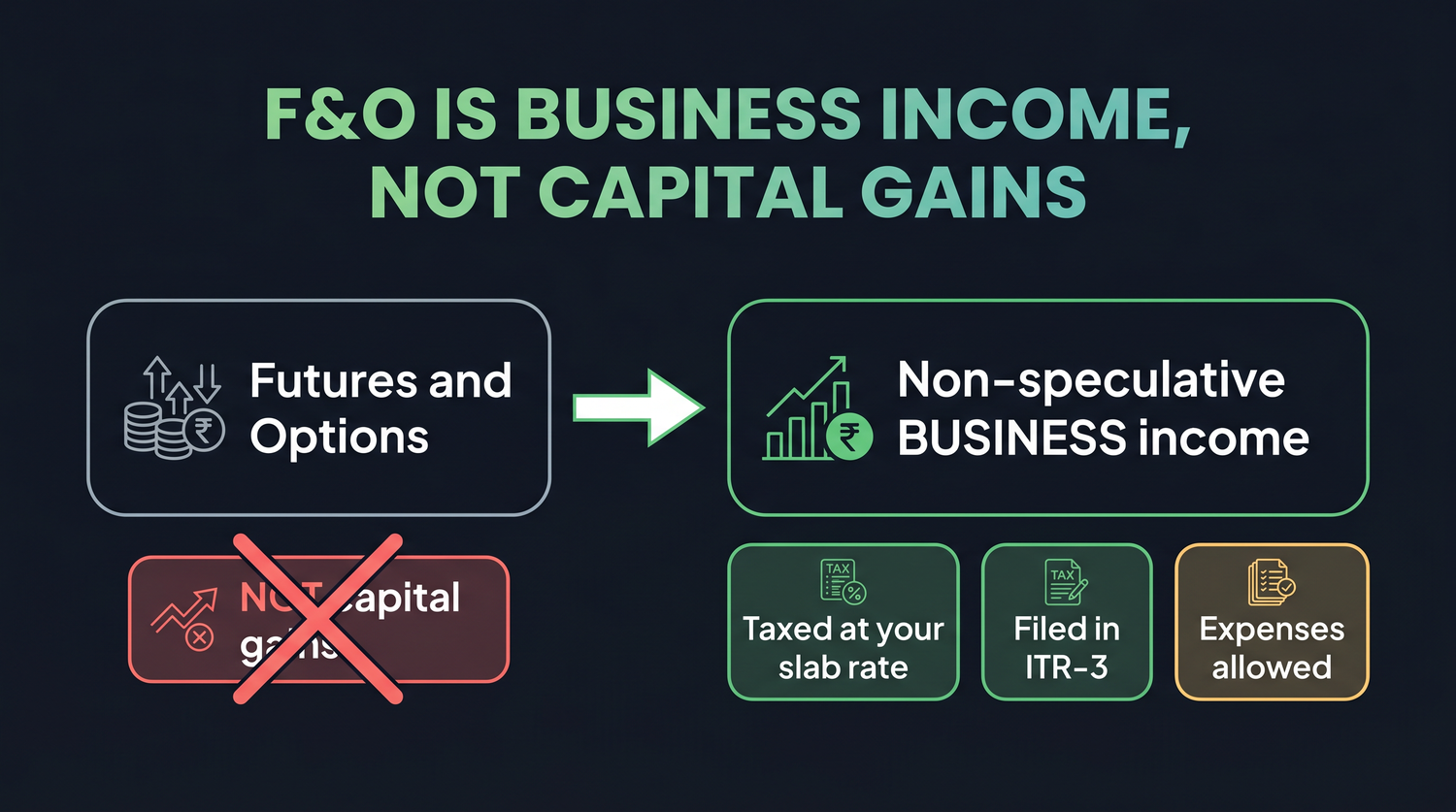
Here is the rule in plain words. Profit from futures and options is non-speculative business income. In the language of the tax law it sits under the head called "Profits and gains of business or profession", the same head a shopkeeper, a consultant or a small manufacturer uses. It is NOT capital gains, even though you clearly bought something and sold it.
This is exactly where beginners slip. Buying shares, holding them for delivery, then selling, genuinely is capital gains. So the new trader reasons that anything bought and sold on an exchange must be capital gains too. That reasoning is simply wrong for F&O. The tax law looks at your futures and options activity and sees a business you are running, whether you place one trade a month or fifty trades a day.
The phrase "non-speculative" is worth slowing down on, because it is doing real work. The tax law sorts trading into three buckets, and F&O has its own.
| Transaction type | Classified as | A loss can be set off against |
|---|---|---|
| F&O (equity, commodity, currency) | Non-speculative business income | Most income heads, except salary |
| Intraday equity trading | Speculative business income | Only speculative income |
| Delivery equity and mutual funds | Capital gains (STCG or LTCG) | Capital gains only |
Notice the pattern. Intraday equity trading is also a business, but the speculative kind. Delivery shares and mutual funds are capital gains. F&O sits in the middle as business income of the non-speculative kind. That non-speculative label is actually good news, and a later chapter shows how it gives your losses much friendlier treatment than an intraday trader ever gets.
Reporting F&O profit as capital gains is the number one beginner tax mistake. Futures and options are non-speculative business income, taxed under "Profits and gains of business or profession" and reported in ITR-3. They are not STCG and they are not LTCG.
Why the bucket you choose changes everything
Putting F&O in the wrong bucket is not a harmless labelling slip. The bucket decides three big things: the tax rate, whether you can claim expenses, and what you can do with a loss.
First, the rate. F&O profit is taxed at your slab rate, which means it simply stacks on top of your other income and is taxed at whatever band it lands in. It is not taxed at a special flat capital gains rate. Short-term capital gains on shares, by contrast, are taxed at a flat 20% under Section 111A, and long-term gains at 12.5% under Section 112A. If Rohan files his F&O profit as short-term capital gains, he forces it to a flat 20% and into a category it does not belong in, which is both incorrect and often more expensive than his real slab would have been.
Second, expenses. Because F&O is a business, you are allowed to subtract the genuine costs of running it before you are taxed: your brokerage, your exchange charges, your internet bill, your research tools and more. Capital gains allow almost none of this. By mislabelling, Rohan quietly hands back every one of these deductions. The very next chapter is devoted to those expenses.
Third, losses. A non-speculative F&O loss can be set off against most other income, and carried forward for 8 years if you file on time. A capital loss is trapped, because it can only be set off against capital gains. Put your F&O loss in the wrong bucket and you lose the right to use it against your salary-free other income.
| Question | F&O as business income (correct) | F&O wrongly as capital gains |
|---|---|---|
| Tax rate | Your slab rate | Forced to flat 20% (STCG) |
| Claim brokerage, internet, tools? | Yes | No |
| Set off a loss against most income? | Yes (except salary) | No, capital gains only |
| Correct ITR form | ITR-3 | Return may be treated as defective |
Filing F&O under capital gains can make your return "defective". The department can issue a defective-return notice, and you may have to file again under the correct head. The wrong box is not a small slip; it can unravel the whole return.
Two traders, one profit, two very different outcomes
Let us put real rupees on Rohan and Meera. Both are salaried, both earn Rs 12 lakh in salary, and both made Rs 3 lakh trading F&O. Their total income is therefore Rs 15 lakh. We will use the new regime slabs for AY 2026-27, which is the default regime.
| Taxable income | Tax rate |
|---|---|
| Up to Rs 4 lakh | Nil |
| Rs 4 lakh to 8 lakh | 5% |
| Rs 8 lakh to 12 lakh | 10% |
| Rs 12 lakh to 16 lakh | 15% |
| Rs 16 lakh to 20 lakh | 20% |
| Rs 20 lakh to 24 lakh | 25% |
| Above Rs 24 lakh | 30% |
Meera files correctly. Her Rs 3 lakh of F&O profit is business income and stacks on top of her salary. The slice from Rs 12 lakh to Rs 15 lakh sits in the Rs 12 lakh to 16 lakh band, taxed at 15%. Before that, she subtracted Rs 20,000 of genuine trading expenses, so she is really taxed on Rs 2,80,000 of profit. Fifteen percent of 2,80,000 is Rs 42,000, plus 4% cess. She also keeps the right to carry forward any future F&O loss.
Rohan files the same Rs 3 lakh as short-term capital gains. Section 111A taxes that at a flat 20%, which is Rs 60,000 plus cess. He claimed no expenses, because capital gains do not allow his internet bill or research tools. And he has filed under the wrong head, so he now carries the risk of a defective-return notice on top of paying more. Same profit, worse outcome, and a compliance problem to top it off.
Meera: Rs 3,00,000 profit minus Rs 20,000 expenses equals Rs 2,80,000, taxed at her 15% slab, about Rs 42,000 plus cess. Rohan: Rs 3,00,000 wrongly taxed as short-term capital gains at a flat 20%, Rs 60,000 plus cess, no expenses allowed, and a defective-return risk. The only difference between them was the box each one chose.
Filing it right: ITR-3, slab rates and Form 10-IEA
Once you accept that F&O is a business, the practical steps fall neatly into place.
You report F&O in ITR-3, the return form built for business and professional income. The simple salary-and-investor forms have no place for it. Most active traders end up on ITR-3 for exactly this reason.
| Who you are | Form |
|---|---|
| Salary and simple investor, small income | ITR-1 (Sahaj), but not for business or F&O |
| Investor with capital gains, foreign assets, crypto as capital gains | ITR-2 |
| F&O, intraday, or trading as a business | ITR-3 (most traders) |
Your F&O profit is taxed at slab rates, adding to your total income as shown above. The new regime is the default for AY 2026-27, and under it the Section 87A rebate of up to Rs 60,000 means taxable income up to Rs 12 lakh effectively pays no tax. If a modest F&O profit kept your total income under Rs 12 lakh, the rebate could wipe out the tax entirely, but you still must report it.
One trap deserves a flag. If you have business income, such as F&O, and you want to choose the OLD regime instead of the default new one, you must file Form 10-IEA by the due date under Section 139(1). Miss that form and you are locked into the new regime for the year. A chartered accountant can tell you which regime actually suits you, but the deadline to opt out is easy to forget.
The moment you place your first F&O trade, mentally file yourself under "business". Plan to use ITR-3, start saving your expense proofs, and decide your regime early. Treating F&O as a small business from day one prevents almost every mistake in this chapter.
Rohan's error was understandable, but it was still an error, and it cost him money and peace of mind. Meera's path was not harder; it was simply informed. F&O is a business in the eyes of the tax law. Report it in ITR-3, tax it at your slab, claim your genuine expenses, and protect your losses, and the number one beginner mistake is no longer available to you.
F&O is non-speculative business income. Slab rates, not flat capital gains rates. ITR-3, not the simple investor forms. Expenses allowed. Losses set off against most income except salary. Get the bucket right and everything else follows.
This chapter is for learning only and is not tax advice. Tax rules and rates change every year, so please confirm your own situation with a qualified chartered accountant before you file.