
Tax on US Stocks for Indian Investors
Owning Apple or an S&P 500 ETF brings two countries into your tax life. Learn how US stock gains and dividends are taxed in India, the holding period that defines long-term, the US dividend withholding, and the credit that stops double tax.
- ·Capital gains on US stocks
- ·The 24-month long-term line
- ·Dividends and US withholding
- ·The foreign tax credit
- ·Form 67 and the DTAA
- ·A worked US-stock example
Somewhere in the last few years, buying a slice of an American company stopped feeling exotic. From your phone in Bengaluru or Pune you can own shares of a US technology giant before lunch. The investing part has become wonderfully easy. The tax part is where people freeze, because now two countries are involved and the word "double taxation" starts to sound scary. Here is the calm truth up front. India and the United States have an agreement specifically so that you are not taxed twice on the same money. Once you understand the handful of rules in this chapter, taxing your US portfolio becomes routine. Let us take it piece by piece, with rupee figures throughout.
Capital gains: the 24-month line
When you sell a US stock for more than you paid, the profit is a capital gain, and how it is taxed depends entirely on how long you held it. For foreign shares the dividing line is 24 months, which is longer than the 12-month line you may know for Indian listed shares.
| How long you held the US stock | Type of gain | How it is taxed in India |
|---|---|---|
| More than 24 months | Long-term | 12.5%, plus cess |
| 24 months or less | Short-term | At your slab rate |
So patience is rewarded. Hold a US stock for more than two years and your gain is taxed at a flat 12.5%. Sell within two years and the gain simply adds to your total income and is taxed at whatever slab you fall into, which for many investors is higher than 12.5%.
The reassuring part is where this tax is paid. Under the India-United States tax treaty, known as the DTAA, capital gains on US shares are taxed only in India for a resident Indian investor. The United States does not tax your capital gains here, so there is no double tax on the profit when you sell.
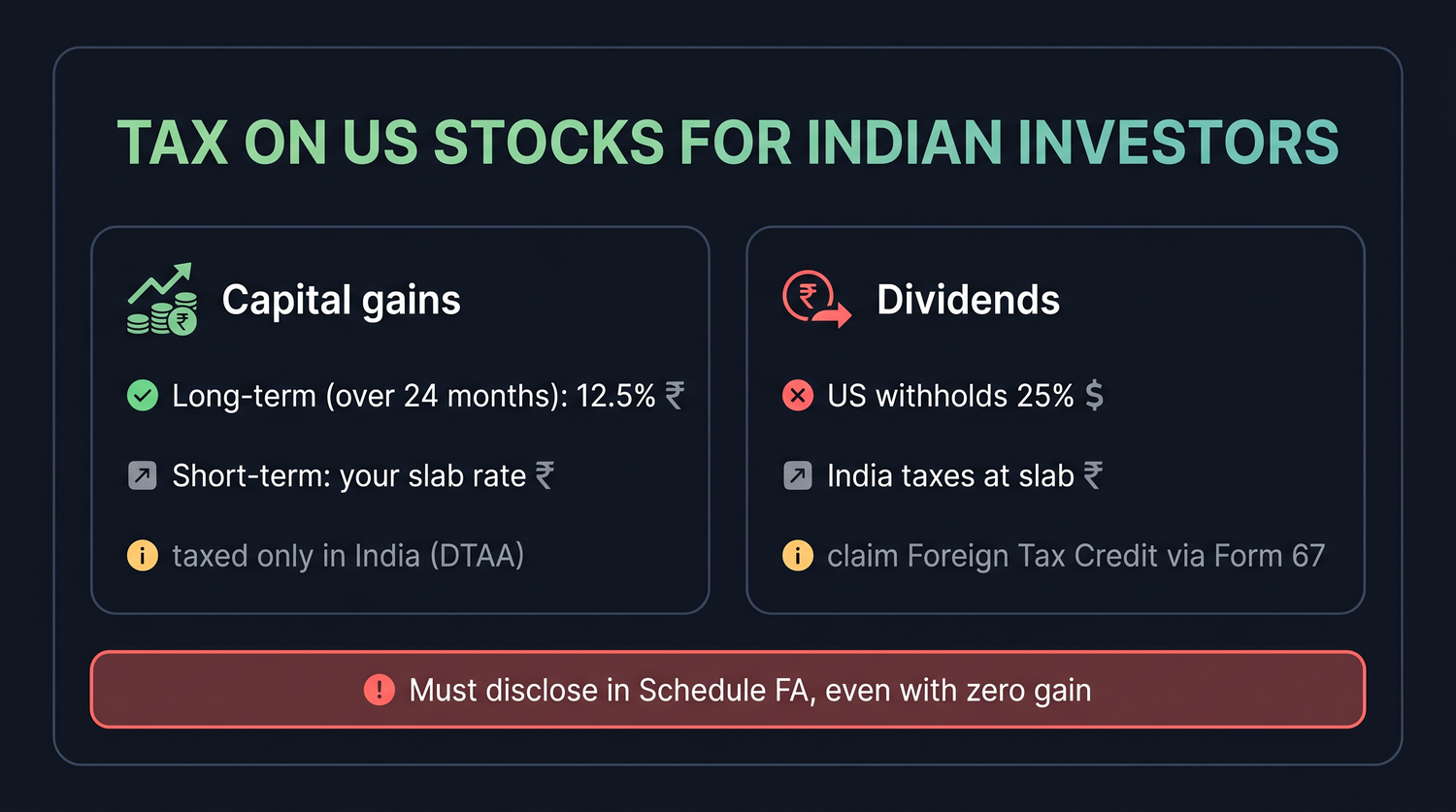
For a resident Indian, capital gains on US shares are taxed only in India under the DTAA. Held for more than 24 months, the gain is long-term and taxed at 12.5%. Held for 24 months or less, it is short-term and taxed at your slab rate.
A worked long-term example
Numbers make this concrete. Suppose you buy US shares worth Rs 8,00,000 and hold them patiently. Thirty months later, comfortably past the 24-month line, you sell them for Rs 11,00,000.
Purchase cost: Rs 8,00,000. Sale value after 30 months: Rs 11,00,000. Your long-term capital gain is Rs 11,00,000 minus Rs 8,00,000, which equals Rs 3,00,000. Because you held for more than 24 months, the tax is 12.5% of Rs 3,00,000, which equals Rs 37,500, plus the 4% Health and Education Cess on that tax. The United States does not tax this gain, so Rs 37,500 plus cess is the whole story.
Notice how clean that is. One holding period check, one rate, one country. The complications people fear with US investing live not in capital gains but in dividends, which is where two tax systems genuinely meet. That is the next piece.
Dividends: the 25% the US keeps, and how you get it back
When a US company pays you a dividend, the United States takes its cut before the money even reaches you. For an Indian individual investor the US withholds 25% of the dividend at source, a reduced rate available under the DTAA. So a dividend of Rs 100 arrives in your account as Rs 75, with Rs 25 already gone to the US tax authorities.
Then India taxes the same dividend too. In India, a dividend is added to your income and taxed at your slab rate. At first glance this looks exactly like the double taxation everyone dreads. The same Rs 100 is being taxed in America and in India.
This is where the Foreign Tax Credit rescues you. India lets you claim a credit for the tax already paid in the US, so you are not charged twice on the same dividend. You subtract the US tax from your Indian tax on that dividend and pay only the difference, if any.
To claim the Foreign Tax Credit you must file Form 67 before you file your income tax return, along with the related Schedule TR and Schedule FSI in the ITR. Form 67 is the document that tells the Indian tax system, "I already paid this much tax abroad, please give me credit for it." Miss the form and you can lose the credit, so it is not optional paperwork.
Let us see the credit working. Say you received a US dividend of Rs 10,000. The US withheld 25%, which is Rs 2,500, so Rs 7,500 reached you. In India the full Rs 10,000 is taxable. Suppose your slab is 20%, making the Indian tax Rs 2,000. Your US tax of Rs 2,500 is larger than your Indian tax of Rs 2,000 on this dividend, so the Foreign Tax Credit fully covers it and you pay no additional Indian tax on the dividend. The money was taxed once in effect, not twice, which is exactly what the DTAA is for.
Schedule FA: you must disclose, even with no gain
Here is a rule that has nothing to do with how much tax you owe and everything to do with disclosure. A resident Indian who owns foreign assets must report them in Schedule FA of the income tax return. US shares and US-listed ETFs are foreign assets, so they belong in Schedule FA.
The part people get wrong is thinking disclosure is only needed when there is a profit. It is not. You must report your US holdings in Schedule FA even if you sold nothing, even if there was no gain at all, even if the stock fell. Ownership itself is what triggers the duty to disclose.
Schedule FA disclosure is mandatory the moment you hold a foreign asset, regardless of profit or loss. This is one place not to be casual. Non-disclosure of foreign assets is treated very seriously under a separate law, and the safe habit is simple: own a US share, declare it in Schedule FA, every year.
So your US portfolio creates two separate jobs at filing time. One is paying any tax on gains and dividends, helped by the Foreign Tax Credit. The other is disclosing the holdings in Schedule FA whether or not any tax is due. Keep these two ideas apart in your mind and US investing stops feeling tangled.
LRS and the 20% TCS on money sent abroad
There is one more number to know, and it appears before you have earned a single rupee of profit. It is about the money you send out of India to buy the shares in the first place. Sending money abroad falls under the Liberalised Remittance Scheme, the LRS, the channel that lets resident individuals remit funds overseas within an annual limit.
On remittances under the LRS, a 20% Tax Collected at Source, or TCS, applies on the amount above Rs 7 lakh in a financial year. The good news is that TCS is not a tax you have lost. It is a credit. It gets adjusted against your overall tax liability when you file, or refunded if you have paid more than you owe, just like TDS.
| Money sent abroad in the year for US stocks | TCS treatment |
|---|---|
| Up to Rs 7 lakh | No TCS |
| The portion above Rs 7 lakh | 20% TCS, which you reclaim as a credit when you file |
The 20% TCS feels painful because it leaves your bank account upfront, but remember it is only a temporary parking of your own money. You claim it back against your tax when you file. Keep the remittance and TCS records from your bank so you can take full credit and not leave that money behind.
Putting your US portfolio together
Step back and the whole picture is just four moving parts. When you send money to invest, watch the LRS limit and remember the 20% TCS above Rs 7 lakh is recoverable. When you sell, your capital gain is taxed only in India, at 12.5% beyond 24 months or at your slab within 24 months, as in our Rs 3,00,000 gain that cost Rs 37,500 plus cess. When you receive dividends, the US keeps 25%, India taxes at slab, and Form 67 hands you the Foreign Tax Credit so the same money is not taxed twice. And every year, profit or not, you disclose the holdings in Schedule FA. Learn those four, keep your statements tidy, and a US portfolio is no harder at tax time than an Indian one.
This chapter is for learning only and is not personal tax advice. Cross-border tax rules, treaty rates and disclosure forms do change, so please confirm the current position with a qualified chartered accountant before you file, especially when foreign assets are involved.