
When an F&O Trader Needs a Tax Audit
Audit is the most misunderstood F&O rule. Learn the simple three-step check, why a loss does not automatically mean an audit, the turnover thresholds, and the cash-transaction rule that decides which threshold applies to you.
- ·Step one: find your turnover
- ·Step two: check the threshold
- ·The 1 crore and 10 crore lines
- ·The 5 percent cash rule
- ·Why a loss is not an audit
- ·The presumptive-tax angle
Vikram had a rough year. His F&O trades added up to a loss of about Rs 2 lakh, and as if losing the money were not enough, a friend at the gym told him something that made it worse. "If you made a loss in F&O, you automatically need a tax audit. That means a CA, fat fees, and the department crawling all over your account." Vikram went home convinced he was in trouble, and he very nearly decided not to file at all, just to stay invisible.
His friend was confidently, completely wrong. A loss does not trigger an audit by itself. Yet this myth is so widespread that it scares honest traders into either expensive panic or, far worse, not filing. This chapter gives you a calm, three-step check to find out whether you actually need a tax audit, and it puts the "loss equals audit" myth to rest for good.
The three-step check
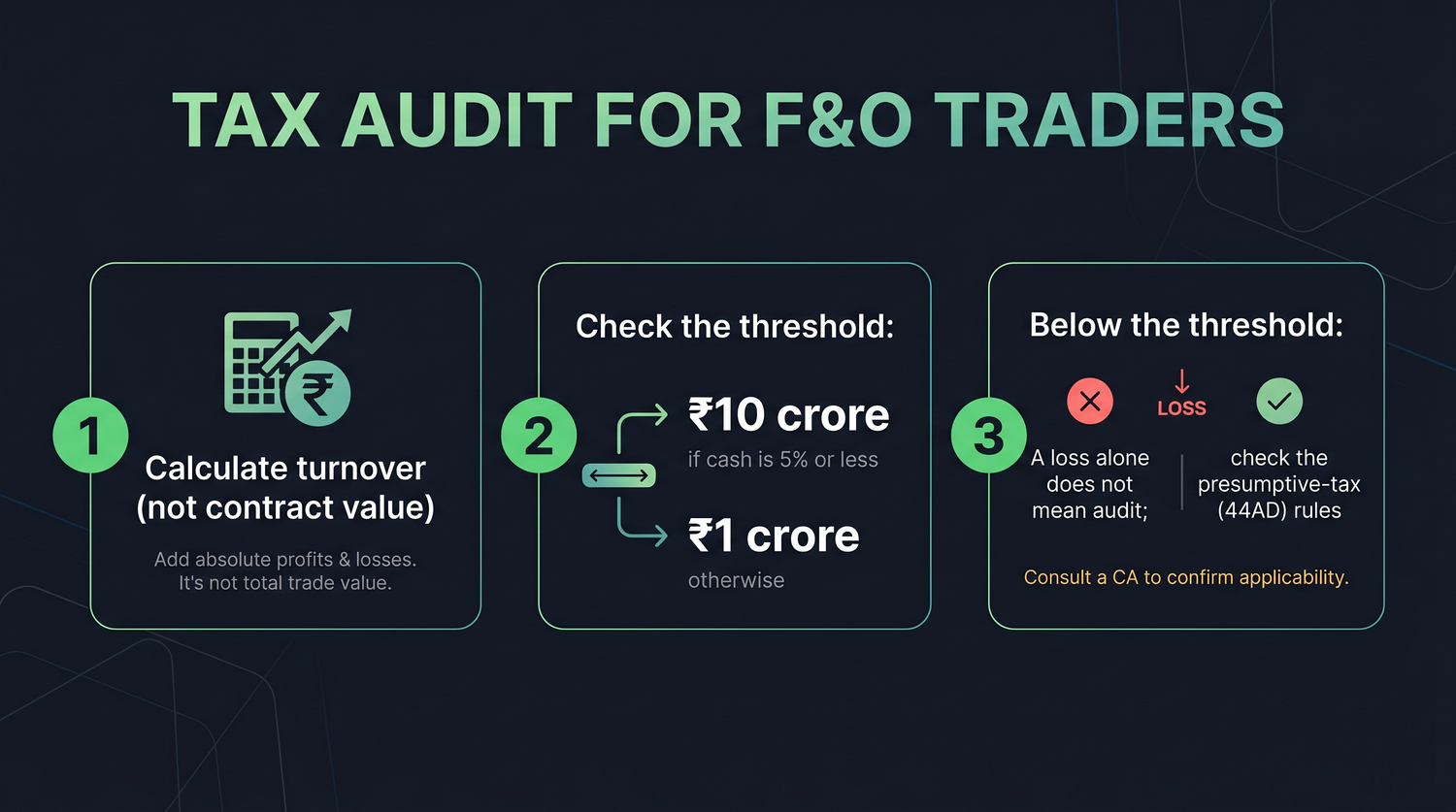
Whether an F&O trader needs a tax audit under Section 44AB comes down to three questions, asked in order. You do not jump to the scary conclusion. You walk the steps.
| Step | The question |
|---|---|
| Step 1 | What is my F&O turnover? |
| Step 2 | Which audit threshold applies to me, and have I crossed it? |
| Step 3 | If I am below the threshold, do any special rules still pull me in? |
Most traders get a clear answer by Step 2 and never reach a worrying place at all. Let us walk each step slowly.
Step 1, find your turnover
You cannot test a threshold until you know the number being tested. So the first step is always to compute your F&O turnover, using the method from the previous chapter.
Remember that turnover is not your contract value. It is the aggregate of your favourable and unfavourable differences, which means you add up the absolute value of every profit and every loss, and for options you also add the premium received on sale. Your broker's tax profit-and-loss report does this for you.
The most important thing to notice here is that the turnover calculation does not care whether you won or lost overall. A loss-making year still produces a turnover figure, often a perfectly ordinary one. Vikram lost Rs 2 lakh, but when he added up the absolute value of all his winning and losing trades, his turnover came to about Rs 40 lakh. That Rs 40 lakh is the number Step 2 will test, not his Rs 2 lakh loss.
The audit test runs on your turnover, not on your profit or loss. A loss-making trader still has a turnover figure, and that figure is what decides the audit question. Whether you made or lost money does not enter Step 2 at all.
Step 2, which threshold applies
Now you compare your turnover against the audit threshold. The catch is that there are two thresholds, and you must use the right one.
| Your situation | Audit threshold for turnover |
|---|---|
| Cash receipts AND cash payments are each 5% or less of the total | Rs 10 crore |
| Anything else (more cash involved) | Rs 1 crore |
The higher Rs 10 crore limit applies only when your cash receipts and your cash payments are each 5% or less of your totals. For a trader who moves money through the banking system, which is almost everyone, this condition is comfortably met. Funds go in and out of your trading account electronically, so cash is essentially zero, and you qualify for the generous Rs 10 crore threshold. If you somehow ran large amounts of physical cash through the business, you would fall to the ordinary Rs 1 crore limit instead.
Bring this back to Vikram. His turnover was about Rs 40 lakh, and every rupee moved digitally, so his threshold is Rs 10 crore. Rs 40 lakh is nowhere near Rs 10 crore. On the turnover test alone, Vikram does not need an audit. His Rs 2 lakh loss never even entered the comparison.
Vikram's turnover is Rs 40 lakh and all his money moves digitally, so his cash is under 5% and his threshold is Rs 10 crore. Rs 40 lakh is far below Rs 10 crore, so on turnover grounds he needs no audit, despite his Rs 2 lakh loss. The loss simply was not part of this test.
The 5% cash rule is what unlocks the high Rs 10 crore threshold, and digital trading meets it almost automatically. This is why the great majority of ordinary retail F&O traders sit far below the line that would require an audit on turnover alone.
Step 3, below the threshold but not yet finished
Suppose your turnover is below the threshold, as Vikram's is. You are probably in the clear, but there is one more box to check before you conclude, and this is where the genuine nuance lives.
Two things are true and worth saying plainly. A loss alone does not mean an audit. And income above the basic exemption limit alone does not mean an audit either. Neither of those facts, on its own, forces you into Section 44AB. This is the heart of the myth that scared Vikram.
What can still apply, in specific cases, is the presumptive-tax rule under Section 44AD. The presumptive scheme is a simplified route that lets eligible small businesses declare a deemed minimum profit and skip detailed bookkeeping. The complication arises in particular situations connected to that scheme, for example where a trader who had earlier opted into the presumptive scheme later declares a profit lower than the deemed figure, or a loss, while their total income is above the basic exemption limit. In that specific combination, an audit can become necessary.
This is deliberately the kind of case to put in front of a chartered accountant rather than judge yourself, because it depends on your filing history and your exact numbers. The point for now is the order of reasoning. You do not start at "I had a loss, so I need an audit." You finish at the presumptive-tax check only after turnover and threshold have been cleared, and even then the answer is often no.
Do not let the "loss equals audit" myth push you into not filing. Filing a loss return is exactly what protects you. It records the loss, lets you carry it forward, and keeps your record clean. Skipping the return to look invisible is the genuinely dangerous move, not the loss itself.
Busting the myth, for good
Let us return Vikram to solid ground. Walk his three steps. Step 1, his turnover is about Rs 40 lakh. Step 2, his money is all digital, so his threshold is Rs 10 crore, and Rs 40 lakh is far below it. Step 3, he checks the presumptive-tax rules with a CA, finds nothing that pulls him in, and concludes he needs no audit. His Rs 2 lakh loss was never the trigger his friend imagined.
So what should Vikram actually do? He should file his return, on time, and report the Rs 2 lakh loss honestly. Filing the loss is not a confession of failure; it is a benefit. A reported non-speculative F&O loss can be carried forward and set off against future income, but only if the return is filed by the due date. The very thing his friend told him to fear is the thing that protects him.
| The myth | The reality |
|---|---|
| A loss means an automatic audit | A loss alone never triggers an audit |
| Income over the exemption means an audit | That alone does not trigger an audit either |
| Skip filing to avoid attention | Filing the loss protects you and saves the carry-forward |
| Audit is decided by profit or loss | Audit is decided by turnover against the right threshold |
Run the three steps in order every year: find your turnover, match it to the right threshold, then check the presumptive-tax rules with your CA. If your turnover sits far below your threshold and nothing special applies, you are not in audit territory, win or lose.
Vikram slept badly over a myth. A few minutes with the three-step check would have saved him the worry and, more importantly, would have kept him from the one real mistake on the table, which was not filing at all. Know your turnover, know your threshold, check the special rules, and let the facts, not gym-locker rumours, decide whether you need an audit.
This chapter is for learning only and is not tax advice. Audit thresholds and presumptive-tax rules can change and depend on your exact situation, so please confirm with a qualified chartered accountant before you decide and file.