
Gifting and Inheriting Shares
Giving shares to family, or receiving them, has its own tax rules. Learn when a gift is tax-free, when it is taxable, whose purchase price counts when you later sell, and the clubbing trap that catches gifts to a spouse or child.
- ·Gifts from relatives are exempt
- ·Gifts from others above a limit
- ·No upper limit for relatives
- ·Whose cost price you inherit
- ·The holding-period carryover
- ·The clubbing of income trap
Mr. Mehta is getting older and wants to start passing his share portfolio to his children while he is still around to guide them. His neighbour warns him darkly that gifting shares triggers a big tax. A colleague insists gifts to family are always tax-free. A cousin mentions something about the income coming back to him anyway. Three opinions, all half right, and Mr. Mehta is more confused than when he started. Gifting and inheriting shares is one of those corners of tax where a little clear knowledge saves a lot of worry, so let us lay it out properly.
A gift of shares is treated under the income tax law much like a gift of money or property. Whether anyone pays tax, and who pays it, depends on three things. Who the giver is, how much the gift is worth, and what happens to the income the shares later produce. Get those three straight and the whole topic falls into place.
Gifts from relatives are fully tax-free
Start with the happiest rule. A gift received from a relative is fully exempt from tax, with no upper limit. Your father can gift you shares worth ten rupees or ten crore rupees, and there is no gift tax on the receiver either way.
The law defines who counts as a relative, and the list is generous. It includes your spouse, your parents, your children, your brothers and sisters, your grandparents, and the corresponding relatives of your spouse, among others on the defined list. For ordinary family transfers between these people, gifting shares is clean and untaxed.
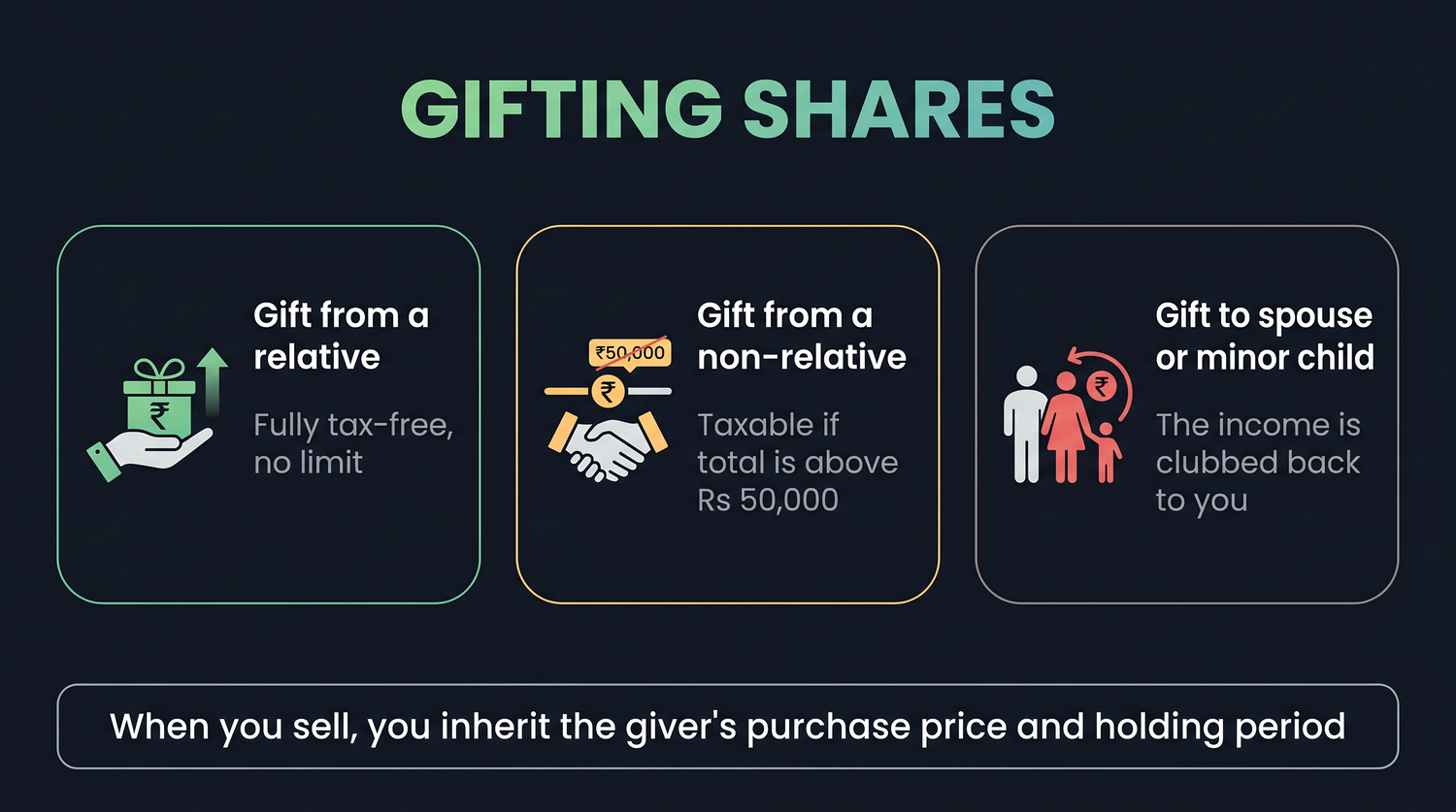
A gift of shares from a relative on the defined list, such as a parent, child, spouse, sibling or grandparent, is fully tax-free for the receiver, with no upper limit. Family transfers within this list do not attract gift tax.
Gifts from non-relatives: the Rs 50,000 line
Now the rule for everyone outside that family list, which the law calls non-relatives. Here a threshold appears. If the total value of gifts you receive from non-relatives in a financial year is more than Rs 50,000, the whole amount becomes taxable in your hands as income from other sources, taxed at your slab rate.
Read that carefully, because the trap is in the wording. The Rs 50,000 is not an exemption that is always free. Once the total crosses Rs 50,000, the entire sum is taxed, not merely the part above the threshold. This sits under Section 56(2)(x) of the law.
Picture it with a quick figure. A friend, who is not a relative, gifts you shares worth Rs 60,000. Because the total from non-relatives has crossed Rs 50,000, the whole Rs 60,000 is taxable as your income from other sources, not just the Rs 10,000 above the line. Had the gift been Rs 50,000 or less, and nothing else came from non-relatives that year, it would have been fully tax-free. A small Rs 1,000 of extra value can flip the entire amount into the taxable column, which is why the threshold deserves real care.
The Rs 50,000 figure is a cliff, not a free allowance. Cross it with gifts from non-relatives and the full amount is taxed, from the first rupee. The threshold also adds up all non-relative gifts in the year, so several small gifts can quietly breach it together.
The donor's cost and holding period carry over
So Mr. Mehta gifts shares to his son, and years later the son sells them. How is the son's capital gain worked out? This is where a neat and very fair rule applies. When you receive shares as a gift, you inherit the donor's original purchase price as your cost, and you inherit the donor's holding period as well.
In plain words, it is as if the clock and the cost simply continue from the giver. The son does not get to reset the purchase price to the market value on the day of the gift. He uses what his father actually paid, and he counts the years from when his father bought, not from the day he received the gift.
Mr. Mehta bought shares for Rs 1,00,000 and held them for three years. He gifts them to his son. Eighteen months later the son sells them for Rs 1,80,000.
The son's cost is his father's cost, which is Rs 1,00,000. His gain is 1,80,000 minus 1,00,000, which equals Rs 80,000.
For the holding period, the son adds his father's three years to his own eighteen months. The combined holding comfortably exceeds twelve months, so the gain is long-term, taxed at the gentler long-term rate rather than the higher short-term rate. The carryover of both cost and holding period worked in the son's favour.
This carryover is usually good news, because a long donor holding period often pushes the receiver's eventual sale into the long-term bracket. But it also means you cannot escape an old low cost simply by routing shares through a gift. The original cost follows the shares wherever they go within the family.
The clubbing trap: a gift can come back to bite you
Here is the rule the cousin half remembered, and it is the one that catches well meaning people. It is called clubbing, under Section 64. If you gift an income-producing asset to your spouse or to a minor child, the income that asset later earns is added back to your own income and taxed in your hands.
The gift of the shares itself is still tax-free, because a spouse and a child are relatives. But the dividends and the capital gains those shares go on to produce do not stay with the spouse or minor child for tax purposes. They are clubbed back into the income of the person who gave the gift. The taxman closes the obvious loophole of shifting income to a lower earning family member.
Clubbing applies to gifts to your spouse and to a minor child. The asset transfer is tax-free, but the income it earns afterwards, such as dividends and capital gains, is taxed back in the giver's hands. A gift to an adult child or to a sibling is not caught by this spouse-and-minor clubbing rule, so the income there genuinely belongs to the receiver.
Inheritance is exempt, and a family put together
One more reassuring point. Shares received under a will or on inheritance are exempt. When assets pass on the death of the owner, there is no gift tax on the person who inherits. As with a lifetime gift, the inheritor steps into the original cost and holding period when they eventually sell.
This is why old records matter so much in a family. If Mr. Mehta's grandfather had bought a holding decades ago, and it passed down by gift and then by inheritance, the very first purchase price and date still travel with those shares to whoever finally sells them. A family that loses the original contract notes can find itself unable to prove the cost, which can mean a larger taxable gain than the law actually intends. Keeping a simple folder of purchase records, and noting each transfer, is a small habit that protects everyone down the line.
Now let us put the whole family in one picture, because the contrast makes the rules stick.
Mr. Mehta makes three transfers in the same year. He gifts shares worth Rs 5,00,000 to his adult son. He gifts shares worth Rs 3,00,000 to his wife. And a family friend, a non-relative, gifts Mr. Mehta's daughter shares worth Rs 70,000.
The gift to the adult son is tax-free, because a son is a relative, and since the son is an adult there is no clubbing. Any future dividends and gains belong to the son and are taxed in the son's hands. The gift to the wife is also tax-free as a transfer, but clubbing bites. Every rupee of dividend and capital gain those shares earn afterwards is added back to Mr. Mehta's income and taxed at his rate. The Rs 70,000 the daughter received from a non-relative crosses the Rs 50,000 line, so the whole Rs 70,000 is taxable in the daughter's hands as income from other sources. Same family, same year, three completely different tax outcomes, all flowing from who gave, how much, and whether clubbing applies.
Before gifting shares, write down two things. Is the receiver a relative on the defined list, and could clubbing apply because the receiver is your spouse or a minor child. Keep the donor's original purchase contract notes safely, because the receiver will need that cost and that date to compute the gain on a future sale. A chartered accountant can confirm the relative status and the clubbing position in tricky cases.
The shape to remember is small. Gifts from relatives are free without limit. Gifts from non-relatives are taxed in full once they cross Rs 50,000 in a year. The receiver inherits the donor's cost and holding period. Gifts to a spouse or minor child bring the future income back to the giver through clubbing. And inheritance is exempt. Hold those five points and you can plan family transfers with confidence rather than fear.
This chapter is educational only and not tax advice. The definitions, thresholds and clubbing provisions can change, so confirm your specific plan with a qualified chartered accountant before you act.