
F&O Losses: Set-Off and Carry-Forward
A losing year can still save you tax, if you handle it right. Learn how F&O losses offset almost any other income, how unused losses carry forward for eight years, and the one condition you must meet to keep that right.
- ·Set-off against most income
- ·The salary exception
- ·Carry-forward for eight years
- ·File on time or lose it
- ·Only against business income later
- ·A worked set-off example
Ravi had a rough year in the futures and options market. After a confident start, a string of trades went the wrong way and he closed the year down about Rs 5,00,000. His first instinct was the one almost every trader has. Forget about it, the year is over, there is nothing to gain by writing a loss into a tax return. That instinct is exactly backwards. In Indian tax law a trading loss is not just a sad number you would rather not see again. It is something closer to an asset. Handled correctly, it can lower the tax on your other income this very year, and any leftover can keep working for you for years to come. This chapter shows you how that works, in plain steps and with real rupee figures.
What "set-off" actually means
Set-off is a simple idea wrapped in a formal word. It means using a loss from one source to cancel out income from another, so that you pay tax only on what is left over. If you earned Rs 2,00,000 from one activity and lost Rs 80,000 in another, set-off lets you be taxed on the net figure of Rs 1,20,000 rather than the full Rs 2,00,000.
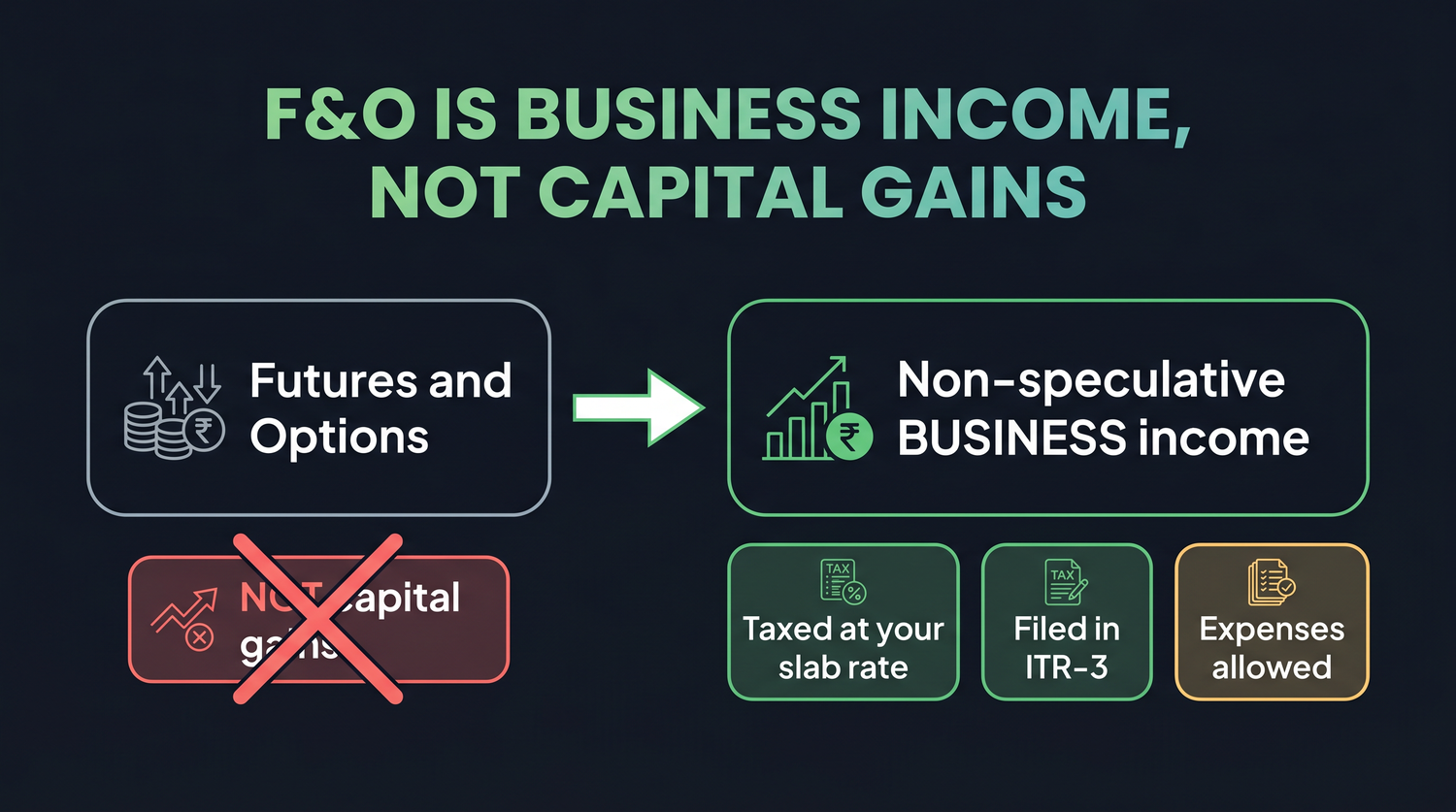
Your income is sorted by the tax law into separate "heads". The main ones are salary, house property (your rental income), business or profession, capital gains, and income from other sources (such as bank interest and dividends). F&O trading sits under business or profession, because F&O is treated as non-speculative business income, not as capital gains. That classification is what makes the set-off rules generous.
As things stand for AY 2026-27, a current-year F&O loss can be set off against income under almost every other head. There is one important exception, and it is worth memorising.
A current-year F&O loss can be set off against most of your income, with one big exception: it can never be set off against your salary. Rental income, interest, dividends, capital gains and other business profits are all fair game.
The one income a loss cannot touch: salary
Here is the table to keep in your head. It shows where a current-year non-speculative F&O loss can and cannot go.
| Income head | Can a current-year F&O loss set off against it? |
|---|---|
| Salary | No |
| House property (your rent received) | Yes |
| Other business or profession | Yes |
| Capital gains (short-term or long-term) | Yes |
| Other sources (interest, dividends) | Yes |
Why is salary fenced off? The law deliberately keeps salary separate so that nobody can manufacture an artificial trading loss purely to wipe out the tax on a salary. A salaried person who also trades F&O therefore cannot use a bad trading year to shrink the tax already deducted from their pay. The salary stands on its own and is taxed in full. Everything else on the list above, though, is open to set-off.
This is genuinely good news for most traders. If you also earn rent, or you hold a fixed deposit that pays interest, or you booked some capital gains on shares this year, a current-year F&O loss can quietly reduce the tax on all of those.
A worked set-off example
Let us put Ravi's full year on the table. Alongside his F&O loss of Rs 5,00,000, he also earned a salary, collected rent from a small flat, and earned interest on his fixed deposits.
| What Ravi earned or lost this year | Amount |
|---|---|
| Salary | Rs 8,00,000 |
| Rental income (house property) | Rs 2,00,000 |
| Fixed deposit interest (other sources) | Rs 1,00,000 |
| F&O loss (business) | minus Rs 5,00,000 |
Now apply the rule. Ravi's F&O loss of Rs 5,00,000 cannot touch his salary of Rs 8,00,000, so that stays taxable in full. But the loss can be set off against his rent and his interest. The rent of Rs 2,00,000 plus the interest of Rs 1,00,000 comes to Rs 3,00,000 of income that the loss is allowed to cancel.
Ravi's F&O loss is Rs 5,00,000. He sets off Rs 2,00,000 against rent and Rs 1,00,000 against interest, which uses up Rs 3,00,000 of the loss. His rent and interest income for the year now become zero. The loss that remains is Rs 5,00,000 minus Rs 3,00,000, which equals Rs 2,00,000. His salary of Rs 8,00,000 stays fully taxable, untouched by the loss.
So in one stroke, Ravi has wiped out the tax on Rs 3,00,000 of rent and interest. That is real money saved this year. And he still has Rs 2,00,000 of unused loss sitting in his pocket. The next section is about what happens to that leftover, and it is where one small mistake can throw the whole benefit away.
Carry forward: eight years, but only if you file on time
When a loss is bigger than the income you can set it off against this year, the unused part is not lost. It is carried forward to future years. A non-speculative business loss, which is what F&O is, can be carried forward for up to eight assessment years. So Ravi's leftover Rs 2,00,000 can travel forward and reduce his tax in a future year when his trading is profitable again.
But there is a condition that catches people out every single year, and it is unforgiving.
You only get to carry a loss forward if you file your income tax return on time, by the original due date under Section 139(1). File even one day late and the carry-forward is gone. The loss simply vanishes for future use. Filing on time is the single cheapest insurance a trader can buy.
Notice how this changes the maths. If Ravi files on time, his Rs 2,00,000 loss waits patiently for up to eight years and can save him tax later. If Ravi files late, that same Rs 2,00,000 is forfeited forever. Same trader, same loss, two completely different outcomes, decided by nothing more than a filing date. The current-year set-off against his rent and interest is still allowed even with a late return, but the future-year benefit is the part you lose by filing late.
What a carried-forward loss can do next year
There is one more twist, and it surprises people. The current-year rule is generous: this year, the F&O loss could reach across to rent, interest, capital gains and other business income. But once a business loss is carried forward into a later year, it becomes narrower. A carried-forward business loss can be set off only against business income in those future years.
So next year, Ravi's carried-forward Rs 2,00,000 cannot be used against his rent or his interest. It can only reduce profit from a business, most naturally his F&O trading itself if he has a good year. Here is the contrast in one place.
| When the loss is used | What it can be set off against |
|---|---|
| In the current year (the year of the loss) | Most heads, including rent, interest, dividends and capital gains, but never salary |
| In a future year (carried forward) | Only business income, such as future F&O or other business profits |
The logic is worth understanding. In the year you make the loss, the law lets it spread widely. Once it is carried forward, it is "earmarked" for business income only. So the best home for a carried-forward F&O loss is a future profitable trading year.
Suppose next year Ravi turns things around and makes an F&O profit of Rs 3,00,000. He first sets off his carried-forward loss of Rs 2,00,000 against it. Only the remaining Rs 1,00,000 of profit is taxed. That is the carry-forward paying him back, two years after the painful loss that created it.
Two habits protect this benefit completely. First, file your return by the due date every year without fail, even in a loss year, because that is what keeps the carry-forward alive. Second, keep your broker's tax profit and loss statement and your turnover report safely, because that is the proof of the loss you are carrying forward.
The takeaway for a bad year
A losing F&O year feels like pure pain, but the tax system quietly hands you two consolations. This year, the loss can shrink the tax on most of your other income, with salary the only thing it cannot touch. And whatever is left over can be carried forward for up to eight years to cushion a future profitable year, as long as you file on time. Ravi's Rs 5,00,000 loss did real work: it erased the tax on Rs 3,00,000 of rent and interest now, and parked Rs 2,00,000 to soften a better year ahead. The one thing he had to do to keep all of this was the most basic thing of all, which was to file his return, and file it on time.
This chapter is for learning only and is not personal tax advice. Tax rules and rates change from year to year, so please confirm your set-off and carry-forward position with a qualified chartered accountant before you file.