
Rights, FPO, OFS, Bonus & Splits
Listed companies keep raising money and rewarding shareholders. Decode rights issues, FPOs, OFS, bonus shares, stock splits and buybacks, and what each does to the price.
- ·Rights issue vs FPO
- ·Offer for sale (OFS)
- ·Bonus shares & splits
- ·Buybacks
- ·Dividends
- ·Price adjustments explained
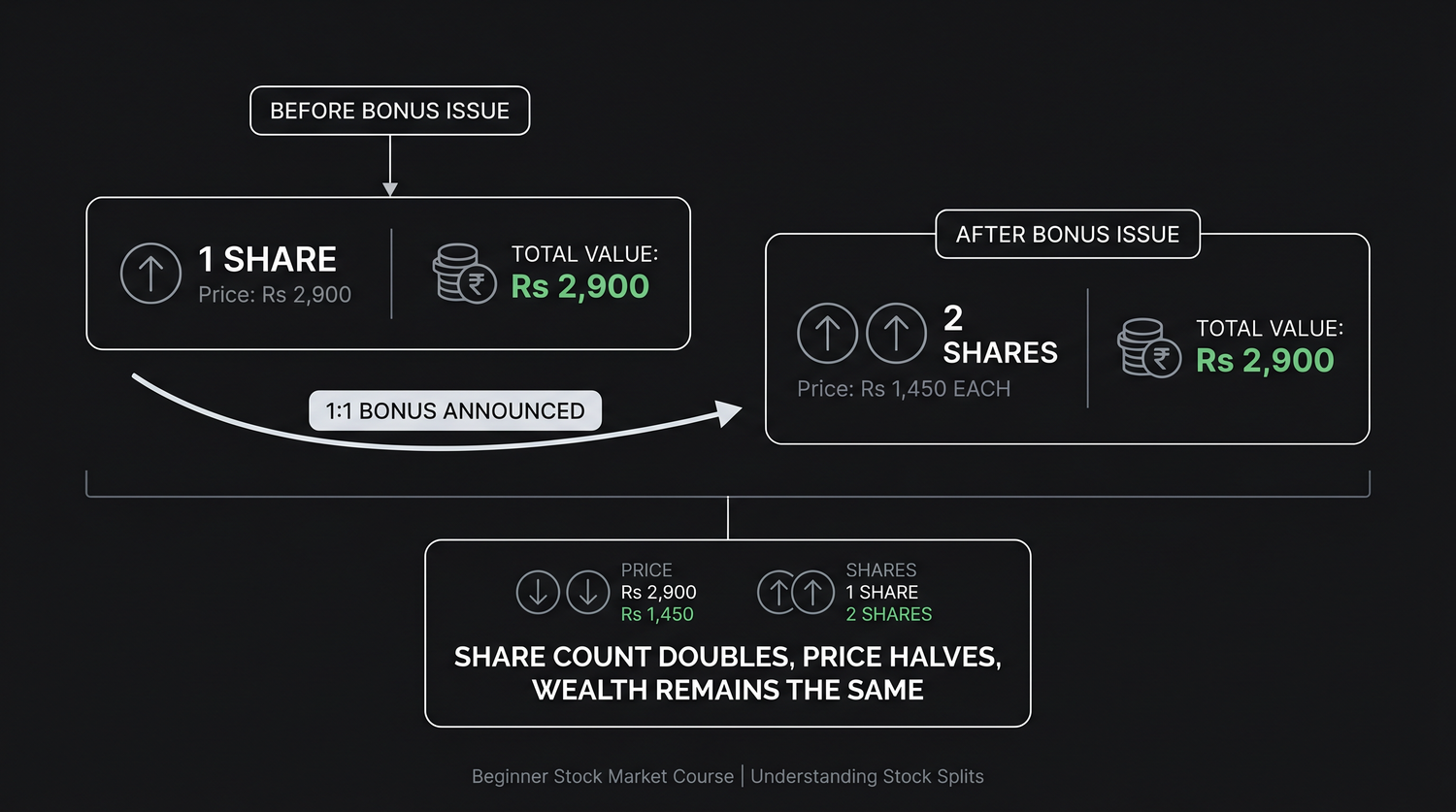
Imagine you open your portfolio one morning and a stock you own, say it closed near Rs 2,900 yesterday, is suddenly showing around Rs 1,450. Your stomach drops. Did the company collapse overnight? Did you lose half your money? Almost certainly not. What you are looking at is a corporate action, a bonus issue, in this case, and your wealth is exactly the same as it was last night. You simply own twice as many shares at half the price.
This single misunderstanding scares more beginners out of good stocks than any real bad news ever does. Listed companies are constantly doing things to their shares: raising fresh money, returning cash, splitting their stock, handing out freebies. This chapter decodes every common corporate action, and, most importantly, shows you why the price changes are usually nothing to panic about.
Two families of corporate action
Everything in this chapter falls into one of two buckets:
- Raising more money, the company (or its big shareholders) need capital: rights issue, FPO, OFS.
- Rewarding or reshaping, the company returns value or rejigs its share count: dividends, bonus, stock split, buyback.
Let us take them in turn.
Raising more money
Rights issue
A rights issue offers new shares to existing shareholders, usually at a discount to the market price, in a fixed ratio. A "1:5 rights at Rs 200" means for every 5 shares you hold you may buy 1 new share at Rs 200 (even if the market price is Rs 300). You are being given the first right to keep your ownership from shrinking.
You are not forced to buy. If you do not want the new shares, your rights entitlement can be sold on the exchange to someone else (it trades as a separate temporary ticker), so the right itself has value. If you simply ignore it, your stake gets slightly diluted.
FPO (Follow-on / Further Public Offer)
An FPO is like a second IPO: an already-listed company issues fresh shares to everyone in the market to raise more capital. Unlike a rights issue, it is open to the general public, not just current holders.
Vodafone Idea's 2024 FPO raised about Rs 18,000 crore, the largest follow-on offer in Indian history. The year before, Adani Enterprises launched an even bigger Rs 20,000 crore FPO, saw it fully subscribed, then cancelled it and returned every rupee after the stock crashed amid the Hindenburg report. Even completed, subscribed offers can be called off.
OFS (Offer for Sale)
In an OFS, large existing shareholders, promoters, the government, early investors, sell their shares to the public through the exchange. No new shares are created, and the company itself receives nothing; the money goes to the seller. The government routinely uses OFS to trim its stake in public-sector companies, often with a small discount for retail applicants. Because no new shares are minted, an OFS does not dilute existing holders the way a fresh issue does, it just transfers ownership.
Rewarding and reshaping
Dividends
A dividend is a slice of the company's profit paid out in cash, usually a few rupees per share. To know who gets it, the company sets a record date: you must own the share before the ex-dividend date (the cut-off) to be eligible. Under India's current T+1 settlement, the ex-date and record date typically fall on the same day, so the simple rule is: buy at least a day before the ex-date to receive the dividend.
On the ex-date, the share price usually opens lower by roughly the dividend amount, because the cash is about to leave the company. A Rs 1,000 stock paying a Rs 10 dividend tends to open near Rs 990. You did not lose Rs 10; it just moved from the share price into your bank account.
Bonus shares
A bonus issue gives existing shareholders free extra shares from the company's accumulated reserves, in a ratio like 1:1 (one free share for each held). No money changes hands. The total value of the company has not changed, so the price adjusts down proportionally.
Stock split
A stock split divides each share into several. The company reduces the face value, say from Rs 10 to Rs 1, and one share becomes ten, with the price dropping to a tenth. It is purely cosmetic, often done to make a high-priced share look more affordable and trade more actively.
Buyback
A buyback is the opposite of a fresh issue: the company uses its own cash to buy back and cancel its shares, usually at a premium, either through a tender offer (you offer your shares back) or open-market purchases. Fewer shares remain, so each surviving share represents a slightly bigger slice of the company.
Since 1 October 2024, the tax rules on buybacks changed: the money you receive in a buyback is now taxed in your hands as deemed dividend income, rather than being tax-free at the shareholder level as before. Buybacks are still a genuine way for companies to return cash, just no longer a tax shortcut.
The part that scares beginners: the price "falls" but you don't lose
This is the most important idea in the chapter, so let us make it concrete with a real example. In October 2024, Reliance Industries did a 1:1 bonus, one free share for each one held.
Suppose you owned 10 shares at Rs 2,900 the evening before. Your holding was worth Rs 29,000.
| Before bonus | After 1:1 bonus | |
|---|---|---|
| Shares you own | 10 | 20 |
| Price per share | Rs 2,900 | Rs 1,450 |
| Total value | Rs 29,000 | Rs 29,000 |
Your shares doubled, the price halved, and your wealth did not move by a single rupee. A stock split works identically, more shares, proportionally lower price, same total. A dividend is the same idea with the value handed to you as cash instead of extra shares.
Bonus, split and dividend do not make you richer or poorer on the day they happen, they only change the form of what you own. The screen shows a lower price because the exchange automatically adjusts it; your past purchase price and charts are adjusted too. Seeing "Rs 1,450" where "Rs 2,900" used to be is normal arithmetic, not a crash.
Why do companies bother, then? Bonuses and splits lower the per-share price, which can widen the pool of buyers and improve trading activity, and they signal management's confidence in future earnings. They do not create value out of thin air, but a more liquid, more accessible stock is a perfectly good outcome.
Every corporate action at a glance
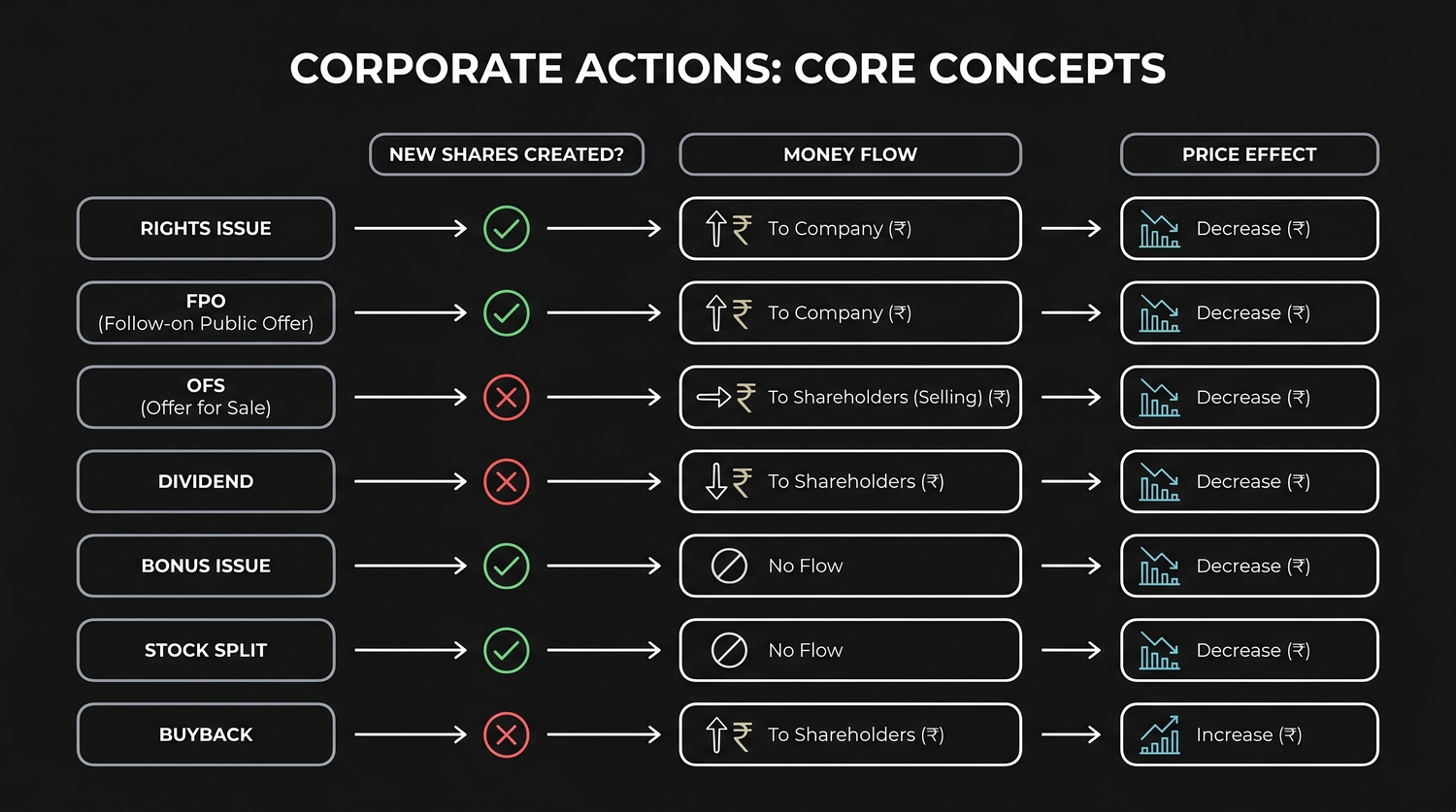
| Action | What it is | Effect on share count | Effect on price | Effect on your wealth |
|---|---|---|---|---|
| Rights issue | New shares offered to existing holders at a discount | More (if you subscribe) | Adjusts down slightly (ex-rights) | Neutral; you pay for the new shares |
| FPO | New shares sold to the public | More (total) | Can dip on dilution | Slight dilution unless you buy |
| OFS | Large holders sell existing shares | No change | Short-term pressure | No dilution |
| Dividend | Cash paid from profits | No change | Drops by dividend on ex-date | Neutral (value moves to cash) |
| Bonus | Free extra shares in a ratio | Up | Falls proportionally | Unchanged |
| Stock split | One share split into many | Up | Falls proportionally | Unchanged |
| Buyback | Company buys back its own shares | Down | Often supportive | Neutral to mildly positive |
When a stock in your portfolio gaps down sharply for no obvious reason, check the corporate actions or announcements tab before reacting. Nine times out of ten it is an ex-dividend, a bonus or a split, and the right response is to do absolutely nothing.
Quick recap
- Companies keep touching the market after listing, to raise capital (rights, FPO, OFS) or to return and reshape value (dividend, bonus, split, buyback).
- A rights issue offers discounted new shares to existing holders; an FPO sells new shares to everyone; an OFS lets big holders sell existing shares without diluting you.
- Dividends pay cash from profits; the price drops by the dividend on the ex-date, so you are no richer or poorer that day.
- Bonus and split multiply your shares and cut the price proportionally, your total wealth does not change.
- A buyback shrinks the share count by returning cash; since October 2024 the proceeds are taxed as dividend in your hands.
- The biggest beginner mistake is panicking at an adjusted price, always check the corporate-action calendar before you react.
You now understand how shares are created, distributed and reshaped. Next we turn to the screen where all of this shows up in real time, the stock quote, and decode every single number on it, from the last traded price to the five-level order book.