
Scams, Manipulation & How to Protect Yourself
From Harshad Mehta to today's WhatsApp pump-and-dumps and finfluencer traps, the famous Indian market scams, the red flags they share, and how to keep your money safe.
- ·The classic scams (Mehta, Parekh, Satyam)
- ·Pump-and-dump schemes
- ·Finfluencer & tip traps
- ·Ponzi & guaranteed-return frauds
- ·Red flags to spot
- ·How to protect yourself
Where there is money, there are people trying to take it from you cleverly. The stock market, oceans of money changing hands on trust and a screen, has always attracted brilliant, charming crooks. The good news is that almost every scam, from a 1992 mega-fraud to a 2026 Telegram tip, runs on the same handful of tricks. Learn the stories and the patterns once, and you become very hard to fool.
This final chapter tells you the big ones crisply and accurately, then turns to the frauds you will actually meet today, on WhatsApp, on YouTube, in a friend's "guaranteed return" plan. By the end you will have a simple red-flag radar and a protection checklist you can use for the rest of your investing life.
The Big Bull: Harshad Mehta (1992)
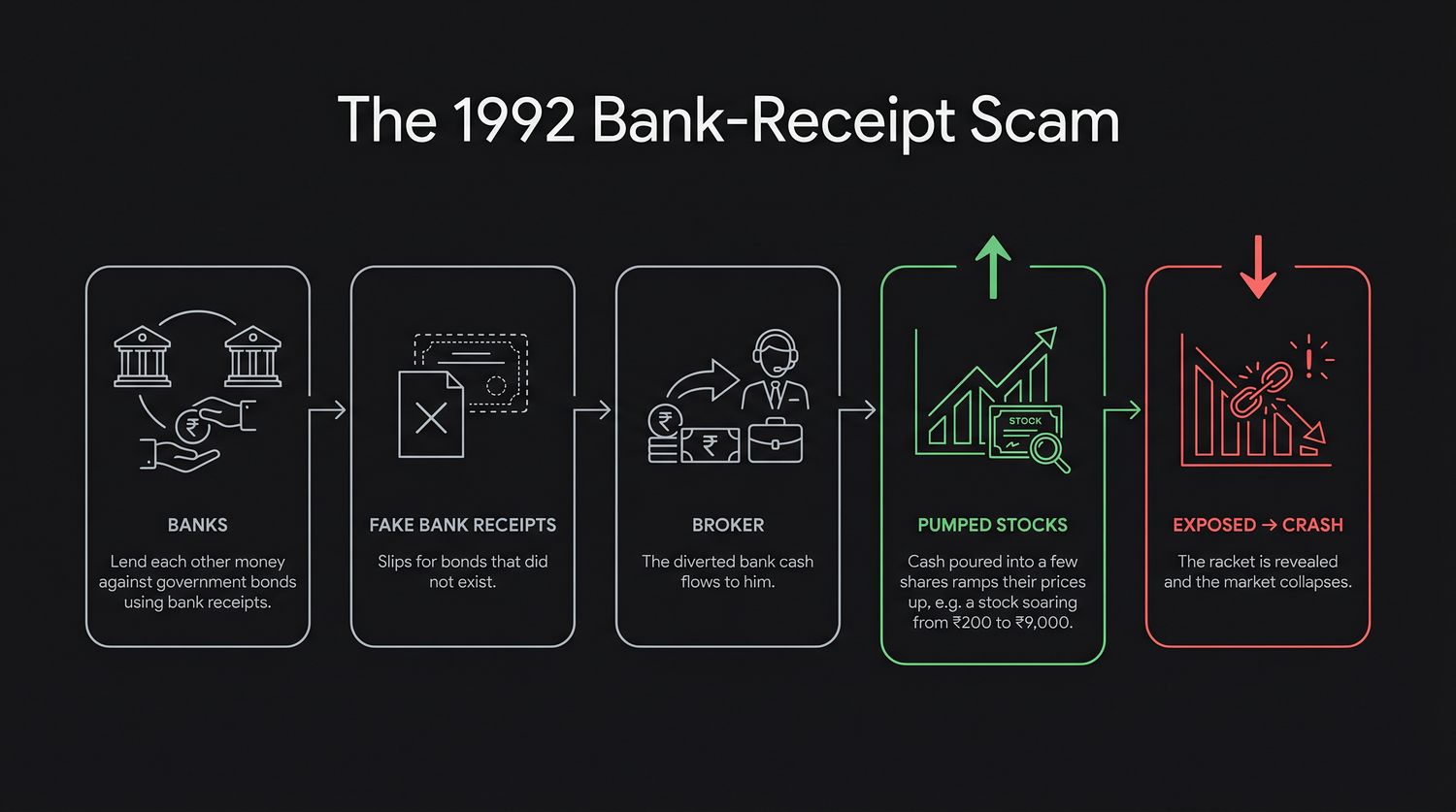
In the early 1990s, a Mumbai stockbroker named Harshad Mehta became a household name, the flashy "Big Bull" who seemed to make the market dance. His secret was not stock-picking genius. It was a hole in the banking plumbing.
Banks lent each other money short-term against government bonds, using paper slips called bank receipts (BRs) as IOUs. Mehta, sitting in the middle of these deals, arranged for banks to issue fake BRs, receipts for bonds that did not exist, and poured the cash that flowed in into a handful of stocks, ramming their prices to the sky. ACC, the cement company, reportedly rocketed from around Rs 200 to nearly Rs 9,000 in roughly a year. When journalist Sucheta Dalal exposed the racket in April 1992 the market crashed, and the scale of the irregularities was later estimated by an official committee at over Rs 4,000 crore, a staggering sum then.
At his peak, Harshad Mehta lived in a roughly 15,000-square-foot sea-facing Worli penthouse with a mini golf course, drove imported luxury cars, and once paid crores in advance tax to burnish his image. It was the lifestyle, as much as the share prices, that lured ordinary investors into believing he had a magic touch.
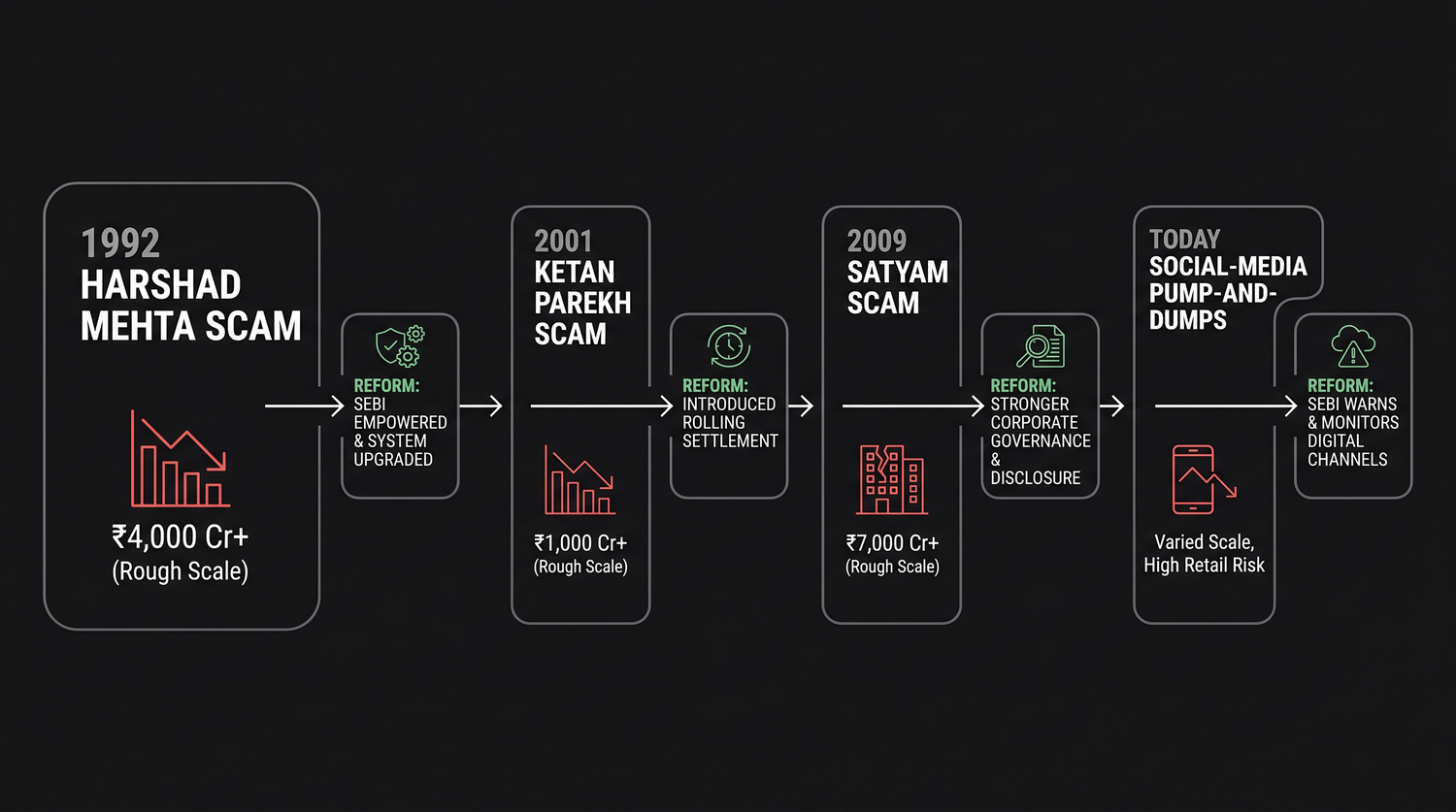
The lasting good news is what the scandal built. It shocked India into giving its market a real police force: SEBI was given statutory teeth in 1992, the National Stock Exchange (NSE) was launched soon after with fully electronic, transparent screen-based trading, and dematerialisation later moved shares out of forgeable paper and into safe electronic accounts. The very protections you rely on today exist largely because of this scam.
The Pentafour Bull: Ketan Parekh (early 2000s)
A decade later, history rhymed. Stockbroker Ketan Parekh, once close to Mehta's circle, ran a set of stocks the market nicknamed the "K-10" (names like Zee Telefilms, HFCL and others). His tool was circular trading: a ring of connected entities buying and selling the same shares among themselves to manufacture the illusion of huge demand, driving prices to absurd heights and pulling in real investors who feared missing out.
The fuel, again, was misused bank money, notably from the Madhavpura Mercantile Co-operative Bank, and links to Global Trust Bank. When the bubble burst in 2001 the K-10 stocks collapsed, the banks were gutted, and SEBI eventually barred Parekh from the markets for 14 years. The lesson: a price rocketing on no real news is often a pump, not a discovery.
India's Enron: Satyam (2009)
The first two scams manipulated prices. The Satyam fraud was darker, the founder simply invented the company's success. In January 2009, Satyam Computers chairman Ramalinga Raju confessed in a now-famous letter that the firm's books were fiction. He had inflated profits for years and fabricated roughly Rs 7,000+ crore, including about Rs 5,000 crore of cash that did not exist, cash that auditors had cheerfully signed off on.
To manufacture fake revenue, Satyam created over 7,500 bogus invoices for work never done, and its payroll carried an estimated 13,000 "ghost employees", people who never existed, drawing salaries that were quietly siphoned off. It earned the company a grim nickname: "India's Enron."
Shareholders were wiped out almost overnight. But once more the system learned: corporate-governance and auditing rules were tightened, the role and accountability of independent directors and auditors came under hard scrutiny, and India later overhauled its company law. Satyam itself was rescued through an open auction and absorbed by another firm.
When the plumbing fails: NSEL and Karvy
Two more recent cases show that scams are not only about price-rigging, sometimes the institution you trust simply misuses your money.
In 2013, the National Spot Exchange (NSEL) abruptly froze trading, revealing a payment default of about Rs 5,600 crore. It had offered "paired contracts" dressed up as spot commodity trades, supposedly backed by goods in warehouses, except in many cases the goods barely existed. Thousands of investors chasing assured-looking returns were left stranded.
In 2019, Karvy Stock Broking was caught misusing the power of attorney clients had signed for routine trading. It quietly pledged its clients' own shares to borrow over Rs 2,000 crore for itself, hitting an estimated 95,000 investors who had no idea their holdings were collateral. SEBI then permanently tightened the rules so brokers can no longer pool or pledge client securities this way, and your shares now sit far more safely in your own demat account.
| Scam | Year | What happened (approx.) | What changed |
|---|---|---|---|
| Harshad Mehta | 1992 | Fake bank receipts funded a ~Rs 4,000+ crore stock ramp; market crashed | SEBI empowered; NSE and electronic trading launched; demat begun |
| Ketan Parekh | 2001 | "K-10" stocks pumped via circular trading on misused bank money | Tighter surveillance; Parekh banned 14 years |
| Satyam | 2009 | Founder faked ~Rs 7,000+ crore of profits and cash; "India's Enron" | Stronger auditing and corporate-governance rules |
| NSEL | 2013 | ~Rs 5,600 crore default on commodity contracts with no real goods | Spot-exchange oversight overhauled |
| Karvy | 2019 | Broker pledged ~Rs 2,000 crore of clients' shares without consent | Client securities ring-fenced; pledge rules tightened |
The new playground: scams you'll actually meet today
You are unlikely to be conned by a fake bank receipt. You are very likely to be targeted on your phone. The classic frauds went big and loud; the modern ones come to you personally, look friendly, and are tuned to the exact emotions from the last chapter.
Pump-and-dump on WhatsApp and Telegram
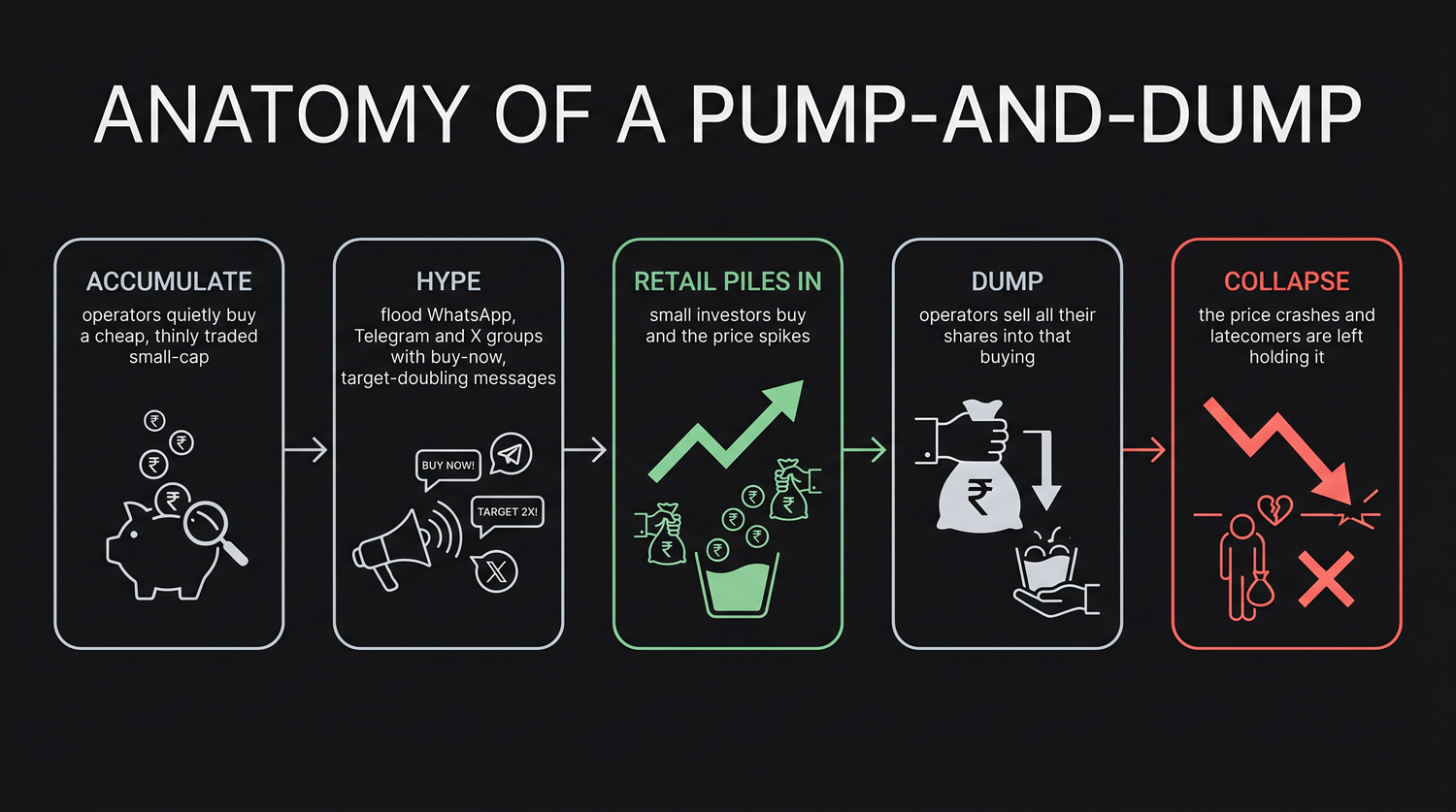
This is the Ketan Parekh playbook, democratised. Operators quietly buy a cheap, thinly traded small-cap, then flood WhatsApp, Telegram and X groups with breathless "buy now, target doubling" messages. Small investors pile in, the price spikes, and the operators dump their shares into that buying, leaving everyone else holding a stock that collapses. SEBI has cracked down repeatedly: in cases around 2024-2026 it has impounded crores in illegal gains, penalised Telegram-driven schemes such as the Darshan Orna case, and barred operators who rigged dozens of scrips. If a stranger in a group is handing out free riches, you are not the guest, you are the meal.
Finfluencers and fake "tips"
Social media overflows with confident "experts", finfluencers, promising riches through paid courses, premium tip channels and "guaranteed multibagger" calls. Most are not registered with SEBI to give investment advice, and many are quietly paid to promote the very stocks they push. Recognising the danger, SEBI tightened the rules in 2024: registered brokers and advisers are now barred from associating with unregistered finfluencers, and genuine educators may not give live buy/sell calls. Education is fine. A stranger telling you exactly what to buy, for a fee, usually is not.
Know your advisers: RA, RIA, and the fakes
Not everyone who talks about stocks is allowed to advise you, and the difference matters. SEBI registers two kinds of genuine professional:
- A Research Analyst (RA) is registered to publish research, reports and buy / sell / hold recommendations on stocks, with disclosures. They analyse and call; they do not manage your personal money.
- A Registered Investment Adviser (RIA) is registered to give personalised investment advice for a fee, and is bound by a fiduciary duty, a legal obligation to put your interest first. A genuine RIA is fee-only and does not pocket hidden commissions for pushing products.
Both carry a SEBI registration number you can look up on sebi.gov.in. The test of a real adviser is simple: registered, upfront about conflicts, and never promising guaranteed returns.
A fake advisory is anyone charging for tips or "advice" without that registration, the Telegram "research" channel, the WhatsApp "SEBI-approved" tipster, the app guaranteeing 30% a month. Giving paid investment advice without SEBI registration is illegal, and these operators are usually the same crowd behind the pump-and-dumps and Ponzi schemes in this chapter. Before you pay anyone for advice, look up their registration number yourself. If there isn't one, that is your answer.
Fake apps and guaranteed-return Ponzi schemes
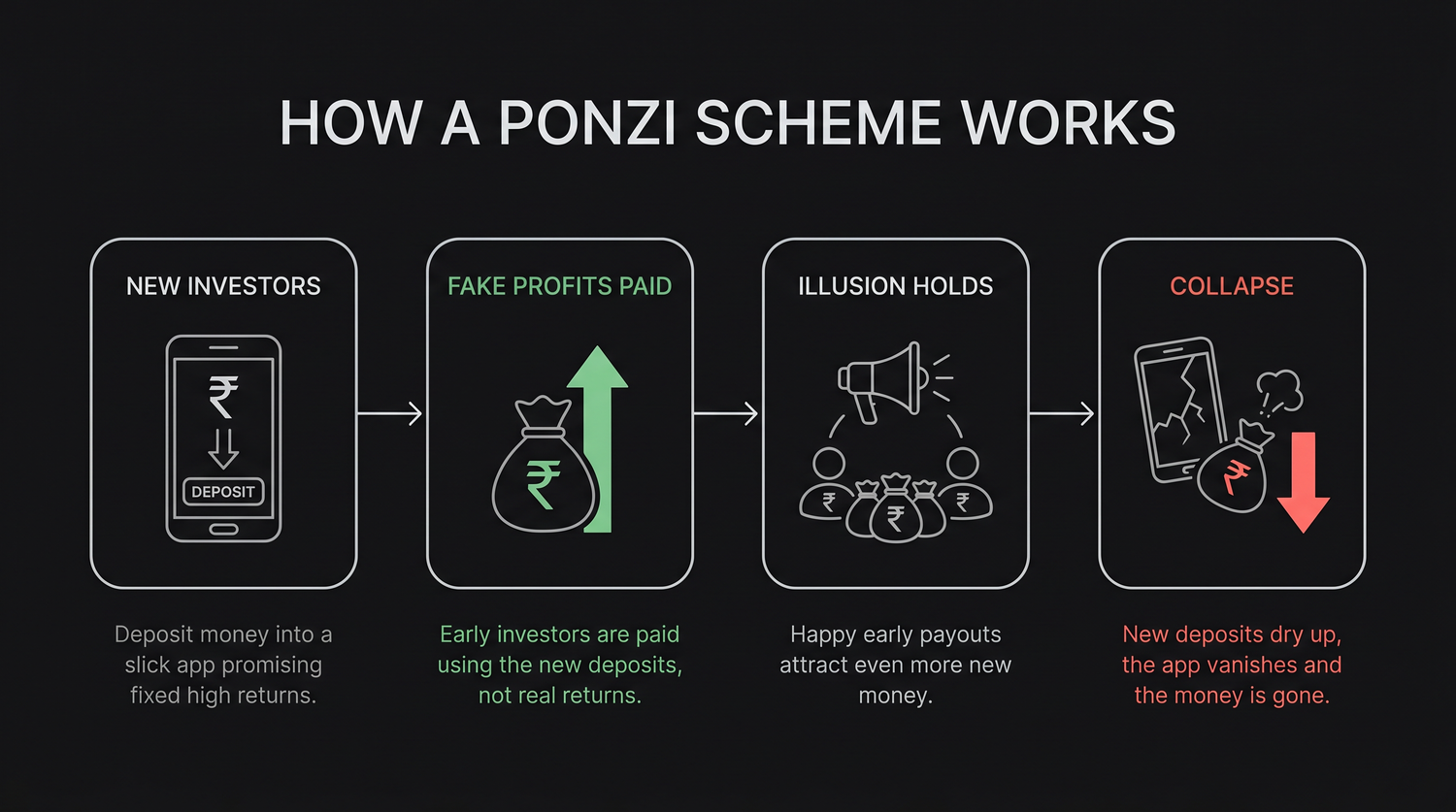
A polished app shows your "investment" growing 5% every week. Early withdrawals work perfectly, because they are paid out of new victims' deposits, the signature of a Ponzi scheme. Then one day the app vanishes, the admin goes silent, and the money is gone. These often arrive via a friend (who was also fooled), a dating-app contact, or a slick "platform" not connected to any real exchange at all.
Dabba trading
Finally, an old illegal trade with a modern face: dabba (box) trading. A shady operator lets you "trade" off the books, no real order ever reaches NSE or BSE; it is all an entry in his private ledger, often with reckless leverage and "no tax, no paperwork." It is a criminal offence under the Securities Contracts (Regulation) Act, carrying up to 10 years' jail or heavy fines. And because no real trade exists, if the operator vanishes with your money, you have no legal protection whatsoever.
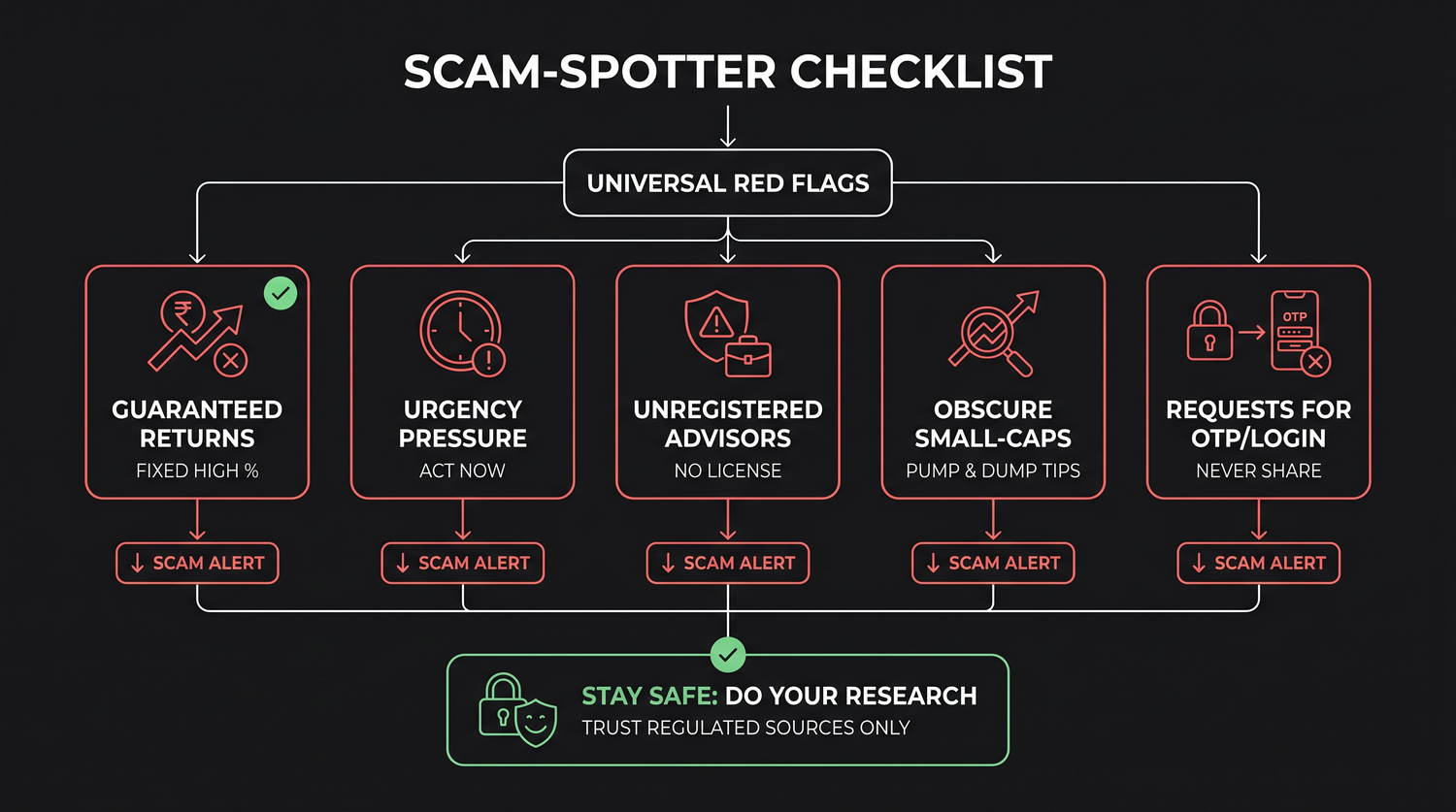
The red flags they all share
Strip away the era and the technology, and every one of these frauds waves the same flags. If you see even one, stop.
- Guaranteed, fixed or "risk-free" high returns. Real markets never guarantee returns. This is the single biggest tell.
- Pressure to act now, "offer closes tonight," "only 10 seats left." Urgency exists to switch off your thinking.
- Unregistered advisors or platforms, anyone giving paid stock advice without a SEBI registration number.
- Hot tips on obscure, illiquid small-caps, the perfect ammunition for a pump-and-dump.
- Too-good-to-be-true, secret "insider" information, or a system that "can't lose."
- Anyone asking for your password, OTP or remote access to your account. No legitimate broker or regulator ever will.
Your protection checklist
You do not need to be cynical, just careful. A few permanent habits make you nearly fraud-proof.
Deal only with SEBI-registered intermediaries, and verify it yourself. Every legitimate broker, adviser and research analyst has a registration number listed on SEBI's official website (sebi.gov.in). If you cannot find them there, walk away, no matter how impressive their results look.
- Verify before you trust. A real registration number you can look up on the SEBI site beats any screenshot of profits.
- Use SCORES to complain. If a registered entity wrongs you, lodge a complaint on SEBI's official redressal platform, scores.sebi.gov.in, free and tracked.
- Ignore "sure-shot" tips. Treat every guaranteed call, hot WhatsApp forward and "doubling" target as a sales pitch, because it is one.
- Be sceptical of social-media tips. A confident video is not research. Ask: is this person registered, and what do they gain if I buy?
- Never share your login, password or OTP with anyone, not a "broker," not "support." Sharing an OTP is handing over the keys.
- Stay on the rails, real exchanges, real demat accounts, real contract notes. Off-market shortcuts like dabba trading have no safety net.
If something has already gone wrong, money sent to a fake app, shares moved without consent, a tip-channel that took your fee and vanished, act fast. Stop all further payments, gather screenshots and transaction records, file a complaint on SCORES for registered entities, and report financial fraud through the national cyber-crime helpline (1930) and cybercrime.gov.in. Speed matters; frozen funds can sometimes be recovered.
Where to go from here
You have come a long way, from "what is a share?" to reading a quote, understanding what moves prices, managing your own mind, and now spotting the wolves. That is genuinely most of what a confident, self-reliant investor needs. The market is not a casino and it is not a conspiracy; it is a powerful, mostly fair machine for turning patient saving into real wealth, once you know how it works and who to trust.
So keep going gently. Start small, automate your investing, stay diversified, ignore the noise, and let time and compounding do the heavy lifting they do so well. Keep learning, too, the more you understand, the calmer and harder to fool you become. When you are ready to go deeper, into technical and fundamental analysis, options, Python for traders, or algorithmic trading, OpenAlgo's other free courses are waiting at /learn.
Welcome to the market. You are no longer a beginner, you are an informed investor. Invest patiently, protect yourself fiercely, and let the years compound in your favour.