
The Stock Market, Demystified
A share is a slice of a real business. Learn what owning stock means, why companies sell it, and the difference between the primary and secondary markets.
- ·What a share really is
- ·Why companies raise equity
- ·Primary vs secondary market
- ·How you make money in stocks
- ·Shareholder rights
- ·The market as an auction
When you buy a share of Reliance or TCS, it is easy to imagine you are buying a flashing number on a screen, a kind of lottery ticket that you hope goes up. That mental picture is the root of almost every beginner mistake. The truth is far more grounded and far more reassuring: a share is a genuine, legal slice of ownership in a real business. Own one share of Reliance and you are, quite literally, a part-owner of the refineries, the petrol pumps, the Jio network and the Reliance Retail stores, a tiny owner, but a real one.
Once that clicks, the stock market stops being a mysterious gambling den and becomes something you already understand: a marketplace where people buy and sell ownership of companies. This chapter demystifies the whole thing, what you actually own, why companies sell pieces of themselves in the first place, and how the market is wired so that millions of strangers can trade these slices every second.
A share is a slice of ownership
Imagine a company is a giant pizza. To raise money, the founders cut that pizza into a fixed number of identical slices and sell some of them to the public. Each slice is a share, and the total number of slices is the company's shares outstanding. Buy one slice and you own that fraction of the whole business, its factories, its brand, its cash, its future profits.
If a company has issued 100 crore shares and you own 100 of them, you own one ten-millionth of everything the company is and will ever earn. It sounds tiny, but for a company like Reliance, worth well over Rs 15 lakh crore, even a sliver represents real value tied to a real, working enterprise.
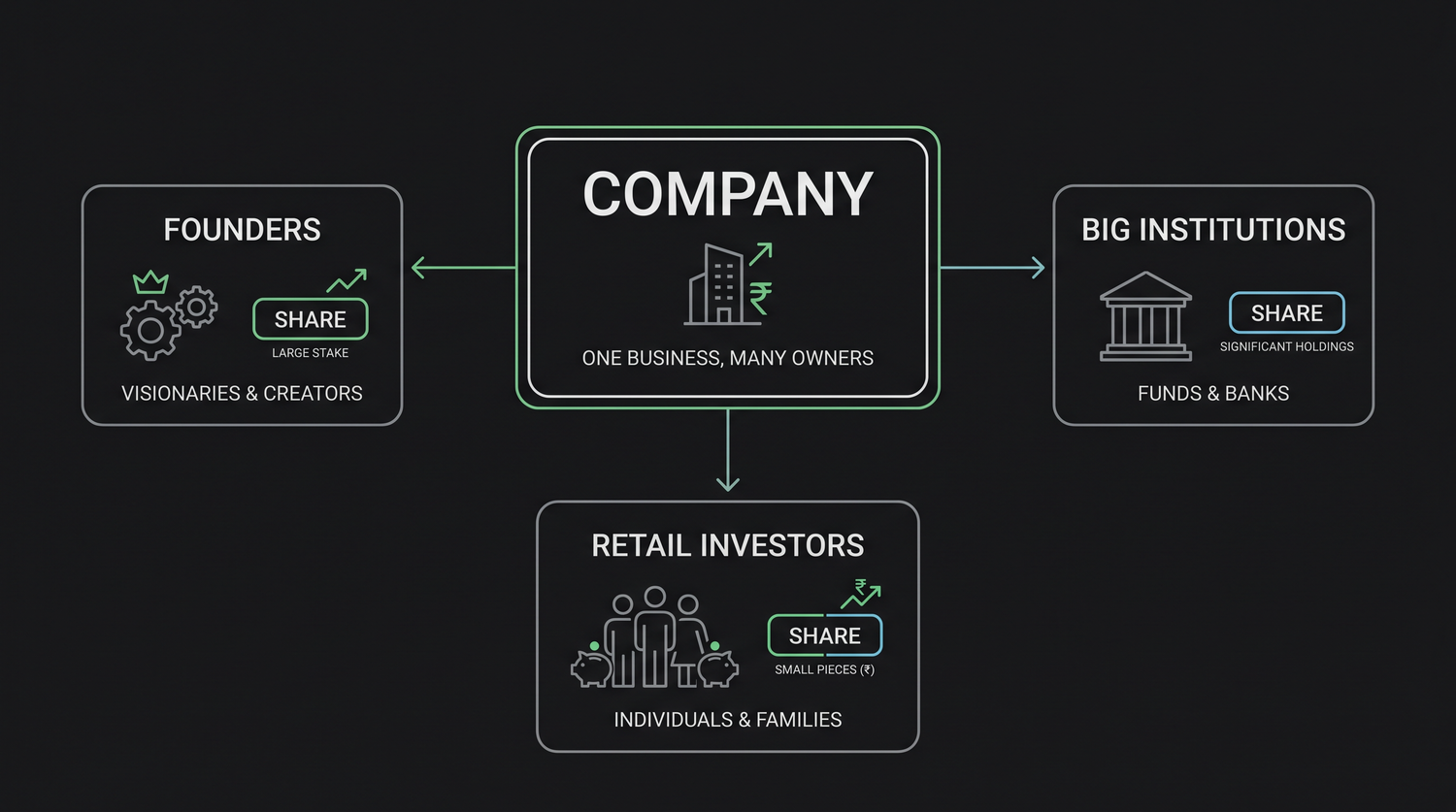
A share is not a betting slip. It is part-ownership of a company. The price moves up and down, but underneath every ticker is a real business with employees, products, customers and profits. You are not betting on a number, you are owning a piece of an enterprise.
What you actually own
Being a part-owner, a shareholder, comes with three concrete things, not just a number that wiggles.
- A claim on the profits. When a company earns money, it can hand a share of those profits back to owners as a dividend, cash paid per share, simply for owning it. A company that pays Rs 8 per share in dividends sends you Rs 800 if you hold 100 shares, win or lose on the price.
- A claim on the company's value. Your shares represent a fraction of everything the company owns after its debts. As the business grows more valuable, so does your slice.
- Voting rights. Shareholders vote on big decisions, electing directors, approving mergers, big pay packages, usually one vote per share. Own a few shares and your vote is small, but it is real, and you will receive notices to vote at the company's Annual General Meeting (AGM).
Owning even a single share makes you an official co-owner with the right to attend the AGM and question the management, in the same room, on the same legal footing, as billionaire investors. Reliance Industries has over 35 lakh individual shareholders; a school student with one share is, on paper, as much an owner as any of them.
Why companies sell pieces of themselves
Here is the natural question: if a business is good, why would its founders sell ownership to strangers at all? The answer is money to grow.
Suppose a company wants to build a new factory costing Rs 500 crore. It has two ways to raise that money:
- Borrow it (debt). Take a loan and repay it with interest, whether business is good or bad. Miss the payments and the lender can drag the company to bankruptcy. Debt is a heavy, fixed obligation.
- Sell ownership (equity). Issue new shares and sell them to investors. The company gets the cash and never has to pay it back. In return, the new shareholders own a piece of the business and share in its future profits.
Equity is powerful precisely because it is not a loan. There is no interest, no repayment deadline, no risk of default. The company simply takes on new co-owners who win when it wins. This is why nearly every large company you know, from Infosys to Zomato, eventually raises money by selling equity.
Selling equity does have a cost: dilution. Each new share issued means the existing owners' slice of the pizza gets a little thinner. Founders accept this because owning a smaller slice of a much bigger, faster-growing company is worth more than a big slice of a tiny one.
Primary market vs secondary market
This is where most beginners get confused, so let us make it simple. There are two distinct stages, and they are easy to mix up.
The primary market is where shares are born. The company itself sells brand-new shares directly to investors and pockets the money. The classic example is an IPO (Initial Public Offering), the first time a company offers its shares to the public. In the primary market, the cash flows to the company and is used to grow the business.
The secondary market is where those existing shares are traded afterwards, investor to investor. This is the stock exchange (the NSE and BSE) that you see on the news. When you buy 10 shares of TCS today, you are not giving money to TCS; you are buying them from another investor who wants to sell. TCS gets nothing from that trade, the money flows between two investors.
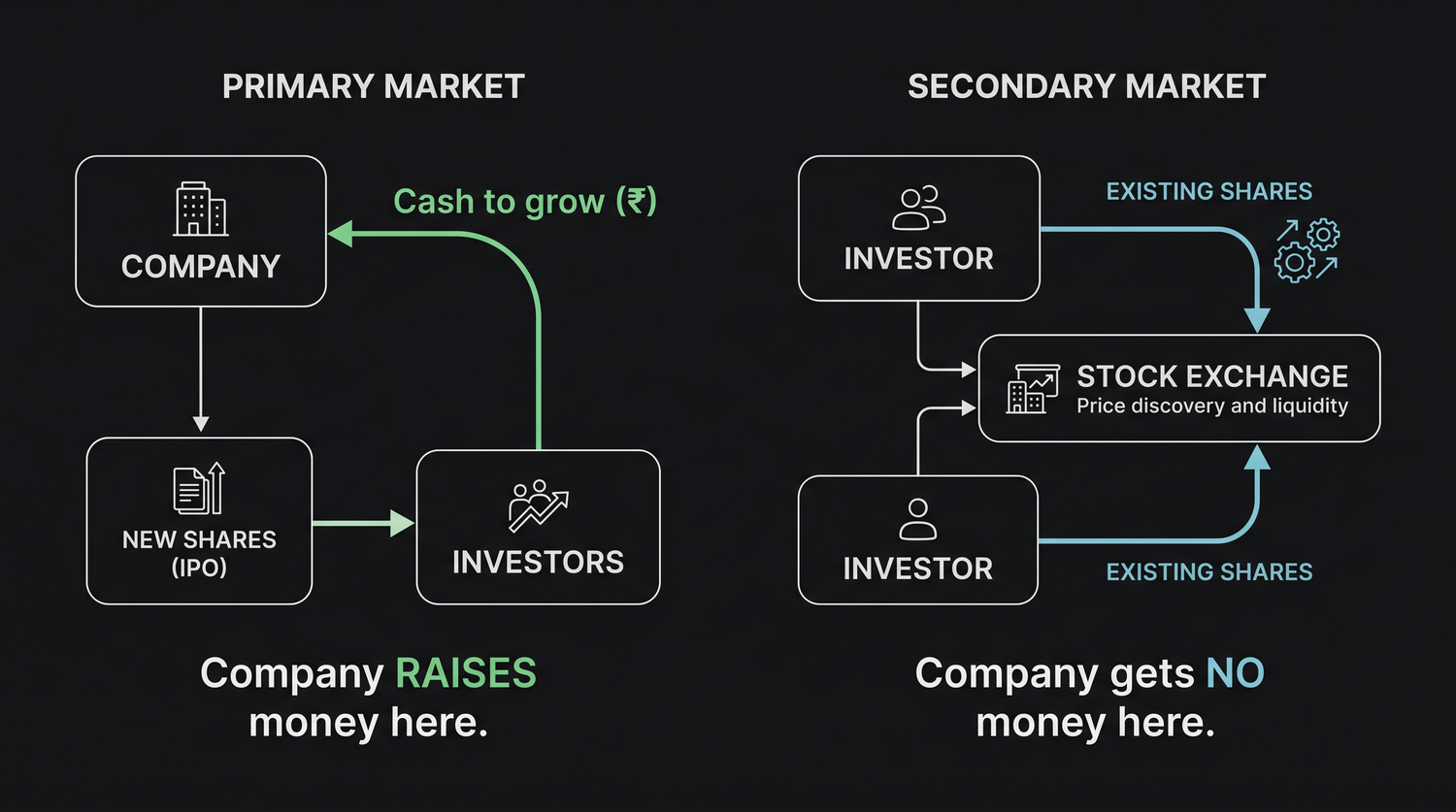
Think of a car. The primary market is the showroom: you buy a brand-new car and the money goes to the manufacturer. The secondary market is the used-car market: you buy that same car from its previous owner later, the manufacturer gets nothing from the resale. A company's IPO is the showroom; daily stock trading is the bustling used-car bazaar.
Why does the secondary market matter so much? Because without it, nobody would buy shares in the first place. The ability to sell your slice whenever you want, to turn ownership back into cash in seconds, is what makes investing in companies practical. The secondary market provides that crucial ingredient: liquidity.
How you actually make money
As a shareholder, your money grows in two ways, and a wise investor cares about both:
- Price appreciation (capital gains). Buy a share at Rs 500 and sell it later at Rs 800, and you keep the Rs 300 difference. As the business grows and earns more, buyers are willing to pay more for a slice of it, and the price rises. This is where the biggest long-term gains usually come from.
- Dividends. The steady stream of profit-sharing cash, paid out periodically while you simply hold the share. Some mature companies pay generous dividends; fast-growing ones often pay little and reinvest everything to grow faster.
Over a long holding period, a great business can reward you on both fronts: a rising price and a growing dividend, year after year, the twin engines of equity wealth.
The market as a giant auction
So what decides the price at any given moment? Not a committee, not the company, just supply and demand, settled continuously like an auction. At every instant, some people want to buy a share and others want to sell it. The price is simply the level where a willing buyer and a willing seller agree to do business right now.
If more people want to buy TCS than sell it, buyers nudge their offers up and the price rises. If sellers outnumber buyers, the price slips. The flashing number you see is nothing more than the latest agreed price between a buyer and a seller, the market's running verdict on what a slice of that business is worth this second.
India's most expensive stock, MRF, has traded above Rs 1,50,000 for a single share, more than the price of many two-wheelers. The company has simply never split its shares into smaller, cheaper units, so one slice of its pizza stays famously large.
Quick recap
- A share is a real, legal slice of ownership in a company, not a lottery ticket or a flashing number.
- As a shareholder you own a fraction of the business and get a claim on profits (dividends), a claim on its value, and voting rights.
- Companies sell equity to raise money they never have to repay, unlike a loan, there is no interest or default risk, only new co-owners.
- The primary market is where new shares are born (the IPO; cash goes to the company); the secondary market is where investors trade existing shares among themselves.
- You make money two ways: price appreciation as the business grows, and dividends paid while you hold.
- Prices move like a continuous auction, the latest number is simply where a buyer and a seller just agreed.
You now understand what you are buying and where. Next, we meet the referees who make this whole marketplace trustworthy, SEBI, the RBI and the rules that protect every investor, born from the scandals of the past.