
Bull, Bear & the Jargon You'll Hear
A friendly glossary of the words thrown around on business TV, bull and bear, large/mid/small-cap, circuits, volume, and how short selling works.
- ·Bull vs bear markets
- ·Large, mid & small cap
- ·Upper & lower circuits
- ·Long vs short
- ·How short selling works
- ·Common TV jargon
Every field has its own slang, and the stock market may be the worst offender of all. Switch on a business channel during market hours and you will be hit with a wall of words, "the bulls are back," "small-caps got hammered," "it hit the upper circuit," "FIIs went short", delivered at speed, as if everyone watching already knows what they mean. For a beginner it can feel like walking into a room where everyone is speaking a private code.
This chapter is your decoder ring. None of these terms are hard once someone defines them in plain English, and by the end you will understand the words that get thrown around the most, including the one that confuses almost everyone the first time they hear it: short selling, where people somehow make money when a stock falls.
Bulls and bears: the market's two moods
The two most famous words in all of investing describe the market's overall direction.
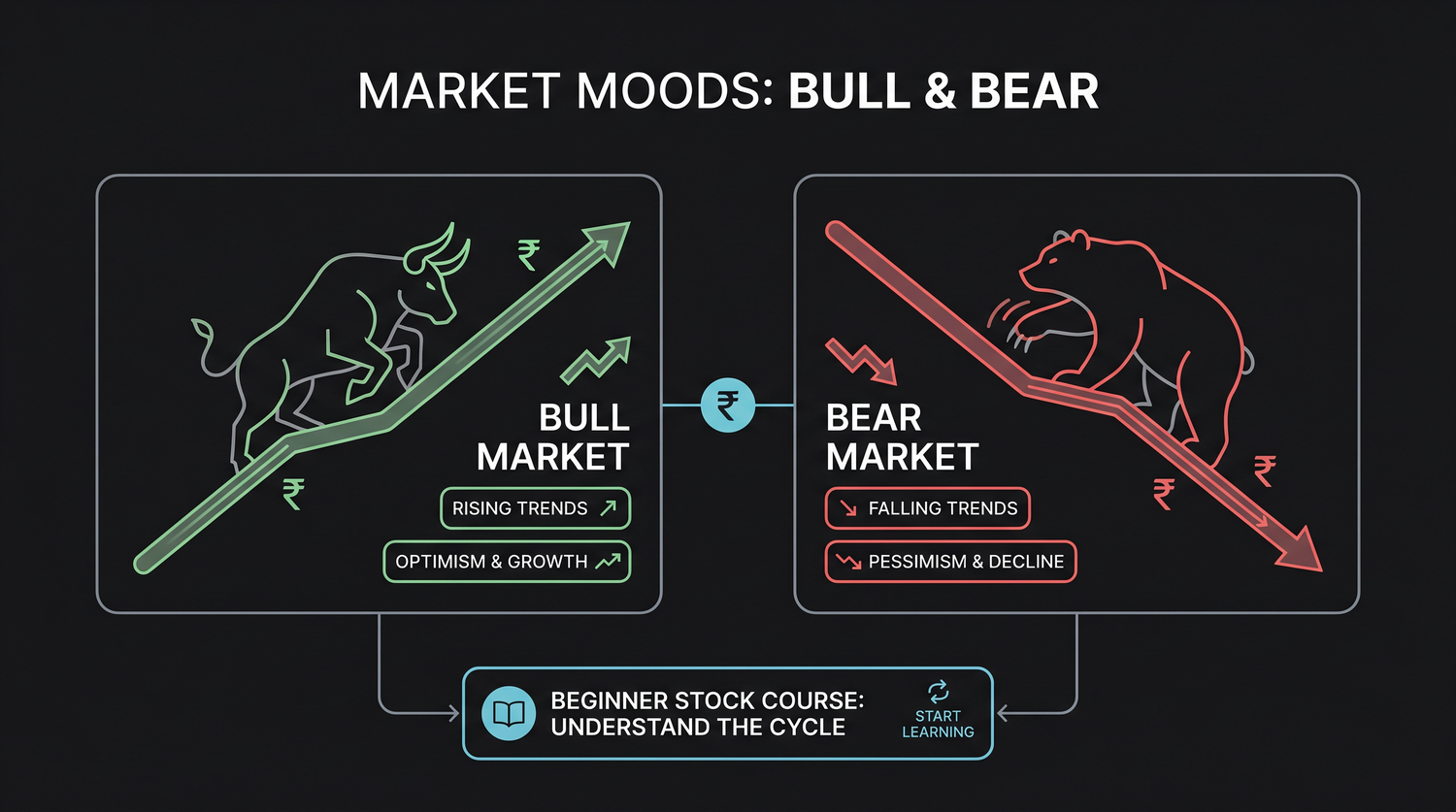
- A bull market is a sustained period of rising prices and optimism. Investors are confident, money flows in, and the trend points up.
- A bear market is the opposite, a prolonged fall, usually defined as a drop of 20% or more from a recent peak, wrapped in fear and pessimism.
Why these two animals? The popular explanation is in how each creature attacks. A bull thrusts its horns upward to gore an opponent, prices charging up. A bear swipes its paws downward to maul, prices being clawed down. Up-horns, down-paws. It is a memorable image, and it has stuck for centuries.
The bull-and-bear language is genuinely old. The "bear" came first, 18th-century London traders who sold something they did not yet own were said to be selling "the bearskin before catching the bear." The optimistic "bull" was coined later as its natural opposite. The words are older than most of the world's stock exchanges.
Large-cap, mid-cap, small-cap
You will constantly hear stocks sorted by market capitalisation (price x number of shares) into three buckets. In India, SEBI fixes the definition by rank, not by a fixed rupee value, so the labels stay meaningful as the market grows:
| Category | SEBI rank by market cap | Rough character |
|---|---|---|
| Large-cap | Top 100 companies | Big, established, stable. The household-name "blue-chips", the Reliances and HDFC Banks. Lower risk, steadier growth. |
| Mid-cap | 101st to 250th | Mid-sized, often fast-growing. More reward, more risk. |
| Small-cap | 251st onward | Smaller, less-proven companies. Highest growth potential, and highest risk of sharp falls. |
The trade-off is the whole story: small-caps can multiply your money fastest and fall the hardest. In a roaring bull market small-caps often fly; when fear returns, they tend to crash first and deepest. Beginners are usually steered toward large-caps for exactly this reason, they are the cargo ships, not the speedboats.
"Blue-chip" simply means a large, financially solid, well-known company with a long track record, the term borrows from poker, where the blue chips carry the highest value. At the other extreme, a penny stock is a very cheap, tiny, often barely-traded share. A low price is not a bargain; it usually signals a small, fragile, easily-manipulated company.
Circuits: the market's automatic brakes
To stop panic or mania from running wild, Indian exchanges impose circuit limits, price bands that halt trading in a stock when it moves too far in a single day.
- An upper circuit is the maximum a stock can rise that day. Hit it and there are only buyers, no sellers, the price is frozen at the top.
- A lower circuit is the maximum it can fall. Hit it and there are only sellers, no buyers, frozen at the bottom.
Individual stocks have bands like 2%, 5%, 10% or 20% depending on the stock. There are also market-wide circuit breakers: if the whole Nifty or Sensex falls 10%, 15% or 20% in a day, trading across the entire market pauses for a cooling-off period. Circuits are a safety valve, a forced timeout so everyone can catch their breath.
A stock locked in the upper circuit can feel like a guaranteed winner, everyone wants in, nobody is selling. It is a classic trap. When the mood flips, the very same stock can get stuck in the lower circuit day after day, with no buyers, leaving holders unable to sell at any price. Circuits cut both ways, and they cut hardest in thin, hyped small-caps.
Volume and liquidity
Volume is the number of shares traded in a period, a day, an hour, a minute. High volume means lots of activity and interest; a price move on heavy volume is taken more seriously than the same move on a trickle of trades.
Liquidity is how easily you can buy or sell without moving the price. A highly liquid stock (think Reliance or HDFC Bank) has so many buyers and sellers that you can trade large amounts instantly at a fair price. An illiquid stock has so few that even a modest order swings the price, and, worse, you may struggle to exit when you want out. Liquidity is the freedom to leave. Never underestimate it.
Long, short, and the magic of selling first
Most people only ever go long: you buy a stock hoping it rises, then sell later for a profit. Buy low, sell high. Simple.
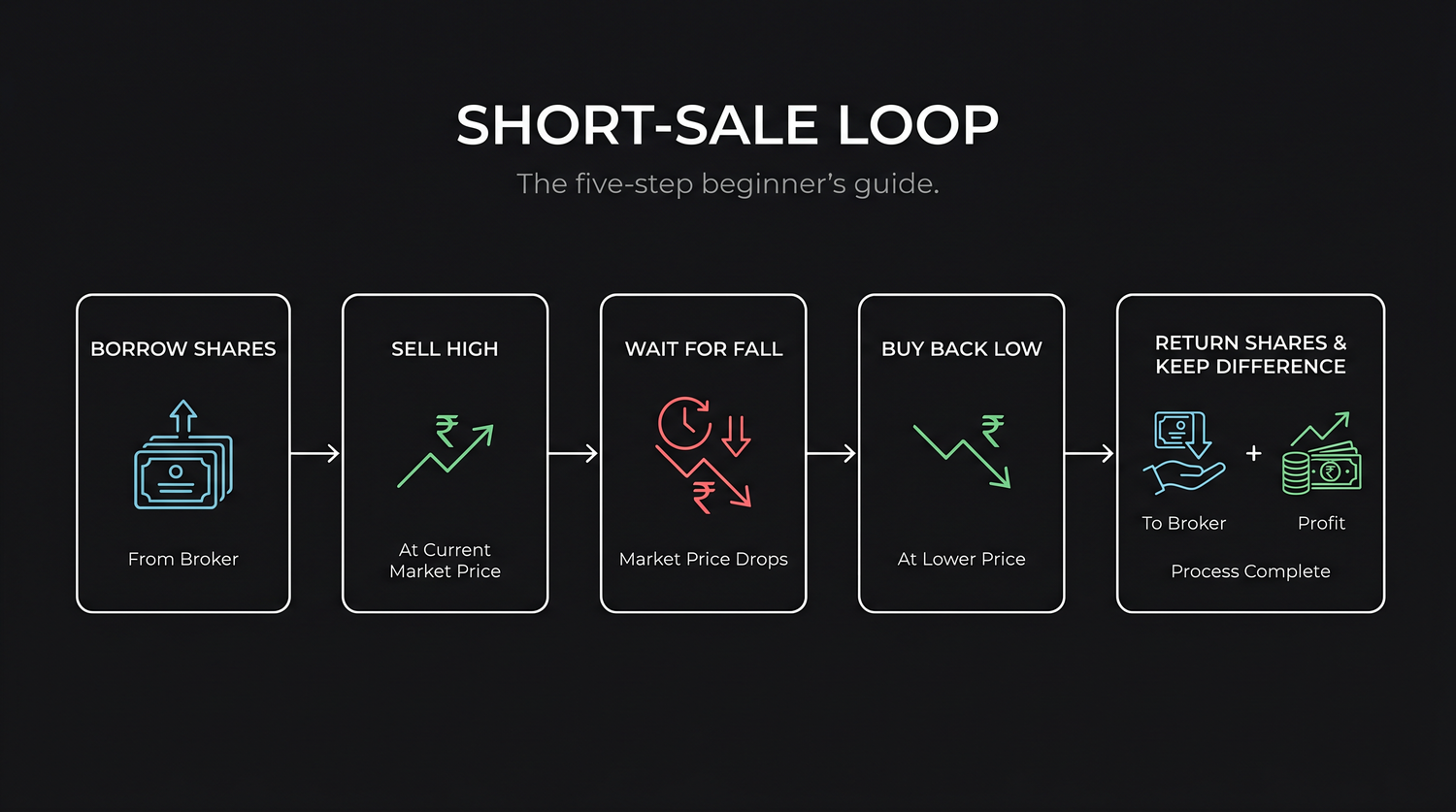
Short selling flips the order on its head, you sell first and buy back later, so you profit when a stock falls. It sounds impossible: how do you sell something you do not own? You borrow it.
Here is the sequence:
- You believe Stock X, trading at Rs 100, is going to fall.
- You borrow the shares (from your broker / the exchange's lending pool) and sell them immediately at Rs 100, pocketing the cash.
- The price drops to Rs 80, as you hoped.
- You buy the shares back at Rs 80 and return the borrowed shares to the lender.
- You keep the difference: Rs 20 per share profit.
Short selling carries a danger that buying never does: your losses can be unlimited. When you buy a stock at Rs 100, the worst case is it goes to zero, you lose Rs 100. But if you short at Rs 100 and the stock keeps climbing, Rs 150, Rs 300, Rs 500, your loss grows with no ceiling, because a price can rise forever but can only fall to zero. That asymmetry is why short selling is firmly an advanced, high-risk activity.
In India, there is a further rule for most retail traders: you can generally only short intraday, you must buy back and close the position before the market shuts the same day. To hold a short overnight you need to formally borrow the stock through the Securities Lending and Borrowing (SLB) mechanism. For a beginner, short selling is something to understand, not to do.
The rest of the TV vocabulary
A quick-fire glossary of the other words you will hear constantly:
| Term | One-line meaning |
|---|---|
| 52-week high / low | The highest and lowest price a stock has touched in the past year, a quick gauge of where it stands. |
| Rally | A sharp, sustained rise in prices over a short period. |
| Correction | A fall of roughly 10% or more from a recent peak, normal, healthy, and frequent. |
| Crash | A sudden, severe, often panic-driven plunge in a single day or few days. |
| Market breadth | How many stocks rose versus fell, "advances vs declines." Strong breadth (most stocks up) means a broad, healthy move; weak breadth means a few giants are masking a falling crowd. |
| Volatility | How wildly prices are swinging. High volatility = big, fast moves in both directions. |
| Bid / Ask | The best price a buyer will pay (bid) and a seller will accept (ask). |
| Blue-chip | A large, stable, reputable company. |
| Penny stock | A very cheap, tiny, risky share. |
You do not need to memorise this glossary. Keep it as a reference and the terms will sink in naturally as you watch the market for a few weeks. Jargon is just shorthand among people who use these ideas daily, and very soon, that will include you.
Quick recap
- A bull market rises (horns thrust up); a bear market falls 20%+ from its peak (paws swipe down). The animals describe how each attacks.
- Stocks split into large-cap (top 100, safest), mid-cap (101-250) and small-cap (251+, highest risk and reward) by SEBI's market-cap ranking.
- Circuits are automatic price-band halts, upper (frozen up, only buyers) and lower (frozen down, only sellers), plus market-wide breakers.
- Volume is how much trades; liquidity is how easily you can get out without moving the price, and it matters most when you want to exit.
- Going long means buy-then-sell (profit when it rises); short selling means borrow-sell-buy-back (profit when it falls), with unlimited loss risk and, for most retail in India, intraday-only.
- Words like 52-week high/low, rally, correction, crash, breadth, blue-chip and penny stock are just everyday market shorthand you will quickly absorb.
Next, we get to the heart of it all: what actually makes a stock move? We will watch price get set tick by tick in the order book, and see why even brilliant earnings can send a stock down.