
Macro, Rates, Inflation & Global Cues
No stock is an island. Understand how interest rates, inflation, the rupee, crude oil, FII/DII flows and global markets sway Indian shares.
- ·Interest rates & the RBI
- ·Inflation's effect
- ·FII vs DII flows
- ·Crude oil & the rupee
- ·Global cues
- ·Reading the macro mood
On some mornings, almost every stock on your screen opens lower at the same time, the great businesses and the weak ones, the company that just posted record profits and the one that posted none. Nothing changed about those companies overnight. What changed is the weather. Sitting high above every individual share is a layer of giant, slow-moving forces, interest rates, inflation, the value of the rupee, the price of crude oil, money flowing into and out of the country, and when that weather shifts, it leans on the whole market at once.
The last chapter looked at what moves a single stock. This one zooms all the way out to the forces that move all of them together. You will never control this weather, and, good news, you do not need to predict it. But learning to read it turns a scary, confusing market day into something you can understand, and most of the time, calmly ignore.
Interest rates: the price of money
At the centre of it all sits the Reserve Bank of India (RBI), the country's central bank, and the single most powerful number it controls: the repo rate.
Think of the repo rate as the price of money itself. It is the interest rate at which the RBI lends to commercial banks. When that rate is low, banks get money cheaply, so they lend cheaply, home loans, car loans, business loans all get more affordable. Companies borrow and expand, people borrow and spend, profits tend to grow, and stocks often rise. When the RBI raises the repo rate, the opposite happens: money gets expensive, borrowing slows, the economy cools, and stocks face a headwind.
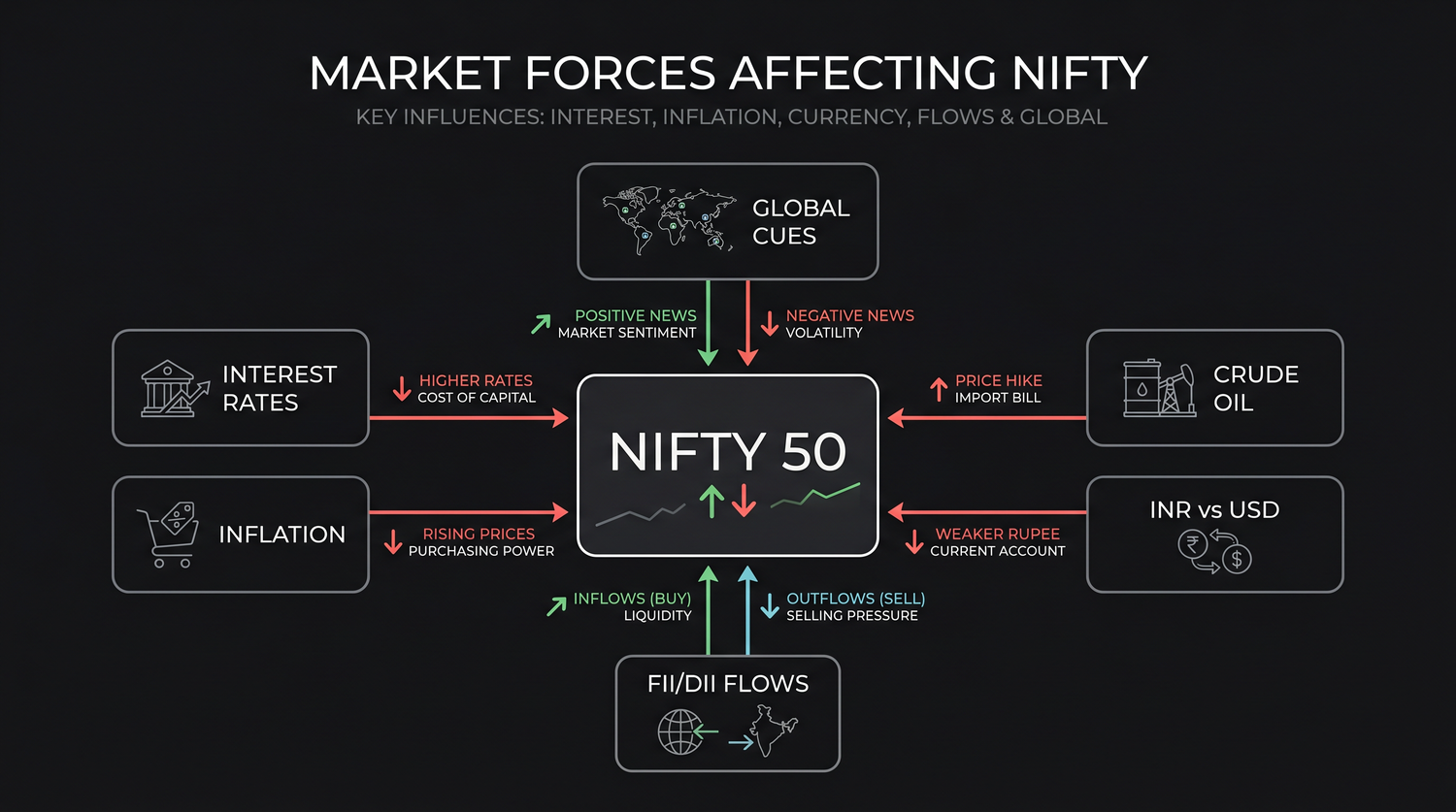
Interest rates work like gravity on share prices. Cheaper money tends to lift stocks; costlier money tends to weigh them down. It is the most important macro lever to understand, and the RBI moves it deliberately, in small steps, after watching the economy.
Why lower rates often lift stocks
- Cheaper EMIs and loans leave households with more to spend, good for company sales.
- Cheaper corporate borrowing lets businesses invest, expand and grow profits.
- Fixed deposits and bonds pay less, so some investors shift money toward equities in search of higher returns.
- Future profits are worth more today when rates are low, which lifts what investors will pay for a stock.
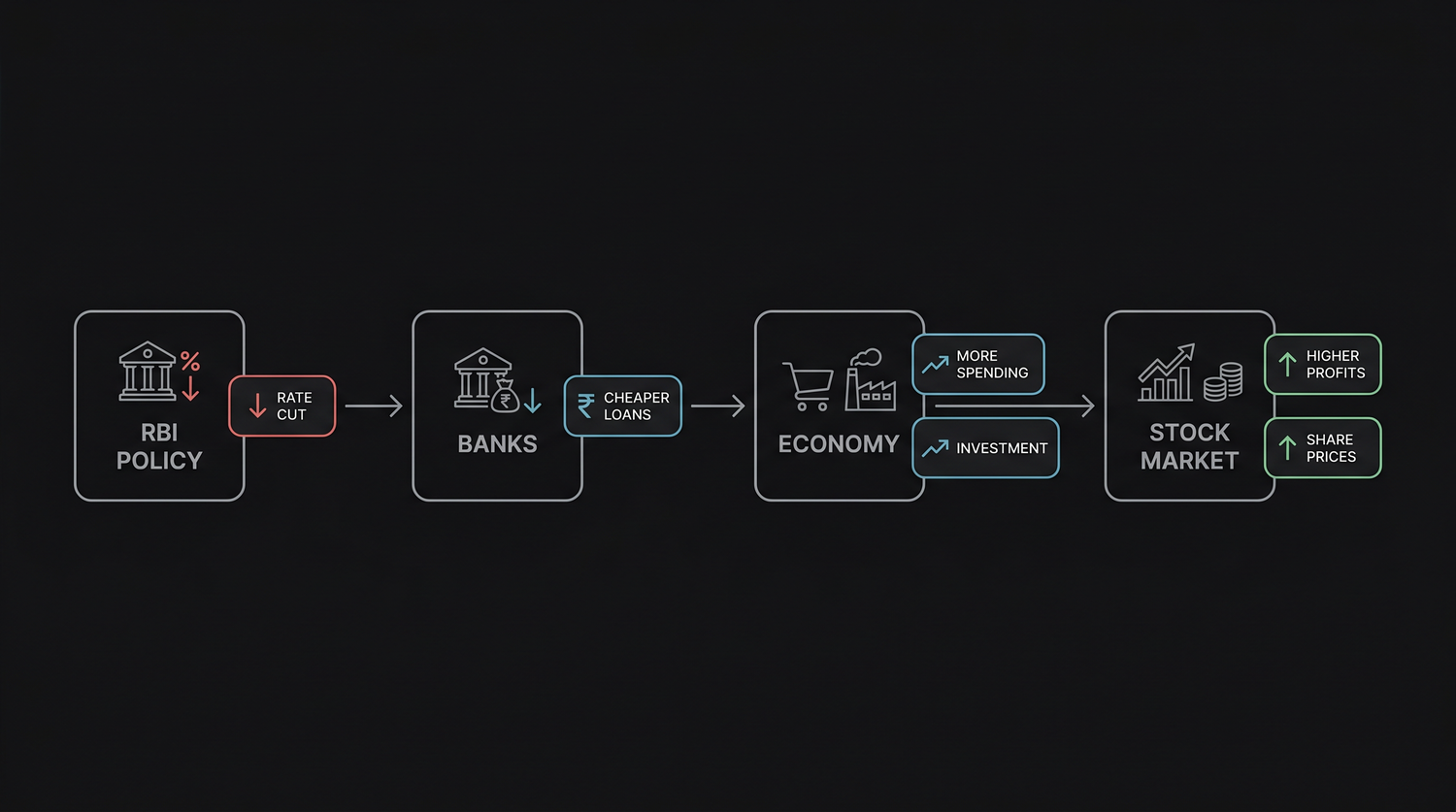
A real, recent example: through 2025 the RBI steadily cut the repo rate, from about 6.5% at the start of the year down to roughly 5.25% by December (approximate), as inflation cooled and the central bank chose to support growth. Cheaper money was, broadly, a tailwind for Indian equities that year.
Inflation: what the RBI is really fighting
Remember inflation from the very first chapter, the silent rise in prices that erodes your money. Fighting it is the RBI's core job. Its official target is to keep retail inflation near 4%, within a tolerance band of 2% to 6%. Its main weapon is that same repo rate.
When inflation runs too hot, the RBI raises rates to cool down spending and borrowing. When inflation falls comfortably within range, the RBI has room to cut rates and help the economy grow. So inflation and interest rates are really two ends of the same lever, which is why investors watch the monthly inflation number so closely. It often tells you what the RBI will do next.
In late 2025, India's retail inflation fell to multi-year lows, at one point printing below 1% (approximate), which is exactly what gave the RBI the room to keep cutting rates. Low inflation is not just good for your grocery bill; it quietly hands the central bank a green light to make money cheaper.
FIIs vs DIIs: the two great rivers of money
Two enormous pools of money flow through the Indian market every day, and the tug-of-war between them sets much of the mood.
- FIIs / FPIs (Foreign Institutional / Portfolio Investors) are overseas funds, global pension funds, hedge funds, asset managers, investing in India. Their money is large, fast, and very sensitive to global conditions. When FIIs sell heavily, the index often dips.
- DIIs (Domestic Institutional Investors) are Indian mutual funds, insurers and pension funds, and behind them flows the steady monthly tide of retail SIP money from ordinary investors like you.
For decades the old saying held: "when FIIs sneeze, Dalal Street catches a cold." That is changing fast.
| FIIs / FPIs | DIIs | |
|---|---|---|
| Who they are | Foreign funds, pensions, hedge funds | Indian mutual funds, insurers, pension funds |
| Money behind them | Global capital | Domestic savings and SIPs |
| Behaviour | Large, fast, reacts to global cues | Steadier, fed by monthly SIPs |
| When they sell heavily | Index often dips sharply | Tends to cushion the fall |
Here is the standout recent example. In 2025, FIIs pulled a record amount out of Indian equities, roughly Rs 1.66 lakh crore (about 19 billion dollars, approximate), the largest annual foreign exodus on record. A decade ago, that kind of selling would have crushed the market. Instead, domestic money largely absorbed the blow: DIIs kept buying, powered by record SIP inflows that climbed to about Rs 31,000 crore a month by December 2025. Around early 2025, for the first time, DIIs' ownership of NSE-listed companies edged past the FIIs'.
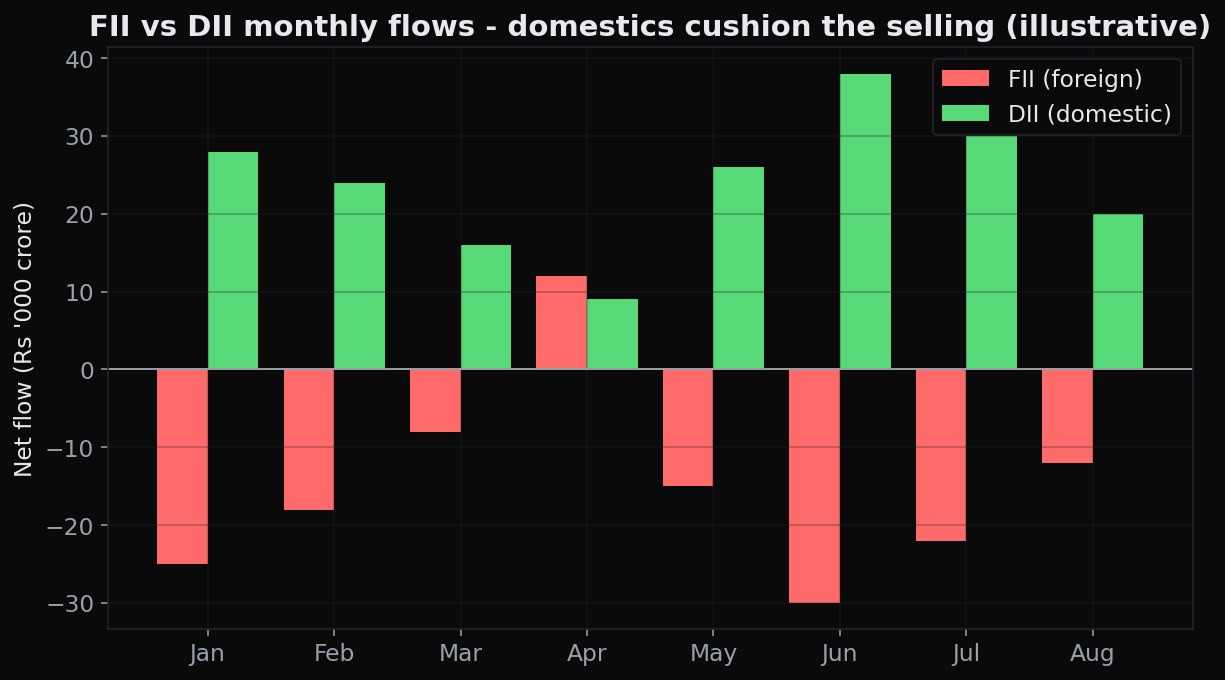
The monthly SIP habit of millions of Indians has quietly become the market's shock absorber. When foreigners rush for the exit, that steady domestic drip of investment money is increasingly what keeps the floor from falling out.
Crude oil and the rupee: India's imported headache
India buys roughly 85% of its crude oil from abroad, and that one fact links three things together: the oil price, the rupee, and inflation.
When global crude prices rise, India's import bill balloons. To pay for all that oil, the country must buy more US dollars, which pushes the rupee down. A weaker rupee then makes all imports, not just oil, more expensive, which feeds inflation, which can force the RBI to keep rates higher. One spike in crude can ripple through the entire chain.
A weak rupee does not hurt everyone equally. Companies that import (oil marketers, many manufacturers) get squeezed, while exporters who earn in dollars, IT services and pharma, for instance, often benefit, because each dollar they earn converts into more rupees.
India's annual oil import bill runs into many lakh crore rupees, so even a 10-dollar move in the price of crude is genuine front-page news here. It is one of the few global numbers that can nudge your petrol price, the rupee, inflation and interest rates all at once.
A recent example ties it together: the rupee weakened from around Rs 85 to the dollar in early 2025 toward the low 90s through 2026 (approximate), pressured in part by firm crude prices and global tensions, a textbook case of crude, currency and sentiment moving as one.
Global cues: why India wakes up reacting
Markets are wired together across time zones. By the time India opens at 9:15 am, a great deal has already happened overnight:
- The US Federal Reserve sets the world's most important interest rate. When the Fed raises rates or merely sounds hawkish, global money tends to flow toward the US and away from emerging markets like India.
- US markets (the S&P 500, Nasdaq) and how they closed; Asian markets in the morning, which often follow Wall Street; and the GIFT Nifty, an early pointer to how India might open.
- Geopolitics, wars, oil shocks, elections and trade tensions, ripples across borders within hours.
This bundle is what TV anchors mean by "global cues": the mood set overnight that India often opens reacting to, before a single domestic event has occurred.
Reading the macro mood without obsessing
Here is the part that matters most for a beginner: you do not need to track any of this hour by hour. The macro weather matters at turning points, not on every ordinary morning. A long-term investor glances at it occasionally, the way a sailor checks the sky, not constantly.
A simple mental dashboard is enough:
- Are interest rates rising or falling?
- Is inflation under control?
- Is the rupee broadly stable or sliding?
- Is crude calm or spiking?
- Are FIIs heavy sellers or steady buyers?
- Is the global mood "risk-on" or "risk-off"?
Most days, the honest answer is "nothing dramatic," and the right action is to do nothing.
Macro is for context, not for timing. Nobody, not economists, not fund managers, reliably predicts the Fed's next move or where crude goes next month. The investors who quietly kept their SIPs running through 2025's record foreign selling did far better than those who panicked at every scary headline. Let the macro inform your understanding, not hijack your plan.
Quick recap
- The repo rate, set by the RBI, is the price of money, lower rates generally lift stocks, higher rates weigh on them.
- The RBI moves rates mainly to fight inflation; cooling inflation in 2025 let it cut rates, a tailwind for equities.
- FIIs (foreign money) are fast and global; DIIs plus retail SIPs are steadier and now cushion the market, record SIP inflows absorbed record FII selling in 2025.
- India imports most of its oil, so high crude weakens the rupee and feeds inflation; exporters gain from a weak rupee, importers lose.
- Global cues, the US Fed, overnight Wall Street, geopolitics, set the mood India often opens reacting to.
- Read the macro mood as context, not a timing signal; most days, the right response is to stick to your plan.
Next, we move from the slow weather of macro to the sharp, scheduled catalysts that jolt individual stocks, earnings season, dividends, guidance and the shock events every investor learns to watch.