
Nifty, Sensex & How Indices Are Built
What an index measures, the constituent stocks inside the Nifty 50 and Sensex, how free-float weighting decides each stock's pull, and exactly how the index rises or falls as its constituents move.
- ·What an index is
- ·The constituents & their weights
- ·Free-float market-cap weighting
- ·How the index rises and falls
- ·Sector vs broad indices
- ·Why indices matter & index funds
Turn on any business news channel and within ten seconds you will hear a single number that supposedly tells you how "the market" did today. "Nifty closed up 120 points." "Sensex slipped half a percent." But India has more than 2,000 listed companies, and on any given day some rise while others fall. So how can one number sum up thousands of moving prices? The answer is an index, a clever piece of arithmetic that squeezes a whole basket of stocks into one figure you can track at a glance. It is the market's thermometer.
In this chapter we will open up that thermometer and see exactly what is inside it: which stocks it holds (its constituents), how much each one counts (its weight), and, the part most beginners never quite grasp, precisely how the number rises or falls as those stocks move through the day.
What an index actually is
An index is just a weighted summary of a chosen basket of stocks, expressed as a single number. India's two headline indices are:
- The Nifty 50, run by the NSE, it tracks 50 large companies.
- The Sensex (short for Sensitive Index), run by the BSE, it tracks 30 large companies.
Both are designed to represent the broad market: pick the biggest, most-traded companies across major sectors, bundle them together, and the resulting number moves up and down roughly the way "the market" does. When people say "the market was up today," they almost always mean one of these two indices rose.
The level itself, the Nifty hovering around 23,800 or the Sensex near 76,200 (approximate, mid-2026), is not rupees and is not a price you can buy. It is just a running score, started from a base value decades ago and compounded forward as the constituent companies have grown.
The Nifty and Sensex overlap heavily, the giant banks, Reliance and the IT majors sit in both, which is why the two indices almost always move in the same direction by a similar percentage on any given day. The Nifty 50 is the more widely tracked benchmark for funds and derivatives.
The constituents: who is actually inside
The companies that make up an index are its constituents. But here is the crucial idea that trips up almost every beginner: not every constituent counts equally. A giant like Reliance pulls on the index far harder than a smaller member. Each stock is assigned a weight, its share of the total index, and that weight is decided by free-float market capitalisation.
That phrase sounds intimidating; it is simple once broken into two pieces:
- Market capitalisation = share price x total number of shares. It is the full price tag of the whole company.
- Free-float = only the shares actually available for the public to trade, it excludes the chunk locked away with promoters, the government, or strategic holders.
So a company's weight reflects the value of its tradable shares. The bigger that free-float value, the bigger its slice of the index, and the harder it tugs the number around.
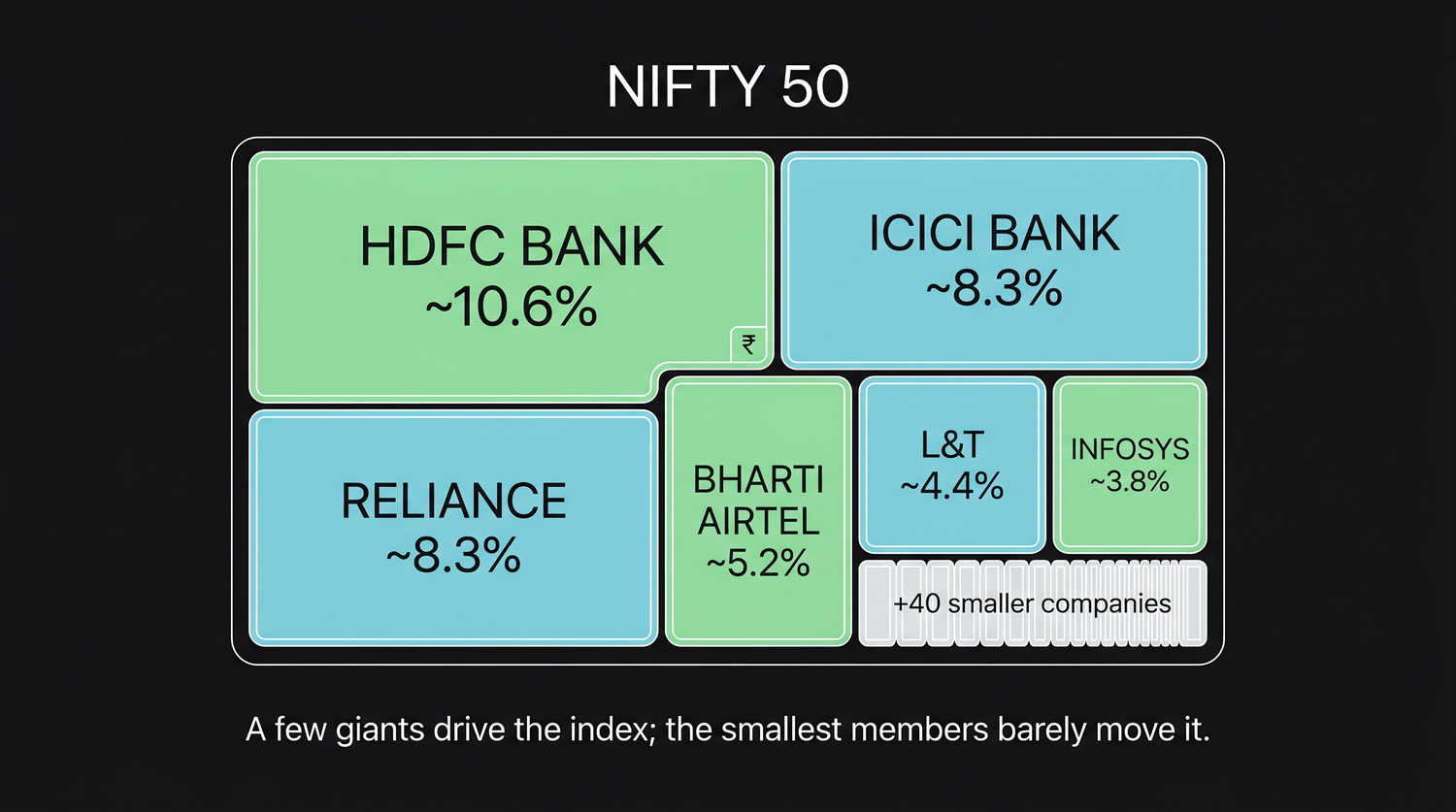
Here is what sits at the top of the Nifty 50, taken from the NSE's own index factsheet. Treat every figure as approximate, weights drift daily as prices move and are reshuffled twice a year.
| Rank | Company | Sector | Approx. weight |
|---|---|---|---|
| 1 | HDFC Bank | Financials (banking) | ~10.6% |
| 2 | ICICI Bank | Financials (banking) | ~8.3% |
| 3 | Reliance Industries | Energy / retail / telecom | ~8.3% |
| 4 | Bharti Airtel | Telecom | ~5.2% |
| 5 | Larsen & Toubro | Construction / infra | ~4.4% |
| 6 | Infosys | IT | ~3.8% |
| 7 | State Bank of India | Financials (banking) | ~3.7% |
| 8 | Axis Bank | Financials (banking) | ~3.4% |
| 9 | Kotak Mahindra Bank | Financials (banking) | ~2.6% |
| 10 | ITC | FMCG | ~2.6% |
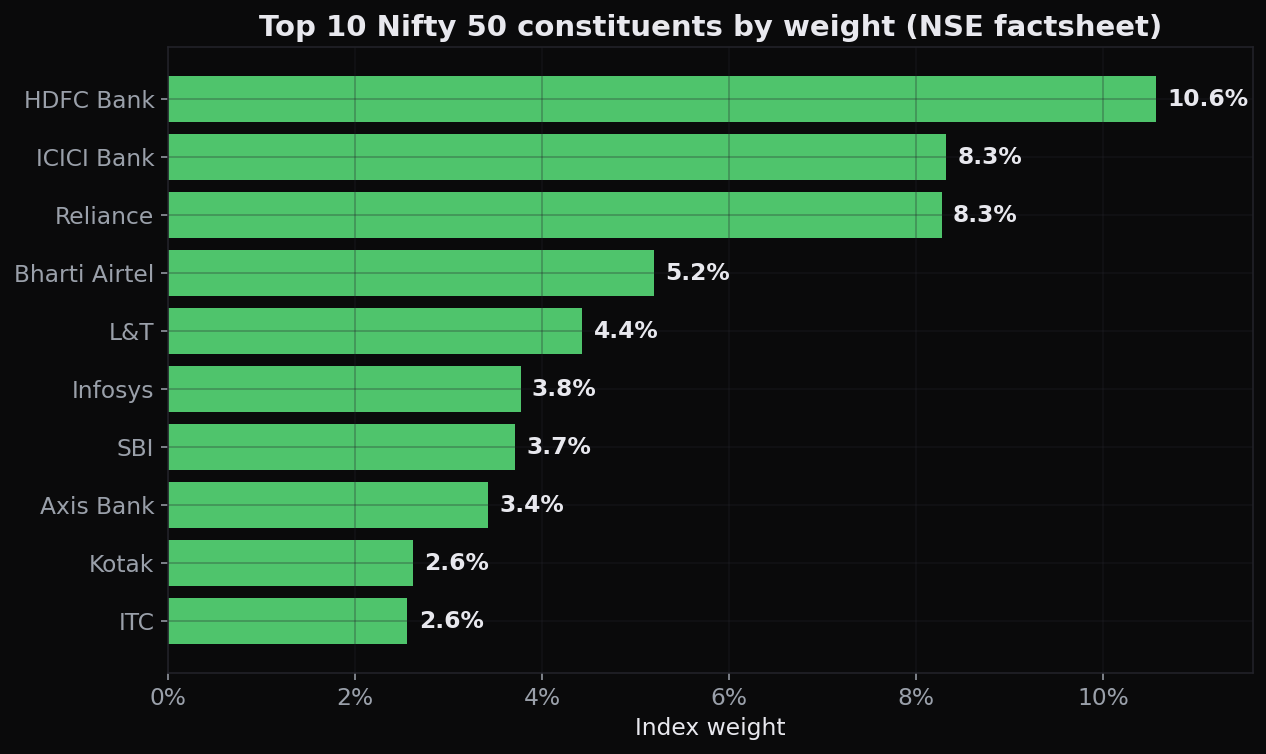
Look at the concentration. The top 10 names alone make up more than half (around 53%) of the entire 50-stock index. The remaining 40 companies share what is left. And notice how financials dominate, lump the big banks and other lenders together and financial services alone is about 35% of the Nifty, more than a third in a single sector. That is why a bad day for banks is so often a bad day for the whole index.
A single company can swing the entire Indian market. HDFC Bank, the Nifty's largest constituent at roughly a tenth of the whole index, can nudge the Nifty up noticeably on its own when it jumps a few percent. And HDFC Bank plus Reliance together are nearly a fifth of the basket, before the other 48 members have done a thing.
How the index actually rises and falls
Now the part everyone wants and few explain clearly. The index level is the weighted sum of all its constituents' moves. Each stock contributes to the day's change in proportion to its weight.
The mental formula is just:
A stock's contribution to the index = (its weight) x (its percentage move)
Let us make it concrete with a worked example.
Suppose HDFC Bank has a ~10.6% weight and rises 2% on a good day. Its push on the index is:
0.106 x 2% = 0.212%, call it about +0.21%.
That single stock, moving a modest 2%, lifts the whole Nifty by roughly a fifth of a percent.
Now take a small constituent with just a ~0.3% weight that also rises 2%. Its contribution is:
0.003 x 2% = 0.006%, essentially nothing. You would not even see it.
Same 2% move in both stocks, but HDFC Bank pushed the index roughly 35 times harder, purely because its weight is about 35 times bigger. The little stock can have a fantastic day and the index will barely register it.
The index does not care equally about every company. A heavyweight's small move beats a minnow's big move. So on a green day, a handful of large-weight stocks usually did almost all the lifting, and on a red day, the same few did the dragging. "The market fell today" very often really means "three or four giants fell today."
This is also why you will hear analysts say the rally was "narrow" or "led by a few heavyweights." If only Reliance and the top banks rose while most other stocks fell, the index can still close green, the heavyweights outvoted the crowd. Add up every constituent's weighted contribution, positive and negative, and the total is exactly the day's index change.
Imagine a tiny 3-stock index. Stock A has 60% weight and rises 1%; Stock B has 30% weight and falls 1%; Stock C has 10% weight and rises 3%. Contributions: A = +0.60%, B = -0.30%, C = +0.30%. Net = +0.60%. Even though two of the three stocks barely helped, the one big member set the tone.
Broad indices vs sector indices
The Nifty 50 and Sensex are broad indices, a cross-section of the whole market. But the same weighted-basket trick is used to build narrower sector indices that track one slice of the economy:
- Bank Nifty, the major banks only (HDFC Bank, ICICI Bank, SBI, Axis, Kotak and others). It is the most heavily traded index in India after the Nifty.
- Nifty IT, the software exporters like TCS, Infosys, Wipro and HCLTech.
- Others include Nifty Auto, Nifty Pharma, Nifty FMCG and Nifty Metal.
Sector indices let you see what is driving the day. If the Nifty is flat but Nifty IT is down 3%, you instantly know the software stocks are having a rough session while the rest of the market holds up. There are also broader benchmarks, the Nifty 100, Nifty 500 and the mid-cap and small-cap indices, that capture far more than the top 50.
Why indices matter to you
Indices are not just television decoration. They do real jobs:
- A benchmark. When a fund manager says they "beat the market," they mean they beat an index like the Nifty 50. It is the scorecard everyone is measured against.
- The market's mood ring. One glance tells you whether sentiment is fearful or greedy today, without scanning 2,000 prices.
- Something you can actually own. You cannot buy "the Nifty," but you can buy an index fund or ETF that mechanically holds all 50 constituents in their exact weights. Buy one unit and you own a slice of the whole basket, instant diversification, with no stock-picking required. This is the single most popular way for beginners to invest, and we return to it later in the course.
Index funds are gloriously lazy and that is their strength. The fund simply mirrors the index, no star manager, no research desk guessing winners, yet over the long run this "buy the whole basket" approach has beaten the majority of actively managed funds that try to outsmart it, and at a fraction of the cost.
Quick recap
- An index is a single number that summarises a basket of stocks, the market's thermometer. India's headlines are the Nifty 50 (NSE, 50 stocks) and the Sensex (BSE, 30 stocks).
- The stocks inside are the constituents, and each carries a weight set by its free-float market cap, bigger tradable value means a bigger slice of the index.
- The Nifty is top-heavy: roughly the top 10 names make up nearly half of it, and financials are about a third on their own.
- The index moves as the weighted sum of its constituents: each stock's contribution = its weight x its percentage move.
- A heavyweight's small move beats a minnow's big move, on most green days a few giants did the lifting, and on red days the same few did the dragging.
- Sector indices (Bank Nifty, Nifty IT) zoom into one slice, while index funds let you own the whole basket in one cheap, diversified purchase.
Next, we decode the language the market speaks, bulls and bears, large-caps and penny stocks, circuits and short selling, so the jargon on your screen and on TV finally makes plain sense.