
Gap Risk and Event Risk
Leverage is most dangerous when the market jumps. Learn why an overnight gap can blow past your stop, the events that cause it, results, RBI policy, the Budget, elections and global news, and why a stop-loss is not a guarantee in a leveraged position.
- ·Why an overnight gap hurts
- ·Events that cause gaps
- ·Why a stop can fail on a gap
- ·Why leverage magnifies a gap
- ·Sizing for the gap, not the stop
- ·Avoiding events you cannot survive
You can do almost everything right. You can pick the direction well, place a sensible stop-loss exactly where the chart says it belongs, and size the position so a normal loss is small and recoverable. Then you go to sleep. And while you sleep, on the other side of the world or in a single press release, something happens. When the market reopens the next morning, the future is not a few rupees away from where you left it. It is a long way away, and there was no chance to trade in between. This is the one danger that only appears when you carry a futures position overnight, and it has ended more leveraged accounts than any bad chart pattern ever has. It is called gap risk, and the event that causes it is its close cousin, event risk.
This chapter is about both, and about the uncomfortable truth that the stop-loss you trusted does not always do what you think it does.
When the market is shut but the world is not
A futures market is open for only part of the day. The world is open all the time. Company results are announced after the close. Central banks abroad decide on rates while India sleeps. Global markets fall overnight, the budget is read, an RBI decision lands, an election result is counted. Every one of these can move the price of your future, and almost all of them happen when you cannot trade.
When the market reopens, the price does not glide smoothly from yesterday's close to the new level. It gaps, opening sharply higher or lower with empty space on the chart where no trading happened. If RELIANCE closes at Rs 1,318 and a disappointing result lands after hours, the stock may simply open the next session at 1,250, or 1,210, with nothing traded in between. You did not get a chance to react at 1,300, or 1,280, or anywhere along the way. The first price you could have acted on is the gapped-open price itself.
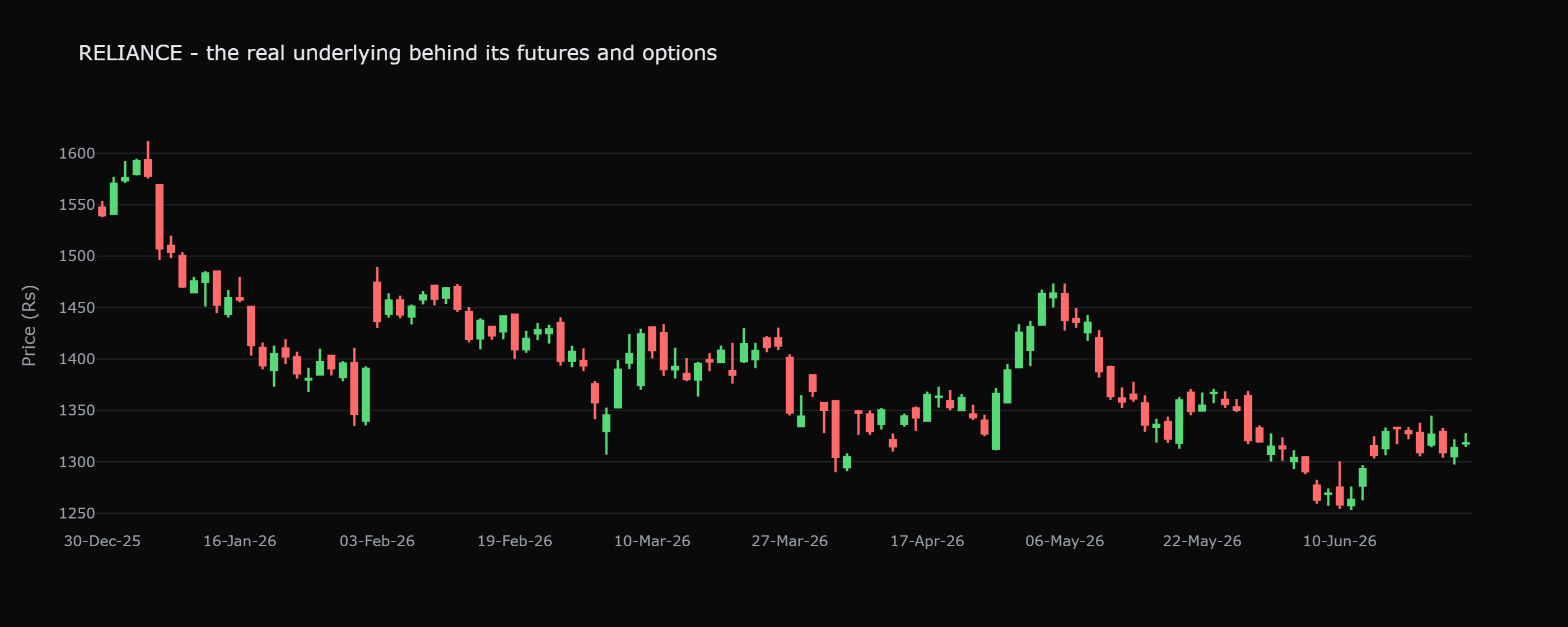
A gap is the market jumping over a range of prices while it was shut. You cannot trade inside a gap. The first price available to you is wherever the future reopens, however far that is from where you last saw it.
A stop-loss does not promise you a price
Here is the part that surprises beginners, and it is the most important idea in this chapter. A stop-loss does not guarantee the price at which you exit. It only guarantees that an order is sent once the price reaches your level.
Think about how a stop actually works. You set a stop-loss on your RELIANCE long at, say, 1,290. The agreement is simple: if the price falls to 1,290, your exit order is triggered and sent to the market. On an ordinary day, with the stock ticking down smoothly through 1,300, 1,295, 1,291, your order fires at 1,290 and you are filled at or very near it. The stop did its job.
Now add a gap. The stock closes at 1,318, terrible news breaks overnight, and the future opens the next morning at 1,250. Your stop level of 1,290 was never traded. The price did not pass through it on the way down; it leaped clean over it. The instant the market opens at 1,250, your stop triggers, because the price is now well below 1,290, and your order is filled at the next available price, which is around 1,250. Not 1,290. You planned to lose 28 points and you lost 68, because the price gapped straight through your stop.
This is why a stop-loss is protection against ordinary moves, not against gaps. On a normal intraday slide it caps your loss near where you planned. Across an overnight gap it can be skipped entirely, and you are filled wherever the market chooses to reopen, which can be far worse than your stop. The loss can be much larger than the one you sized for.
A stop-loss guarantees that your order is sent when price reaches your level. It does not guarantee the price you get. If the future gaps past your stop overnight, you are filled at the reopening price, which can be far beyond your planned loss. Never assume a stop makes an overnight position safe.
Gap plus leverage: the classic account-blower
A gap is unpleasant for anyone. For someone holding a leveraged future it can be ruinous, and the reason is the same leverage that drew them in.
Recall the RELIANCE numbers that have run through this course. One lot is 500 shares. At Rs 1,318 a single future controls about Rs 6,59,000 of stock, yet you post a margin of only around Rs 1,10,000. That is leverage of roughly six times. On a cash holding, a gap is measured against the full value you own. On a future, the same rupee gap is measured against your small margin.
Work the numbers. A 6 percent overnight gap down in RELIANCE is about 79 points. On 500 shares that is a loss of about Rs 39,500. Against the Rs 6,59,000 of stock a buy-and-hold investor owns, that is a 6 percent dent, painful but survivable. Against your margin of about Rs 1,10,000, that same Rs 39,500 is more than a third of your money gone, in a single open, before you could lift a finger. Push the gap to 10 percent, around 132 points, and the loss is about Rs 66,000, well over half your margin, from one night. This is the arithmetic behind the phrase you will hear from experienced traders: a gap plus six-times leverage is the classic account-blower. The gap supplies the sudden move, the leverage multiplies it into a wound the account cannot absorb.
A trader carries one RELIANCE long overnight with a margin near Rs 1,10,000 and a stop placed at 1,290. Weak results gap the stock down to 1,250 at the open. The stop triggers but fills at about 1,250, not 1,290, a loss of roughly 68 points, about Rs 34,000. The planned loss was around Rs 14,000. The gap nearly trebled it, and the stop, which felt like safety the night before, never stood a chance against the jump.
Event-driven margin hikes
There is a second, quieter way an event can hurt you, and it arrives right when you can least afford it. Margins are not fixed. The exchange raises them when it expects the market to become more volatile, and big scheduled events are exactly when it expects that. Around a budget, a major central-bank decision, an election result, or a single stock's results in its physical-settlement week, the required margin on the affected contract is often increased in advance.
The effect on you is awkward. A position you opened comfortably at a margin of about Rs 1,10,000 can suddenly demand more cash to stay open, precisely as the risk you are exposed to is rising. If you do not have the extra funds ready, you may be forced to reduce or close the position at an inconvenient moment, before the event even resolves. So an event can cost you twice: once through the gap it may cause, and once through the higher margin it demands beforehand. Keeping a cash buffer, rather than running your account to the last rupee of margin, is what lets you survive a hike without being forced out.
Exchanges raise margins ahead of known high-risk events. A position that fit your account yesterday can demand more cash tomorrow, just as volatility climbs. Always keep a cash buffer so an event-driven margin hike does not force you out at the worst time.
How to defend yourself
You cannot abolish gap risk while holding overnight, but you can refuse to be destroyed by it. The defences are plain and they work.
- Reduce size or stay flat ahead of a known event. The calendar tells you when results, a budget, a central-bank meeting or a major political event are due. If you know the event is coming, that is the time to carry less, or nothing at all. There is no rule that says you must have a position on through every event. Sitting out the biggest unknowns is a professional habit, not a timid one.
- Consider a hedge. If you want to keep a position through an event, you can offset some of its risk, for instance by pairing it with an opposing position so a violent gap in either direction is partly cushioned. A hedge gives up some profit in exchange for a softer landing, and around a true coin-flip event that trade can be worth making.
- Prefer the liquid near month. A gap is worse when the contract is thin, because even the reopening price can be hard to trade in size. The near-month future is the most liquid, with the tightest market, so your exit, when it fires, meets the most willing buyers and sellers. Far-month and thinly traded single-stock contracts compound a gap with poor liquidity. Beginners should live in the near month.
- Never assume a stop makes an overnight position safe. Place stops, always, but size every overnight position as if the stop might be skipped, because across a gap it can be. The honest question before you carry a future overnight is not "where is my stop" but "could I survive seeing this gap against me at the open." If the answer is no, the position is too big.
Before you carry any future overnight, check the event calendar, carry less or nothing into the biggest unknowns, stay in the liquid near month, and size the position so that even a gap straight through your stop would leave you bruised, not broken.
The takeaway is sober and simple. The overnight gap is the danger that only appears when you hold a leveraged future past the close, and a stop-loss, your usual shield, can be leaped straight over. Respect that, keep a cash buffer for margin hikes, lighten up around known events, and treat every overnight position as something you must be able to survive seeing gap against you. Do that, and the morning surprise becomes a bruise you can absorb rather than the blow that ends your account.