
Position Sizing with Futures
The fastest way to blow up is to trade too large. Learn how to size a futures position from your capital and your risk per trade, the stop-distance times lot-size method, the difference between intraday and positional sizing, and why many accounts are simply too small for futures.
- ·Capital genuinely required
- ·Risk per trade, a small slice
- ·Stop distance times lot size
- ·Intraday vs positional sizing
- ·Notional exposure is not capital
- ·Why small accounts should wait
Ask a roomful of struggling traders what went wrong and most of them will not point to a bad chart or a missed signal. They will tell you they were too big. They put on a position so large that one ordinary swing wiped out a month of careful gains, or worse, a chunk of their capital. The single most important survival skill in futures is not picking the right direction. It is deciding how many lots to trade, and the honest answer is almost always fewer than you want.
This chapter is about that decision. It is not glamorous and it will never feel exciting, which is exactly why beginners skip it and exactly why they blow up. Get position sizing right and you can survive a long run of bad luck. Get it wrong and even a good strategy will not save you, because you will not be in the game long enough to let the good trades work.
Start with what you can afford to lose
Most beginners size a trade by asking the wrong question. They ask, "how many lots can I afford to buy?" The margin lets them in cheaply, so the answer feels large, and they max it out. The right question is the opposite. Ask, "how much am I willing to lose if this trade goes against me?" Size flows from that, and only that.
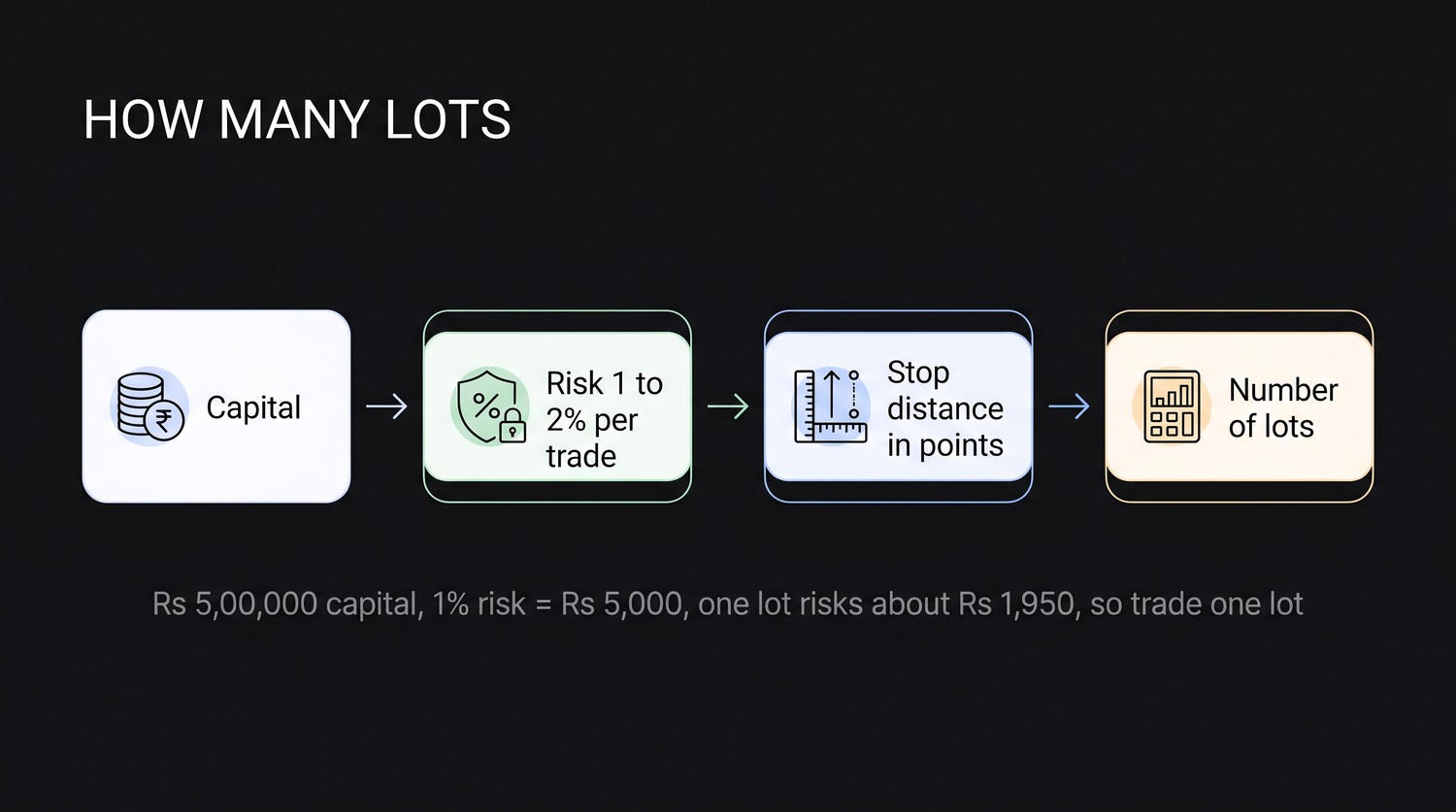
The method professionals use is called fixed-fractional risk. The rule is simple: on any single trade you risk only a small, fixed slice of your trading capital, usually 1% to 2%. Not 1% of margin, not 1% of the contract value, but 1% of the total money you have set aside for trading. With Rs 5,00,000 of trading capital, a 1% risk budget is Rs 5,000. That Rs 5,000 is the most you will allow this one trade to cost you if your stop is hit. Everything else is arithmetic.
Fixed-fractional risk means risking a small fixed fraction of your capital, 1% to 2%, on any one trade. The position size is whatever amount makes your stop-loss equal to that budget. You decide the loss first, then the lots.
Why so small? Because losses come in clusters. Even a sound trader can take five or six losers in a row, and that is normal, not a failure. If each loss is 1% of capital, six in a row is about 6%, a bruise you recover from. If each loss is 20% because you were oversized, two in a row and you are crippled. Small risk per trade is what lets you survive the inevitable bad streak with enough capital and enough nerve to keep trading.
Work backward from the stop
Here is the part that makes sizing concrete. You cannot size a trade until you know where you will get out if you are wrong. That exit is your stop distance, the number of points between your entry and the price at which you admit the trade has failed. The stop comes first. The size is calculated from it.
The chain of reasoning runs in three plain steps:
- Decide your stop distance in points. This comes from the chart and your plan, not from how much you wish to risk.
- Turn that into the rupee loss of a single lot: points at risk multiplied by the rupees per point per lot.
- Divide your risk budget by that one-lot loss. The result, rounded down, is how many lots you may take.
That is the whole engine. Notice that a wider stop means a bigger loss per lot, which means fewer lots. A tighter stop allows more lots for the same budget. Your size is not a fixed habit. It changes with every trade depending on where the sensible exit sits.
A clean NIFTY example
Put real numbers on it. You have Rs 5,00,000 of capital, so your 1% budget is Rs 5,000. You want to go long a NIFTY future trading near 24,000, where each point is worth Rs 65 a lot. Your plan says you will exit if the future falls 30 points against you, so your stop distance is 30 points.
The loss on one lot if the stop is hit is 30 points times Rs 65, which is about Rs 1,950. That single lot already eats nearly forty percent of your Rs 5,000 budget. Now divide: Rs 5,000 divided by Rs 1,950 is about two and a half. You never round up, only down, so the raw arithmetic points to two lots. But two lots is not the prudent answer here, and this is where careful traders separate themselves from reckless ones.
A stop is a plan, not a guarantee. In a fast market the future can jump straight past your level and fill you worse than 30 points, a problem you will meet properly in the next chapter on gaps and event risk. On top of that, every round trip carries real costs, and as an earlier chapter showed, one NIFTY lot bought and sold costs roughly Rs 929 before you make a paisa. Two lots means double the costs and double the slippage if the stop slips. Once you fold those realities into the Rs 5,000 line, a second lot quietly pushes your true worst case past the budget. So you take one lot. The clean number said two and a half; honesty and a margin of safety say one.
Always round the lot count down, never up, and then ask whether costs and a possible slipped stop have already eaten your buffer. If they have, drop one more lot. The trader who rounds up to feel busy is the trader who gets carried out.
Size by the contract, never by the margin
This is the trap that destroys small accounts, so read it twice. The margin is the small deposit that lets you open a position. It is not your risk. Your risk is set by the full contract value and the size of your loss if the trade moves against you.
One NIFTY lot near 24,000 controls about Rs 15,60,000 of index exposure, yet the margin to hold it might be only a fraction of that. One RELIANCE lot at Rs 1,318 is 500 shares, about Rs 6,59,000 of stock, and again the margin is far smaller. The danger is obvious once you see it. If you size by margin, you look at Rs 5,00,000 of capital, see that one RELIANCE lot needs perhaps a lakh of margin, and conclude you can hold five lots. Five lots is over thirty lakh of RELIANCE riding on five lakh of capital. One bad gap on that book and the account is gone.
Never size a position by the margin that lets you in. The margin is a deposit, not a measure of risk. Size by the full contract value and the rupee loss your stop implies. Margin sizing is the single most common way beginners turn a leveraged account into a smoking hole.
The same backward method works on a stock future, and it shows you why single stocks demand respect. RELIANCE moves Rs 500 a lot for every one rupee of price, so each point is heavy. Suppose you would exit a RELIANCE long if it fell 8 rupees. That is 8 times Rs 500, a loss of Rs 4,000 on a single lot, which already swallows eighty percent of your Rs 5,000 budget. One lot is your absolute ceiling, and barely. Widen the stop to a more realistic 12 rupees and one lot risks Rs 6,000, which breaches the budget entirely. The honest reading is that with this capital and this stop, a RELIANCE future may simply be too big, and the right trade is no trade.
A trader with Rs 5,00,000 wants to short one RELIANCE future with a 10 rupee stop. Ten rupees times 500 shares is Rs 5,000, exactly the whole 1% budget for a single lot. There is no room for a second lot and no room for the stop to slip. The sizing maths is telling the trader, plainly, that one lot is the most this account can carry, and even that leaves no cushion.
The one-lot reality
Beginners often feel that trading a single lot is somehow not real trading, that serious people trade ten. The arithmetic above says the opposite. For many small accounts a single lot is already the maximum prudent size, and on tighter capital or wider stops even one lot can be too much. There is no shame in trading one lot. There is enormous shame, and real pain, in trading five because the margin allowed it.
A single lot, sized correctly and protected with a stop, is a complete and respectable position. It keeps you in the game, lets you learn with real money at survivable cost, and grows naturally as your capital grows. The trader who patiently compounds one lot will outlast the one who swings ten and detonates.
Intraday or positional
How long you hold the position changes the sizing conversation too. An intraday trade is squared off by the close, so you never carry the overnight gap, and the margin is often lighter. That sounds safer, and on gap risk it is, but it carries its own trap: cheap, frequent trading tempts you to over-trade, taking marginal setups and paying costs again and again until the account bleeds even when your calls are fine.
A positional trade is held overnight or for days. It needs the full margin, not the lighter intraday amount, and it carries the gap and event risk you will study next, where a position can leap against you while the market is shut and a stop cannot protect you. Positional trades therefore deserve a wider plan and usually a smaller size, because the worst case is larger and less controllable.
Intraday avoids the overnight gap but tempts over-trading, so guard your number of trades. Positional needs full margin and survives gaps you cannot control, so guard your size and keep it smaller. Same instrument, two different disciplines.
The takeaway is blunt and freeing at once. Decide your risk budget before you look at a single chart, find your stop, work backward to the lots, round down, and respect the answer even when it is one or none. Size is the lever that keeps you alive long enough for skill to matter.