
Index Futures vs Stock Futures
NIFTY and BANKNIFTY futures behave differently from a single stock's future. Learn the practical differences in liquidity, risk and use, and why beginners usually start with the index.
- ·Index futures (NIFTY, BANKNIFTY)
- ·Single-stock futures
- ·Liquidity differences
- ·Single-stock gap risk
- ·Cash settlement for index
- ·Where a beginner should start
When a beginner first opens the list of tradeable futures, two very different kinds of contract sit side by side. One is a future on a single company, like RELIANCE, where the price rises and falls with the fortunes of that one business. The other is a future on a whole index, like NIFTY or BANKNIFTY, where the price reflects a basket of many companies moving together. They look similar on the screen, both have a price, a lot size, and an expiry, but they behave differently in ways that matter a great deal for your risk. Choosing the wrong one for your level of experience is a common early mistake, so let us see clearly what separates them.
The short version is this. An index future tracks a diversified basket and tends to move smoothly. A stock future tracks one company and can lurch violently on a single piece of news. Both are useful, but they are not equally forgiving, and a newcomer is usually safer starting with the index.
Two kinds of underlying
The difference begins with what the contract is built on. A stock future has a single share as its underlying. RELIANCE is our running example, trading around Rs 1,318, with a lot of 500 shares, so one contract controls roughly Rs 6,59,000 of a single company. If RELIANCE reports bad earnings or faces a regulatory headline, that one event drives your entire position.
An index future has an index as its underlying. The two most traded in India are NIFTY, with a lot of 65, and BANKNIFTY, with a lot of 30. An index is not one company but a weighted basket of many. NIFTY tracks fifty large companies across sectors. BANKNIFTY tracks the major banks. When you trade an index future, no single company's news can dominate your position, because the index is an average of many names pulling in different directions.
A stock future rides on one company. An index future rides on a diversified basket of many companies. That single difference shapes almost everything about how the two behave and how much they can surprise you.
Cash settlement versus delivery
The two also settle differently at expiry, and this catches beginners off guard. Index futures are cash-settled. There is no basket of shares to hand over, so at expiry the position simply closes at the final settlement price and the profit or loss is adjusted in cash. Nothing physical changes hands. You can hold a NIFTY future to expiry without any fear of a delivery obligation.
A stock future in India is settled by physical delivery if carried to the close of expiry. Hold a RELIANCE long into final settlement and you can be obliged to take delivery of 500 actual shares and pay the full value, around Rs 6,59,000, far more than the margin you posted. This is why the rollover discipline from the previous chapter matters so much more for stock futures than for index futures.
| Feature | Index future (NIFTY, BANKNIFTY) | Stock future (RELIANCE) |
|---|---|---|
| Underlying | Basket of many companies | One single company |
| Lot size | NIFTY 65, BANKNIFTY 30 | 500 |
| Settlement at expiry | Cash | Physical delivery |
| Single-company news risk | Diluted across the basket | Falls entirely on you |
| Typical liquidity | Very deep | Good in large names, thinner in small |
Liquidity: depth makes a market fair
Liquidity is how easily you can enter and exit without moving the price against yourself. Index futures, especially NIFTY and BANKNIFTY, are among the most liquid instruments in the entire Indian market. Enormous volume trades every session, the gap between the buying and selling price is tight, and even a large order fills smoothly at a fair price.
Stock futures vary. The biggest names like RELIANCE are very liquid and trade well, with tight spreads and plenty of depth. But many smaller stock futures are thin. A wide gap between the buying and selling price means you pay more to get in and out, and a single order can shove the price around. So while the largest stock futures are easy to trade, the average stock future is less reliable than an index future.
- Index futures offer the deepest, most consistent liquidity in the market.
- Large stock futures like RELIANCE are also liquid and trade fairly.
- Smaller stock futures can be thin, with wide spreads and jumpy prices.
Liquidity is not a luxury, it is protection. In a deep market your stop gets filled near where you placed it. In a thin one, a fast move can fill you far worse than expected. Index futures give a beginner the deepest liquidity available.
Gap risk: the single-stock danger
Here is the most important practical difference, and the reason a stock future can hurt a beginner badly. A single company can be hit by sudden news, an earnings shock, a regulatory order, a credit downgrade, a management exit, that arrives outside trading hours. When the market reopens, the stock does not move smoothly from yesterday's close. It gaps, opening at a sharply different price with no chance to trade in between. Your stop loss, the level where you meant to exit, is simply leapt over. You are filled far worse, and the leverage of the future multiplies that jump straight into your margin account.
Look at a real single stock to feel this risk.
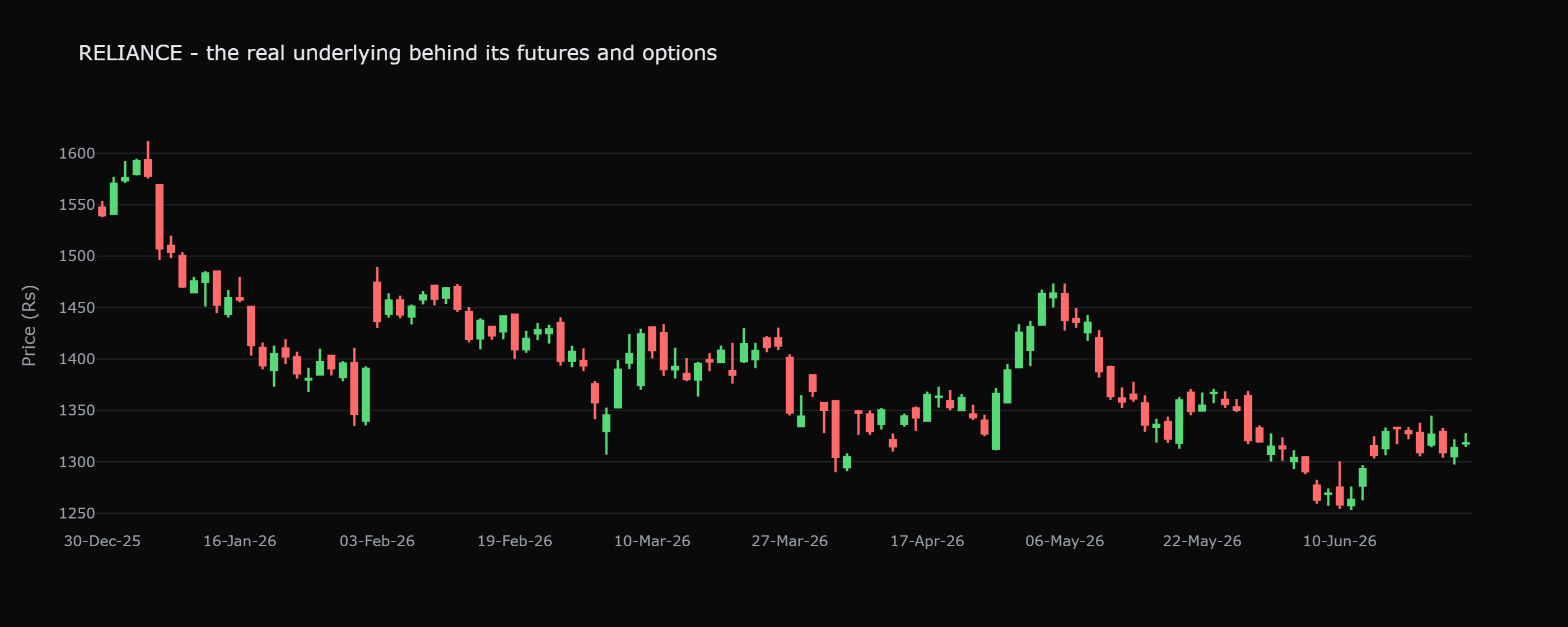
Study those candles. Most days move modestly, but a single-stock chart will show occasional jumps where the price opened well away from the prior close. Each of those gaps represents news that hit while the market was shut. Holding a leveraged RELIANCE future through such a gap means you wear the full move with no chance to react in the gap itself.
An index dilutes this. For the whole NIFTY to gap violently, many companies would have to be hit at once, which usually requires a broad market shock rather than one company's bad day. A disaster at a single index member is softened by the forty-nine others. So index futures gap too, but far less savagely on company-specific news, because no single company controls the basket.
Gap risk is the defining hazard of single-stock futures. A leveraged stock position can blow through your stop overnight on company news you never saw coming. The index spreads that risk across many names; a single stock concentrates it entirely on you.
Practical differences in risk and use
Put the pieces together and the two instruments suit different purposes. Index futures are the tool of choice for trading the broad market, for expressing a view on the economy or on banks as a sector, and for hedging a diversified portfolio, which is the next chapter's topic. They are smooth, deeply liquid, cash-settled, and free of single-company landmines.
Stock futures are the tool for a view on one specific company. If your research says RELIANCE in particular is mispriced, the stock future lets you act on exactly that, with no dilution from other names. That sharpness is their strength and their danger. You get the full move when you are right, and the full gap when news blindsides you.
- Use an index future to trade the overall market or a whole sector with diversification built in.
- Use a stock future to act on a specific, well-researched view of one company.
- Expect smoother behaviour from the index and sharper, gappier behaviour from the single stock.
A trader bullish on the banking sector buys one BANKNIFTY future, a lot of 30, and gets exposure to many banks at once, so no single bank's stumble wrecks the trade. A trader convinced RELIANCE alone is undervalued buys one RELIANCE future, a lot of 500, and accepts that one company's news now drives the entire position.
Why a beginner usually starts with the index
For someone new to futures, the index is almost always the gentler classroom. The liquidity is the deepest available, so entries and exits are fair. Cash settlement removes any fear of an accidental delivery obligation worth lakhs. And the diversification of the basket means a beginner is not exposed to the brutal overnight gap risk that a single stock can spring without warning.
None of this makes the index safe. It is still a leveraged instrument that can lose money quickly, and the next chapters do not let you forget it. But of the two, the index is the more forgiving place to learn the mechanics of going long and short, reading mark-to-market, and managing a position, without the added hazard of a single company gapping against you overnight.
The lasting point is that index and stock futures are cousins, not twins. The index gives you a diversified, deeply liquid, cash-settled basket that moves smoothly. The single stock gives you a sharp, concentrated bet that can gap hard on one company's news and may demand physical delivery at expiry. Start with the index, learn how a future behaves with the broad market spreading your risk, and graduate to single-stock futures only once you respect the gap risk that comes with betting on one name alone.