
Going Long and Going Short
Futures let you profit from a fall as easily as a rise. Learn what going long and going short mean, and why selling first is normal and not exotic in the futures market.
- ·Long means buy first
- ·Short means sell first
- ·Profiting from a fall
- ·No borrowing needed to short
- ·Both sides face unlimited risk
- ·When you would use each
Most people who come to the market carry one mental habit from a lifetime of shopping: you buy something cheap, wait for it to become dear, and sell at a profit. Buy low, sell high. It feels like the only way to make money. Futures quietly break that assumption in half. In the futures market you can just as easily start by selling something you do not own, and profit when the price falls. The order is reversed. Sell high first, buy low later. For a beginner this is one of the strangest and most powerful ideas to absorb, so let us take it slowly.
Every futures trade points in one of two directions. You are either long or short. Long is the familiar direction, betting a price will rise. Short is the mirror image, betting a price will fall. Understanding both, and the fact that futures treat them as equals, is what lets a trader make money whether the market is climbing or sinking.
Going long: the familiar direction
To go long is to buy a futures contract first because you expect the price of the underlying to rise. You enter at one price, and if the future climbs, you can sell it back higher and pocket the difference. This is the direction that matches everyday intuition, so it usually needs little explanation.
Take our running example. RELIANCE trades around Rs 1,318, and the round level on the future is 1320. If you believe RELIANCE is heading higher over the next few weeks, you buy one lot of the future at 1320. The lot is 500 shares, so each one rupee rise in the future is worth Rs 500 to you. If the future climbs to 1360, that is a 40 point gain, which is 40 times 500, or Rs 20,000 in profit before costs.
- You profit when the price rises above your entry.
- You lose when the price falls below your entry.
- The further it rises, the more you make, with no fixed ceiling.
That is going long. Buy first, sell later, profit from the rise. Nothing here is unfamiliar to anyone who has bought a share.
Going long means you buy the future first and profit if the price rises. It is the standard buy low, sell high trade, just done with a contract instead of the shares themselves.
Going short: profiting from a fall
To go short is to sell a futures contract first, without owning anything, because you expect the price to fall. You enter by selling at one price, and if the future drops, you buy it back lower to close the position. The gap between your higher selling price and your lower buying price is your profit.
This is the part that surprises beginners. How can you sell something you do not own? In the futures market it is completely natural, because a future is not a thing you possess, it is an agreement. When you sell a future you are simply taking on the obligation to deliver at the agreed price. You can cancel that obligation later by buying an equal contract back. Nothing has to be borrowed first.
Back to RELIANCE. Suppose you think the stock has run too far and is about to slip. You sell one lot of the future at 1320. If the future falls to 1280, that is a 40 point drop. Because you sold high and can now buy back low, you gain those 40 points, which is 40 times 500, or Rs 20,000. The price went down and you made money, which is the whole point of going short.
- You profit when the price falls below your entry.
- You lose when the price rises above your entry.
- The lower it goes, the more you make, all the way down to zero.
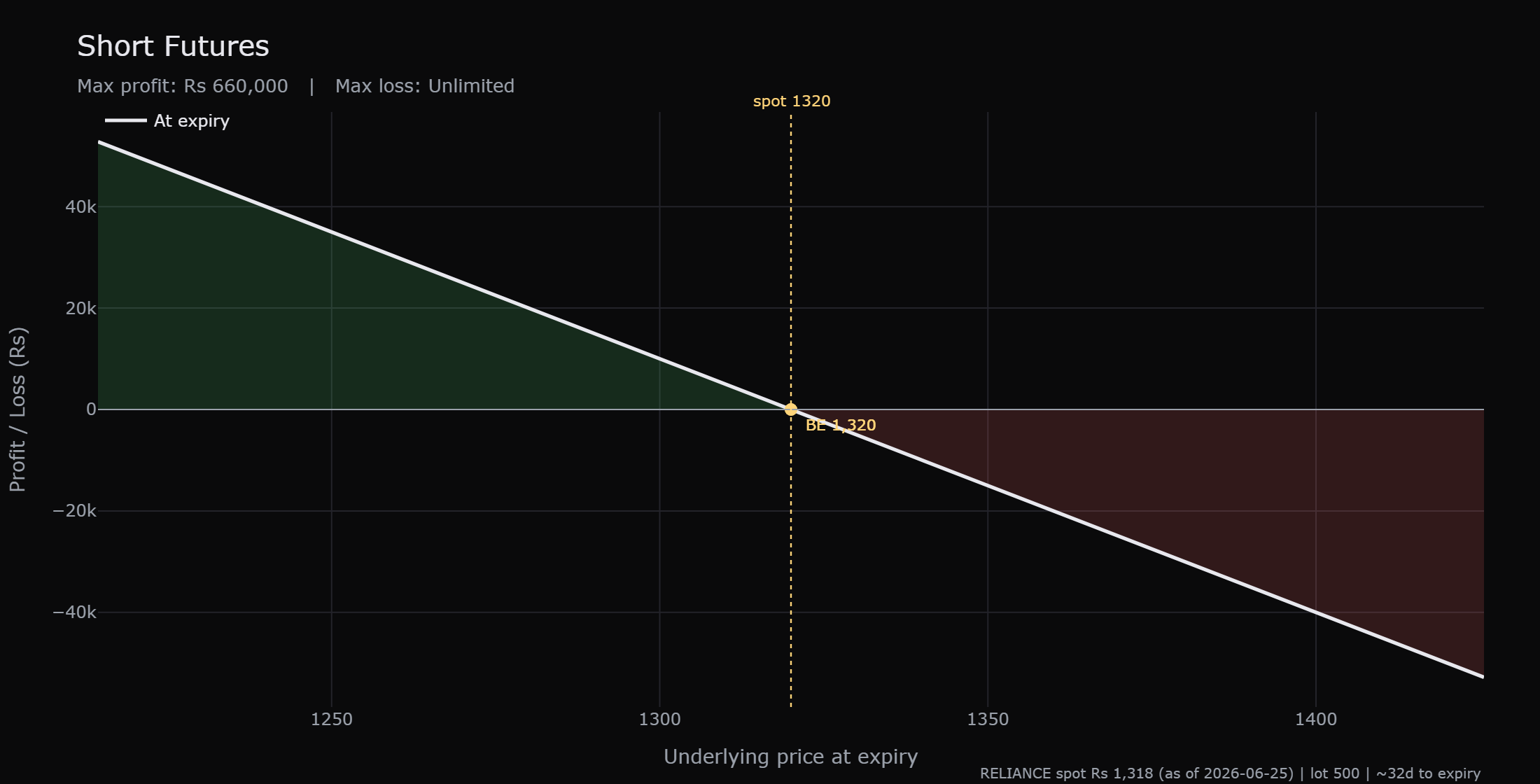
A trader convinced RELIANCE will drop sells one lot of the future at 1320. The stock falls to 1280, the trader buys the future back, and the 40 point fall becomes a profit of Rs 20,000 on the single lot. Going short turned a falling price into a gain.
Why shorting futures is easy when shorting shares is hard
If you have ever tried to short ordinary shares, you know it is awkward. To sell shares you do not own, you normally have to borrow them from someone first, pay a fee for the loan, and return them later, and in the Indian cash market a retail short usually has to be closed by the end of the same day. It is fiddly, restricted and short-lived.
Futures sweep all of that away. Because a future is an agreement rather than a stack of borrowed shares, short selling in futures needs no borrowing, no stock lending fee, and no rush to close by day end. Selling a future is mechanically identical to buying one. You simply place a sell order to open instead of a buy order. You can hold that short position for days or weeks, right up to expiry, exactly as you would hold a long one.
| Long futures | Short futures | |
|---|---|---|
| You start by | Buying a contract | Selling a contract |
| You profit when | Price rises | Price falls |
| You close by | Selling later | Buying later |
| Borrowing needed | None | None |
| Can hold to expiry | Yes | Yes |
This symmetry is one of the defining features of futures. The market does not favour optimists over pessimists. A falling market is just as tradeable as a rising one, and a short is no harder to place than a long.
In the cash market, shorting a share usually means borrowing it and closing by day end. In futures, going short is just selling to open. No borrowing, no special permission, and you can hold it as long as the contract lives.
Reading a long versus short decision on the real chart
Theory becomes real when you put it against an actual price history. Here is RELIANCE over its last 120 sessions, closing near Rs 1,318. Stand at the right edge of this chart, at today's price, and the long versus short choice is simply the question of which way you think the next move goes.
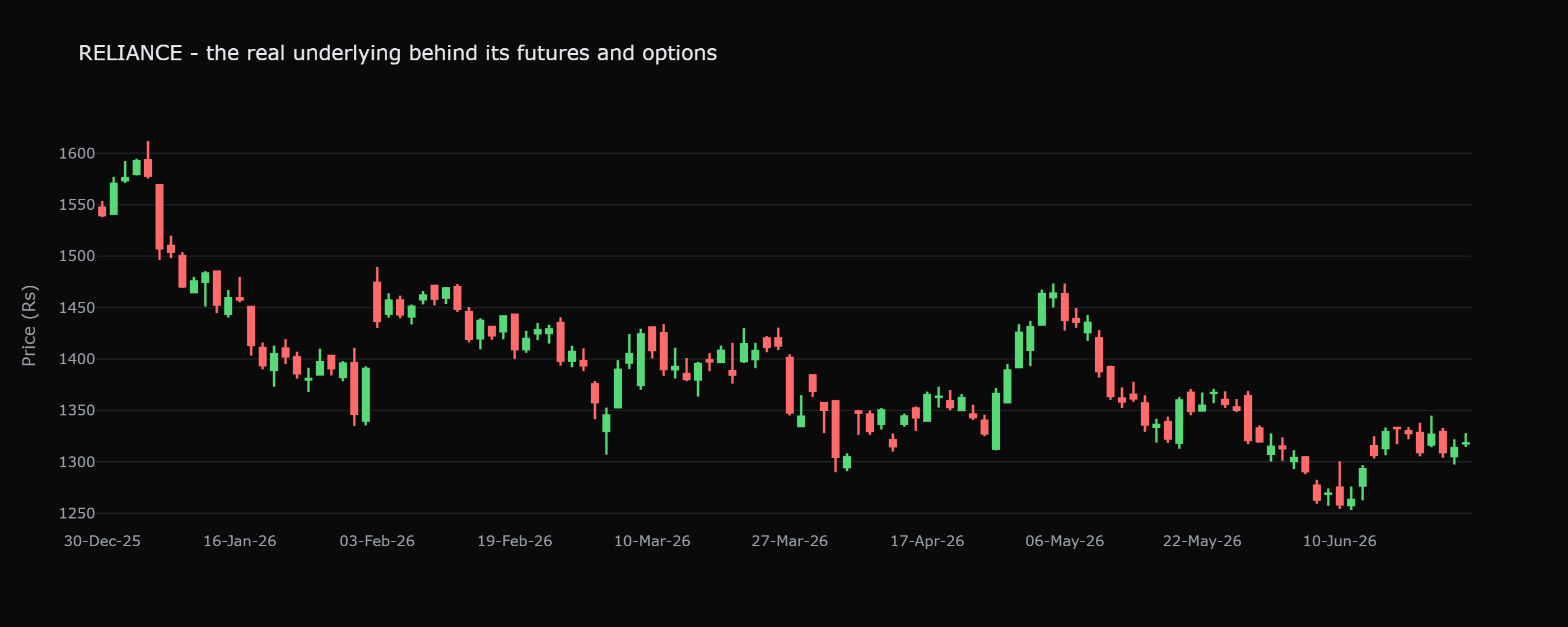
If you study the chart and conclude the trend is still upward, with each dip being bought, you would lean long. You buy the future at 1320 and you want to see those candles march higher, because every rupee up is Rs 500 in your favour.
If instead you read the chart as tired, stretched, or rolling over, you would lean short. You sell the future at 1320 and you want the candles to fall, because now every rupee down is Rs 500 in your favour. The same chart, the same starting price, two opposite trades. Which one is right is never certain in advance, and that uncertainty is exactly why risk control matters so much.
Both directions carry real risk
It is tempting to feel that shorting is a clever trick that doubles your chances. It is not a free lunch. Long and short both carry large, leveraged risk, and the danger sits in different places for each.
When you are long, your loss grows as the price falls, and the worst case is the stock going all the way to zero. That is a big loss, but it is a bounded one. When you are short, the picture is more frightening. Your loss grows as the price rises, and a price can rise without any natural limit. A stock can double or triple on good news, and a short seller feels every rupee of that climb multiplied by the lot. The arithmetic that makes shorting attractive in a fall makes it brutal in a sharp rally.
- A long loses if the market falls, with the loss capped only by the stock reaching zero.
- A short loses if the market rises, and that loss has no fixed ceiling.
- Both are amplified by leverage, so a modest move against you is a large hit to your margin.
Shorting is not safer than going long, and in one way it is more dangerous. A rising price has no upper limit, so an unhedged short can lose more than you ever imagined. Use a stop on every short, and respect that the most painful losses often come from betting against a market that keeps climbing.
When a trader chooses each
So when would you reach for a long, and when for a short? In plain terms, you go long when your honest reading of the market, the trend, the news, the broader mood, says higher. You go short when that same reading says lower. Skilled traders also use shorts defensively, selling an index future to protect a portfolio they own, a use we return to later in this course.
The lasting takeaway is freedom with responsibility. Futures let you profit in both directions, which means a falling market is an opportunity rather than a wall. But each direction can hurt you badly if the move goes the other way, and leverage makes that hurt fast. Decide your direction from genuine analysis, size the position so a wrong call is survivable, and always know your exit before you enter.