
What Is a Futures Contract?
A future is simply an agreement to buy or sell something at a fixed price on a future date. Learn what that means in plain words, with a real Indian example, before any jargon arrives.
- ·An agreement for a future date
- ·Buyer and seller obligations
- ·Underlying, price and expiry
- ·A simple real-world analogy
- ·How a stock future works
- ·Why nobody waits for delivery
Imagine you are a baker, and you know that in two months you will need a large quantity of wheat. The price today looks fair, but you are worried it might jump before you buy. So you find a farmer and you both agree, in writing, on a price right now for a delivery two months from today. You have not paid yet. The wheat has not moved. But the price is locked. You have just struck something very close to a futures contract, and people have been doing exactly this for centuries. The modern stock market version is more polished and traded on a screen, yet the idea has not changed at all.
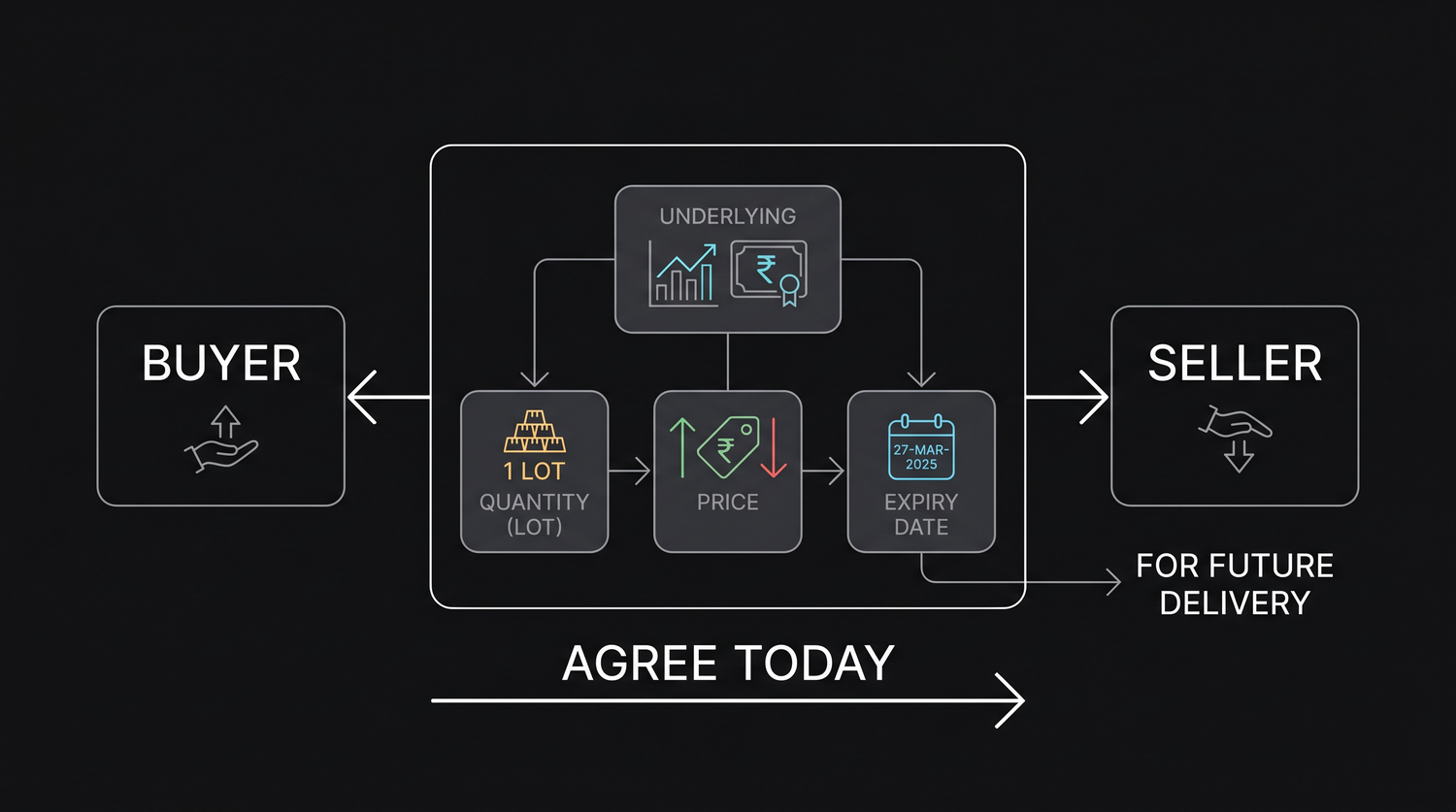
A futures contract is an agreement made today to buy or sell a fixed quantity of something at a fixed price on a fixed date in the future. Four things are decided in advance and none of them are left vague. That precision is the whole point, and once you see those four parts clearly, futures stop feeling mysterious.
The four things every future fixes
Every futures contract, no matter how complex the market around it looks, pins down four simple facts.
- The underlying is the thing being traded. It could be a stock such as RELIANCE, an index such as NIFTY, or a commodity such as crude oil or gold.
- The price is the rate you agree on today. This is the level at which the deal will be honoured later, whatever the market does in between.
- The lot size is the fixed quantity. You cannot trade one share of RELIANCE in the futures market. You trade in a standard bundle, and for RELIANCE that bundle is 500 shares.
- The expiry is the date the contract comes due. For RELIANCE stock futures this is monthly. In our worked examples the contract expires on 28 July 2026.
Here are those four parts filled in for our worked RELIANCE contract, the example we return to throughout the course.
| The four fixed parts | Our RELIANCE contract |
|---|---|
| Underlying | RELIANCE (recent close about Rs 1,318) |
| Price | Rs 1,320, the round strike near today's price |
| Lot size | 500 shares, about Rs 6,59,000 of stock |
| Expiry | 28 July 2026, about 32 days out |
Put those together and a single sentence describes a real contract. You agree today to buy 500 shares of RELIANCE at Rs 1,320 each, with the deal coming due on 28 July 2026. RELIANCE recently closed at Rs 1,318, so the round number 1,320 sits right next to today's price. Multiply 500 shares by roughly Rs 1,318 and one contract controls about Rs 6,59,000 of stock. That is one lot. It is a serious amount of money riding on a single agreement, which is why the rest of this course spends so much time on risk.
A future is a promise with four fixed parts: the underlying, the price, the lot size, and the expiry date. Decide those four and you have described the contract completely.
Two sides, and both are obliged
A futures contract always has two sides. One trader is the buyer and the other is the seller, and here is the part that newcomers must understand before anything else. Both sides are obliged to go through with the deal.
The buyer of a future has agreed to buy the underlying at the fixed price when the contract comes due. We say this trader is long. The seller has agreed to sell at that fixed price. We say this trader is short. Neither side can simply walk away because the price moved against them. The buyer must buy and the seller must sell, at the level they agreed, regardless of what the market does.
This obligation is the single biggest difference between a future and an option, and it is worth fixing in your mind now because it shapes everything later. An option gives its holder a choice. The holder can let the option expire worthless and lose only the small premium they paid. A future gives no such mercy. If you are long a future and the price collapses, you are still on the hook for the full move. There is no premium to abandon and no escape hatch.
A future is an obligation, not a choice. Both the buyer and the seller must honour the contract. Unlike an option, you cannot abandon a losing future by simply letting it lapse, so the loss can be large.
Why the price you lock matters
Locking a price is useful precisely because nobody knows what the future holds. Think about the baker again. If wheat soars, the baker is delighted to have locked a low price. If wheat crashes, the baker is stuck buying at the higher locked rate while everyone else buys cheap. The lock cuts both ways. It removes uncertainty, and removing uncertainty is sometimes worth giving up a windfall.
The same logic runs through financial futures. Suppose you are convinced RELIANCE will rise over the next month. You could buy the shares outright, but that ties up the full Rs 6,59,000. Instead you buy one RELIANCE future at Rs 1,320. You have locked the right and the duty to buy 500 shares at that level. If RELIANCE climbs to Rs 1,400, your locked price of Rs 1,320 looks excellent, and the gain on 500 shares is large. If RELIANCE falls to Rs 1,250, that same lock now hurts, and you carry the loss in full.
You buy one RELIANCE future at Rs 1,320 for the 28 July 2026 expiry. The lot is 500 shares. Every Rs 1 that RELIANCE moves is Rs 500 to your position, because 500 shares times Rs 1 is Rs 500. A move of Rs 20 in your favour is Rs 10,000. The same move against you is a Rs 10,000 loss. The contract is perfectly even-handed about which way it pays.
How a RELIANCE stock future actually works
On the OpenAlgo platform and across Indian exchanges, this RELIANCE contract has a precise name. The symbol format is the base name, then the expiry written as day, month and year, then the letters FUT. So the July contract reads RELIANCE28JUL26FUT. You do not need to memorise the format yet. The point is that the contract is completely standardised, so that any buyer and any seller anywhere are trading the exact same thing.
When you place a buy order for one lot, the exchange matches you with a seller. From that moment you hold a long position of 500 shares of RELIANCE through the future. You did not pay Rs 6,59,000. You posted only a margin, a fraction of the value, and we devote a whole chapter to that idea later because it is where both the opportunity and the danger live.
Almost nobody waits for delivery
A reasonable beginner now asks a sensible question. If you buy a RELIANCE future, do 500 actual shares land in your account on 28 July? In practice, almost never, and there are two reasons.
First, most traders close their position before expiry. Closing is simple. If you are long one future, you sell one future of the same contract, and the two cancel out. The difference between your buy price and your sell price is your profit or loss, settled in cash. This is called squaring off, and the vast majority of futures trades end this way long before the expiry date arrives.
Second, the settlement rules differ by underlying. Index futures such as NIFTY and BANKNIFTY are cash-settled. There is no basket of shares to deliver, so any open position at expiry is simply settled in rupees against the final index level. Single-stock futures such as RELIANCE can go to physical delivery in India if you hold them to expiry, which is one more reason ordinary traders square off in good time rather than arrange to receive or hand over 500 shares.
If you ever want to feel how a contract behaves without risking money, use sandbox trading (analyzer mode in OpenAlgo). You can place and square off a RELIANCE future and watch the profit and loss move, with no real capital at stake.
The mental model to carry forward is small and sturdy. A future is a locked agreement between two obliged parties to trade a fixed quantity at a fixed price on a fixed date. The buyer is long and hopes the price rises. The seller is short and hopes it falls. Most positions are closed for cash before they ever reach delivery. Hold that picture firmly, because every chapter from here builds directly on it.
Futures markets are older than stock exchanges. Standardised contracts for rice were trading in Japan in the seventeenth century, for the very same reason traders use them today, to lock a price against an uncertain future.
In the next chapter we look at why these contracts exist at all, and you will meet the two kinds of people who trade them. One is trying to get rid of a risk. The other is happy to take it on. The market only works because both show up.