
Beginner Mistakes and Your Futures Checklist
Close the course with the mistakes that ruin beginners and a checklist to avoid them. Trading too large, holding stock futures into expiry, ignoring liquidity, averaging leveraged losses, and treating margin as the most you can lose, then a clear pre-trade checklist.
- ·Trading too large
- ·Holding stock futures to expiry
- ·Ignoring liquidity
- ·Averaging a leveraged loss
- ·Margin is not your max loss
- ·The pre-trade checklist
You have reached the end of the course, and you now understand more about futures than most of the people trading them around you. You know what a contract is, how leverage and margin work, why a position is settled every single day, what the basis and rollover mean, how stock futures settle physically while the index settles in cash, and how to size a position so that being wrong does not end you. That is a real foundation. But knowing all of it in a calm chapter is not the same as holding your nerve in a loud, fast market with real money on the line. This final chapter is the bridge between the two. It collects the mistakes that quietly empty beginner accounts, then hands you a short checklist to run before every trade, so the discipline you have learned actually survives contact with the market.
Almost every blown-up account is some combination of the same few errors. None of them is exotic. Learn to recognise them and you have already side-stepped most of the damage that beginners do to themselves.
The mistakes that empty beginner accounts
These are the recurring ways new futures traders lose, drawn straight from the threads that have run through this whole course. Read them as a list of things not to do.
Oversizing by sizing off the margin instead of the exposure. One RELIANCE future is 500 shares, controlling about Rs 6,59,000 of stock at the latest price near Rs 1,318, even though you only post a margin of roughly Rs 1,00,000 to Rs 1,30,000 to open it. Beginners look at the small margin, decide they can "afford" several lots, and quietly take on twenty or thirty lakh of exposure. The exposure is the thing that moves against you, not the margin.
Trading without a stop. Entering a leveraged position with no pre-decided exit is not courage, it is a slow surrender. You must know the price at which you admit the trade is wrong before you enter, because a move that is merely uncomfortable on a cash holding can be account-threatening on a future.
Averaging into a loser. Adding more to a losing position to "improve the average" feels clever and is one of the fastest ways to ruin. You are increasing leverage and exposure on the exact trade the market is already telling you is wrong, so a small loss becomes a large one.
Chasing the illiquid far month. The near-month contract is where the volume and the tight spreads live. The far month often trades on a wide spread with thin depth, so you pay extra to get in, pay again to get out, and suffer slippage every time. A beginner belongs in the near month.
Ignoring transaction costs and over-trading. A single NIFTY round trip, one lot bought and sold near 24,000, costs about Rs 929 once you add brokerage, STT, exchange and GST charges, stamp duty and the rest. That is roughly 14 points the future must move in your favour before you make a single rupee. A trader who takes ten round trips a day pays that ten times, and over-trading bleeds an account even when the calls are right.
Carrying a stock future into physical settlement by accident. RELIANCE and other single-stock futures settle by physical delivery. Hold one to expiry and you are not just paid a difference, you must give or take the actual shares, which means finding the full Rs 6,59,000 in cash or the stock itself. For someone who only wanted a leveraged bet, that is a nasty, expensive surprise. Close or roll a stock future before the final days.
Revenge trading after a loss. A loss stings, and the urge to "win it straight back" with a bigger, hastier trade is powerful and dangerous. Revenge trades are sized by emotion, not by your risk plan, and they are how one bad morning becomes a wrecked account.
Confusing the small margin with the real risk. The margin is the deposit that lets you in, not the most you can lose. An overnight gap can hand you a loss larger than the margin you posted, leaving you owing money on a position you thought was capped. The instrument's danger is the full exposure behind that small deposit.
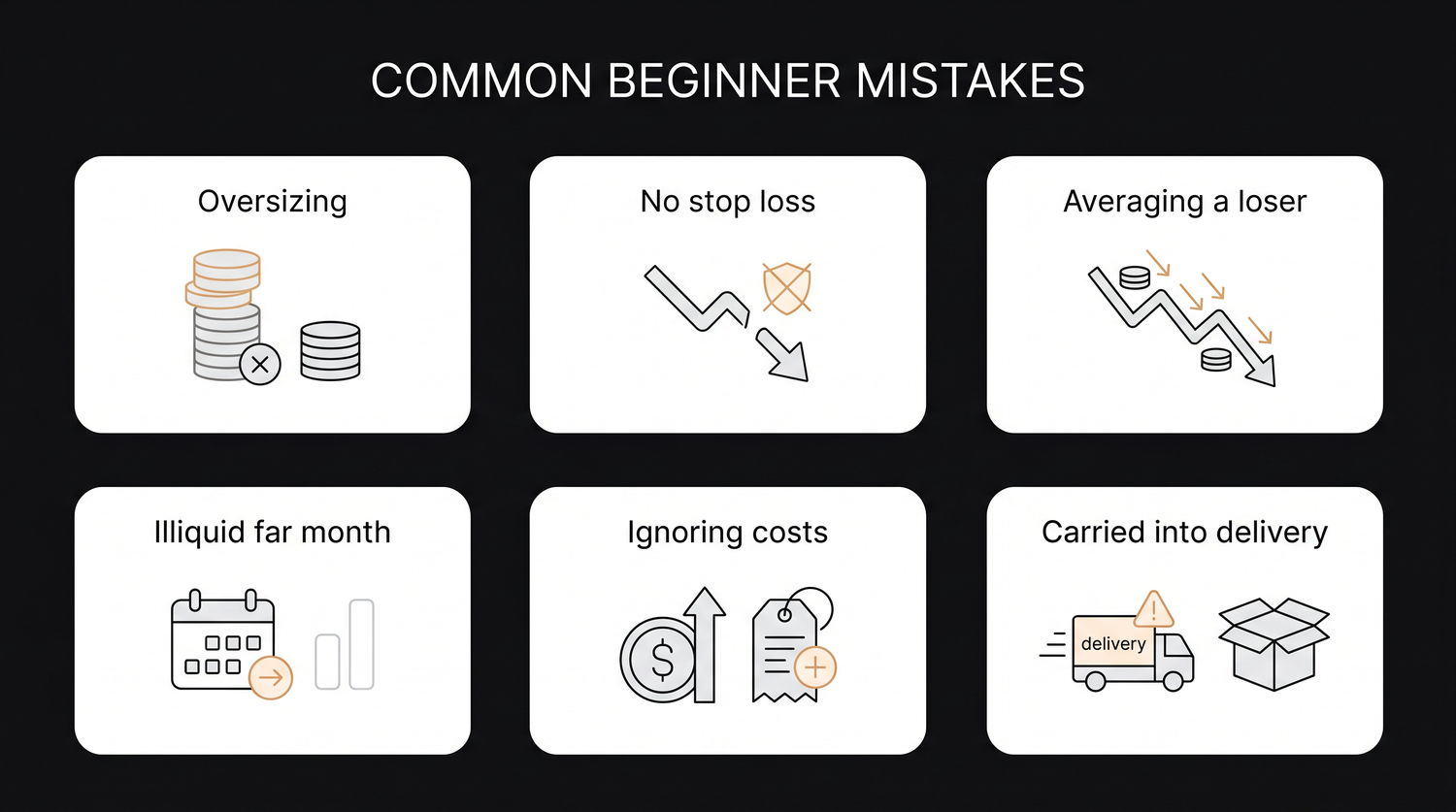
Notice how many of these mistakes are really one mistake wearing different clothes: forgetting that the small margin sits on top of a large, leveraged exposure. Oversizing, averaging down, revenge trading and being dragged into delivery all start with underestimating what you actually control.
The pre-trade checklist
The cure for all of this is boring, repeatable, and works. Before you press buy on any futures order, walk this checklist. It takes under a minute once it is a habit, and it catches almost every error above before it can cost you anything.
| Before you press buy | What it protects you from |
|---|---|
| Confirmed the exact contract and expiry | Trading the wrong month or being auto-settled by surprise. Read the symbol in full, for example RELIANCE28JUL26FUT, and know that 28 July 2026 is the last Tuesday, so you decide the exit, not the calendar. |
| Checked the margin on the calculator and hold a cash buffer | A margin shortfall and a forced exit. Use the OpenAlgo margin calculator for the real requirement, then keep spare cash, because exchanges raise margins before big events. |
| Sized the position to a fixed fraction of capital | Oversizing. Risk only about one to two percent of capital per trade, sized off the full exposure and the stop distance, never off the tempting small margin. |
| Set a stop before entering | The position running away from you. Decide the exit price calmly in advance, so a fast loss meets a plan instead of panic. |
| Accounted for costs | Over-trading and break-even blindness. Know that a NIFTY round trip is about Rs 929 and roughly 14 points, and that costs scale with size and price. |
| Checked the event calendar | Gap and event risk. Look for results, an RBI decision, the budget, an election count or expiry week, and reduce size or stay flat ahead of a known shock. |
| Written down the exit plan for a win and a loss | Drifting and revenge trading. Decide your target and your stop before entry, so both outcomes are already handled and no decision is made in the heat of the moment. |
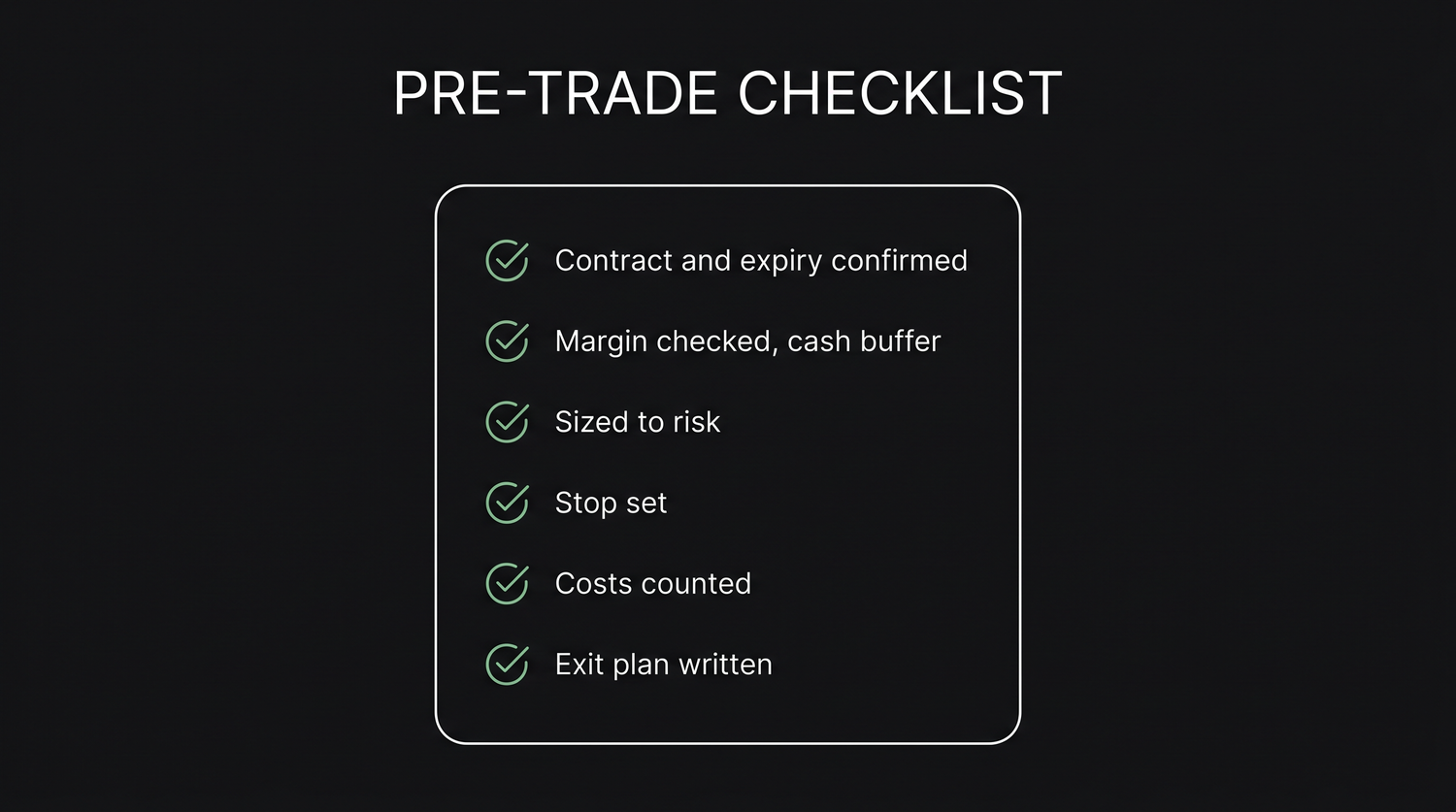
Keep this checklist somewhere you cannot avoid it, taped to your monitor or pinned in your trading notes. The goal is not to memorise it but to make running it automatic, so the discipline does not depend on how you happen to feel that morning.
Run the checklist on one real trade
Watch the whole course come together on a single position. Suppose you want to go long one NIFTY future near 24,000, where the lot of 65 means one contract is about Rs 15,60,000 of exposure. Your trading capital is Rs 5,00,000 and you cap risk at one percent, which is Rs 5,000.
First, the contract and expiry: you confirm the near-month symbol and its date, so you are never surprised by settlement. Next, the margin: you check the calculator for the real requirement and confirm you hold a cash buffer on top. Then sizing: your stop sits 30 points away, and at Rs 65 a point per lot, one lot risks about Rs 1,950. That fits inside your Rs 5,000 budget, but two lots would risk close to Rs 3,900 and push you toward the edge, so the disciplined choice is one lot. You set that 30-point stop before entering. You note the cost, about Rs 929 and 14 points round trip, so your target has to clear that to be worth taking. You glance at the event calendar and see nothing major before your planned exit. Finally you write the plan down: enter here, exit at the target, cut at the stop, no averaging down. Seven small checks, and a trade that cannot quietly turn into a disaster.
The same RELIANCE long that looked tempting at five or six lots, controlling thirty to forty lakh on a margin of a few lakh, fails the very first checks: it oversizes off the margin and risks far more than two percent of a normal account on one trade. The checklist would have stopped it before the market did.
Where you go from here
You now hold the complete picture of a futures contract, from the agreement made today to the cash or shares that change hands at expiry, and you understand the one feature that decides everything, leverage. The traders who last are not the boldest or the best at predicting the next candle. They are the ones who respect the exposure behind the margin, size small enough to be wrong many times, always know their exit, and run a checklist that turns good intentions into a habit. Be one of those. If you want to rehearse the discipline with nothing at stake, practise in sandbox trading, the analyzer mode in OpenAlgo, until the routine is second nature.
Survival in futures is not about being right more often. It is about staying small, controlling the exposure behind the margin, and never skipping the checklist. Do that and you give yourself the time every trader needs to actually learn.
The natural next step from here is options. A future gives you a straight, symmetric payoff and an obligation you cannot walk away from, while an option lets you shape risk, cap your loss to a known premium, and build positions that bend rather than run in a straight line. The options courses on this site pick up exactly where this one ends, taking the same real Indian instruments and the same honest, plain-English approach into that richer toolkit. You have built the foundation. Go and add the next floor.