
The Last Edge: Psychology, Discipline & What's Next
Most traders fail not on analysis but on themselves. Learn the mental traps, the discipline of a written plan and a journal, and where to go next, including automating a tested setup with OpenAlgo.
- ·Fear, greed and FOMO
- ·The trading plan and journal
- ·Why most retail traders lose
- ·Discipline over prediction
- ·Backtesting and automation with OpenAlgo
- ·Your path from here
You can finish this entire course, read every candle, draw every level, memorise every base rate, and still lose money. Not because the analysis failed, but because in the live moment, with real rupees on the line, you did not do what you knew to do. You held the loser "just a little longer." You skipped the stop because the chart "felt" like it would bounce. You chased the breakout you swore you would wait for.
That gap, between knowing and doing, is the last and largest edge in trading. Every chart skill in this course is available to anyone with an internet connection; what is scarce is the discipline to use them when it is uncomfortable. This closing chapter is about the one thing no indicator can measure, the person in the chair, and then it points you toward what comes next: turning a tested plan into a system that runs whether or not your emotions cooperate.
The three saboteurs: fear, greed and FOMO
Almost every self-inflicted trading wound traces back to three emotions, each one flipping a rule you already know.
- Fear makes you cut winners early and freeze on losers. You sell a good trade the moment it shows a profit, terrified of giving it back, then you sit paralysed as a loser drifts past your stop, because closing it makes the loss "real." Fear gets the reward-to-risk math, how much you make versus how much you lose, exactly backwards: small wins, big losses.
- Greed makes you oversize and overstay. After a couple of wins you risk 5% instead of 1% "because you are hot." You hold past your target hoping for more, and watch the gain evaporate. Greed is what turns the careful sizing of the last chapter into a single bet big enough to hurt you.
- FOMO, the fear of missing out, makes you chase. A stock jumps 6% on news and you buy at the high, abandoning your plan, because watching it run without you is unbearable. Recall the data: more than half of 20-day breakouts fail and fall back within five days, and bigger gaps fill less often but run harder, so chasing a move that has already stretched is precisely the low-odds trade.
The cruel design is that all three feel like action, like you are doing something smart. In reality each one overrides a rule you set when you were calm. The market is an engine for converting your emotions into other people's profits.
Your worst trades will feel the most justified at the time. Revenge-trading after a loss, doubling down on a "sure thing," chasing a runaway move, these never feel like mistakes in the moment. They feel like conviction. That is exactly why you need rules written down before the moment arrives.
Why most traders lose
It is no secret that the large majority of active retail traders, ordinary individuals trading their own money, lose money over time. Study after study, in India and abroad, finds the same uncomfortable result. The interesting question is why, and this course has quietly answered it, chapter by chapter, with data.
The losses are not mainly because people pick bad indicators. They are because the edges are thin and the mistakes are expensive:
- The signals barely beat doing nothing. The baseline drift, the average move of any Nifty 50 day, was already +1.48% over 20 days. A golden cross was positive only 59% of the time at 60 days. A full trend filter beat simple buy-and-hold in just 8% of 48 stocks. The honest edge in a single signal is small, and small edges are easily erased.
- Costs and overtrading erase the thin edge. Fees, taxes, and slippage, the gap between the price you wanted and the price you actually got, are subtracted from every trade. Trade constantly, chasing every wiggle, and you pay those costs over and over until a slim edge goes negative.
- Emotion inverts the math. Cutting winners and riding losers flips reward-to-risk against you; oversizing turns a normal losing streak into the deadly bottom rows of the drawdown table.
- Curve-fitting and false confidence. Stacking five indicators that all say the same thing, or tuning a system until the past looks perfect, feels like rigour and delivers ruin.
Put it together: a small real edge, minus costs, minus emotional errors, minus overtrading, lands most people below zero. The losers are not short of charts. They are short of the discipline and risk control that protect a thin edge long enough for it to pay.
Most traders do not lose because the market is unbeatable. They lose because they take a small statistical edge and then give it all back through oversizing, overtrading, chasing, and refusing to take stops. The edge was never the problem. The behaviour was.
Discipline over prediction
Here is the reframe this whole course has been building toward. Beginners think trading is about prediction, being right about where price goes next. The data says prediction is a coin flip plus a little: a 59% signal, a 56% fakeout rate, a +2.2% best-bucket return. Nobody is reliably right.
Professionals do not try to be right. They try to be disciplined: to take many small, fixed-risk bets where the odds are slightly in their favour, cut the losers without argument, let the winners run, and repeat the process thousands of times so the thin edge compounds. The edge is not in the next trade. It is in following the same sound process across hundreds of trades while everyone around you is improvising.
This is genuinely good news, because discipline is learnable in a way that prediction is not. You will never reliably forecast a stock. You can absolutely learn to honour a stop, size every trade the same way, and not chase. That is a skill, and it is the one that pays.
The written plan
Discipline does not survive contact with a live, moving market unless it is written down beforehand. A trading plan is your calm self leaving instructions for your panicked self. It does not need to be long; it needs to be specific enough that there is nothing to decide in the heat of the moment:
- What I trade: which instruments, which timeframe, which setups, and nothing else.
- My entry: the exact condition, decided top-down, that puts me in.
- My stop and target: where I am wrong, and the reward-to-risk I require before taking the trade.
- My size: risk 1% to 2% of capital, sized from the stop, every time.
- My rules of conduct: no trading after a set number of losses in a day; no chasing gaps; no widening stops; no trade that breaks the plan.
The power of the plan is that it turns trading from a series of fresh, emotional decisions into the simple act of following, or not following, a rule. When a trade tempts you off-plan, you do not have to win an argument with yourself; you only have to notice that it is not in the plan.
The trading journal
If the plan is the rulebook, the journal is the game tape, the recording you review afterward. After each trade, write down what the setup was, why you took it, where your stop and target sat, and, most importantly, whether you followed your plan, win or lose. Note the emotion you felt.
This separation is the whole point. A good trade is one where you followed your rules; a bad trade is one where you broke them. The outcome is almost beside the point: a winning trade taken on a whim is a bad trade that happened to pay, and it will teach you a habit that eventually costs you dearly. Over a few dozen entries, the journal stops lying to you. It shows the patterns, the FOMO chases, the moved stops, the oversized "sure things," that no amount of charting skill will fix until you can see them.
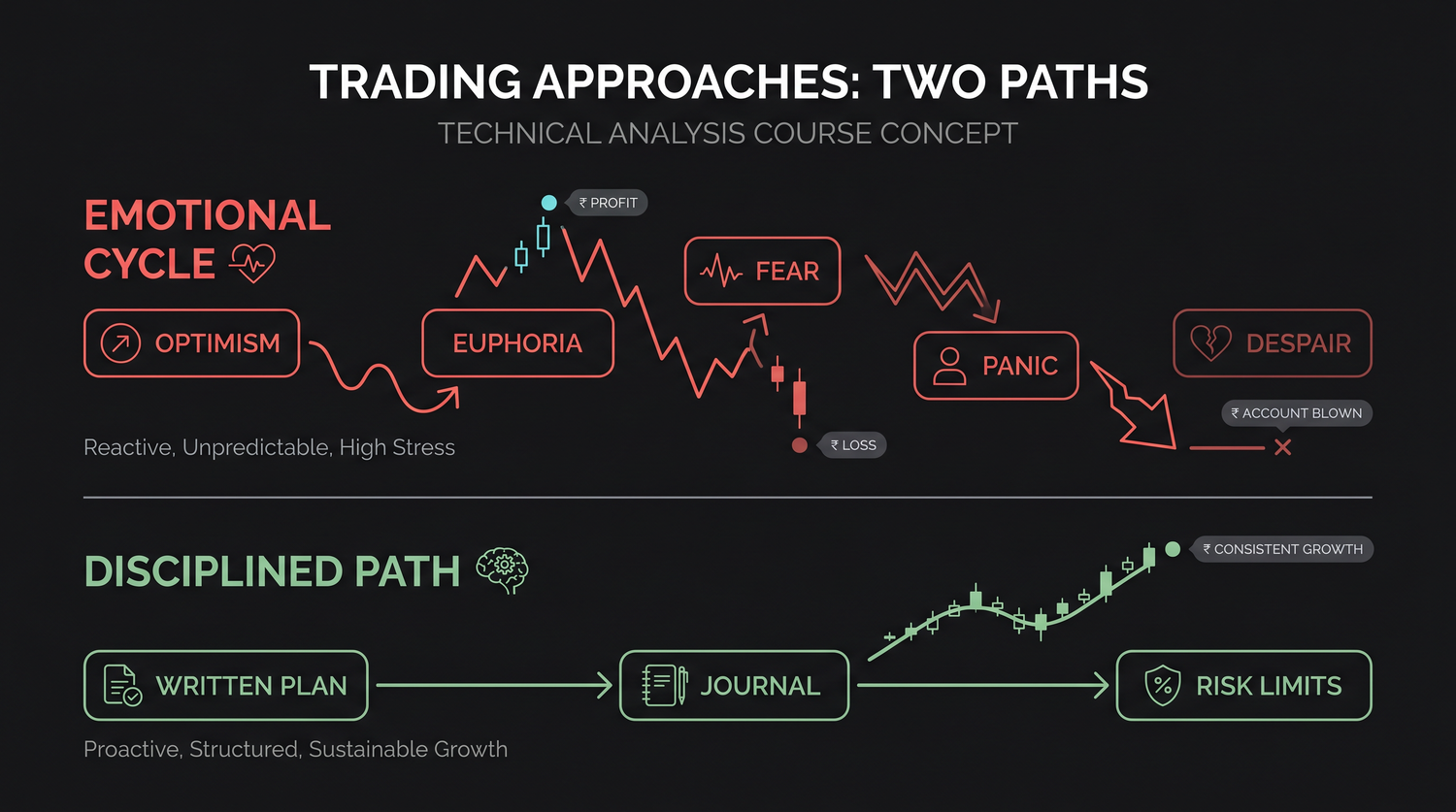
Grade yourself on process, not profit. Tally how many of your last twenty trades followed your written plan exactly. If that number is low, your problem is not your charts, and no new indicator will fix it. Your edge is leaking out through your own hands.
From reading charts to running systems
There is a structural reason discipline is so hard for a human: you have to feel fear and greed in real time and override them, trade after trade, forever. There is a way to take much of that weight off your shoulders, and it is the natural next step from everything you have learned.
Once a plan is written as clear rules, as we did in the strategy chapter, with risk defined as we did in the last chapter, it no longer needs you to pull the trigger. It can be backtested rigorously over years of history, then automated, set up to carry out the rules by itself, exactly as written, with no chasing, no moved stops, no skipped entries. A machine does not feel FOMO.
This is exactly what OpenAlgo, the free and open-source platform behind this course, is built for. It can pull real NSE market data, work out your signals, test the plan against years of history, run it first in sandbox trading (analyzer mode) so you can see how it behaves with no money at risk, and then connect to your own account for live trading, all driven by your written rules instead of your emotions. Automation does not invent an edge you do not have, but it does protect a real edge from the one thing most likely to destroy it: you.
The honest promise is not that automation makes you money; the backtests in this course are proof that simple rules are no money machine. The promise is that automation makes you consistent: it carries out a tested, risk-managed plan the same disciplined way on your worst day as on your best. Consistency is what lets a thin edge survive long enough to matter.
Your path from here
You began this course unable to tell a candle from a bar. You can now read market structure, mark the levels that matter, judge a pattern in context, use indicators without drowning in them, and, most importantly, you know the base rates: which classic "rules" the data supports and which it quietly debunks. That honest, evidence-first foundation is rarer than any pattern.
Where you go next depends on what pulled you in:
- To turn these chart skills into running, automated strategies, continue with the other free courses at /learn. They cover Python for traders, algorithmic and quantitative trading, and building systems on OpenAlgo, picking up exactly where this course's bridge leaves off.
- To deepen the analysis itself, return to any chapter and re-run its study on the stocks you follow. Every chart in this course came from real NSE data you can pull yourself; test the claims again, because a fact you have checked with your own hands is one you will actually trust under pressure.
A final word. Technical analysis is not a crystal ball, and this course never pretended otherwise; that honesty was the point. What it gives you is a disciplined way to read probability and control risk: to take sensible bets, lose small when you are wrong, win bigger when you are right, and stay in the game long enough for a modest edge to compound. The charts are the easy part. The discipline to follow them is the craft of a lifetime, and you now have everything you need to begin it well.
Quick recap
- Fear, greed, and FOMO each flip a rule you already know, cutting winners, oversizing, chasing extension, and each one feels like smart action.
- Most traders lose not from bad charts but from giving back a thin edge through costs, overtrading, and emotional errors; the edge was never the problem, the behaviour was.
- Aim for discipline, not prediction, a learnable skill that compounds a small edge across many trades.
- A written plan made when calm, plus a journal that grades you on process rather than profit, are the tools that build that discipline.
- The next step is to backtest a tested, risk-managed plan and automate it with OpenAlgo, running it in sandbox trading (analyzer mode) first, so consistency replaces emotion.
- Continue your journey with the free courses at /learn, and keep checking every claim against real data with your own hands.
That is the course. You came to read charts; you leave knowing how to read odds, manage risk, and act with discipline, the difference between someone who watches the market and someone who can trade it. Go well.