
OS6xxx Data
The errors about the data a script runs on: timeframes, request expressions, other instruments, the bars themselves, the compiled program and backtest settings.
On this page
This page covers the OS6xxx codes of OpenScript (also called OpenAlgo Script): the errors about the data a script is given and the data it asks for. They cover timeframes written in a request, other instruments, the bars the engine receives, the facts about an instrument, the compiled program a host loads, and the settings of a backtest run. Many of them are not mistakes in your script at all but answers from the host or faults in the data, and the explanations below say so wherever that is the case, so you know whether to change the script or look elsewhere.
When they appear
| When | Codes | What happens |
|---|---|---|
| When the script compiles | OS6001, OS6003 | Shown in the console under the editor. Nothing runs |
| When the program loads, before bar 0 | OS6001 for a timeframe from an input, OS6002, OS6004, OS6006, OS6012, OS6015 to OS6019 | The study or run is refused whole and nothing is drawn. On a chart, /trading shows the code and the message in a notice |
| When the bars arrive, or while they run | OS6010, OS6011, OS6005 | The run stops at that bar, as for any runtime error |
| When the host answers a request | OS6007, OS6008, OS6009, OS6014 | Nothing stops. The read is absent, and req.error() returns the message |
| Before a backtest's first bar | OS6020, OS6021, OS6023, and OS6022 on a replay | The run is refused and nothing is computed. Of these, only OS6021 can appear in the Backtest panel, which shows the code and the message |
| Not raised in version 0.5.0 | OS6013 | The shape it describes is refused earlier, when the script compiles |
The host named throughout this page is the application the engine runs inside. It supplies the bars and the facts about the instrument, and answers requests for other data. In OpenAlgo it is the /trading page for charts and backtests, and the strategy runner on the OpenAlgo server for a deployed strategy.
The request answers deserve a note of their own. A read that the host cannot answer does not stop the study: everything that does not depend on it keeps drawing, the read is absent, and req.error() on the read's name returns the message with the host's reason. A study that shows that reason, as the example below does, never leaves you guessing at an empty line. See Other instruments.
A request written to avoid them
This study colours the bars by the daily trend on an intraday chart. The timeframe comes from an input, everything computed on the daily bars is inside the request expression, and a table in the corner says whether the daily data arrived.
version 1
study("Daily trend filter", overlay = true)

tf = input("1D", "Higher timeframe", kind = "interval")
len = input(20, "Average length", min = 1, max = 200)

// Everything computed on the daily bars goes inside the request expression,
// and the timeframe comes from an input, so both are fixed before bar 0
// (OS6003, OS6013).
dailyAvg = req.timeframe(tf, ema(close, len))
dailyUp = req.timeframe(tf, close > ema(close, len))

plot(dailyAvg, "Daily average", orange, style = "step")
barColor(isNone(dailyUp) ? none : (dailyUp ? lime : red))

// A read the host could not answer is absent, and req.error says why
// (OS6007, OS6008, OS6009, OS6014).
why = req.error(dailyAvg)
status = table("Status", 1, 1, position = "topRight")
if bar.isLast
    cell(status, 0, 0, why != "" ? why : "Daily data ready")
Timeframes
A timeframe is written as a string: a count and a unit, or a bare number of minutes. See Timeframes and Higher timeframes.
OS6001 Unknown timeframe
What it means
The units are case sensitive:
| Unit | Means | Examples |
|---|---|---|
m | Minutes | "1m", "5m" |
h | Hours | "1h" |
D | Days | "1D", "2D" |
W | Weeks | "1W" |
M | Months | "1M", "3M" |
| none | Minutes | "15", "60" |
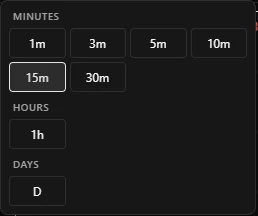
So "1M" is one month and "1m" is one minute, and "60" and "1h" are the same timeframe. Anything else is refused: a word such as "hourly", a lower-case day or week such as "1d", or "D" with no count. A timeframe written in the source is checked when the script compiles; one that comes from an input() is checked when the study loads, with the same code.
One case catches people out on /trading. The chart's daily interval is named D, which is not a timeframe the language reads, so req.timeframe(chart.interval, close) compiles and is then refused with this code when the study loads on a daily chart. Write "1D" in the request instead of passing chart.interval.
How to fix it
Write a count and a unit, or a bare number of minutes: "5m", "1h", "1D", "1W", "60".
Before
d = req.timeframe("hourly", high)After
d = req.timeframe("1h", high)OS6002 The requested timeframe is lower than the chart's
What it means
Folding bars upward works: twelve 5 minute bars make an hour. Folding downward cannot, because the chart was never given the prices inside its own bars, and a study that invented them would repaint. So a request for an interval finer than the chart's, such as "5" on a 60 minute chart, is refused when the study loads, naming both intervals. If you need 5 minute detail, put the chart on 5 minutes and read the coarser interval from there.
How to fix it
Request chart or higher, or change the chart's interval to the lower one and fold upwards instead.
Before
m5 = req.timeframe("5", close)After
h1 = req.timeframe("60", close)OS6015 The requested timeframe does not fold into the chart's
What it means
An intraday request is built by counting chart bars into groups, so its interval must be a whole multiple of the chart's. On a 5 minute chart, "15" and "60" fold cleanly; on a 30 minute chart, "45" does not, because 45 minutes is one and a half chart bars. Day, week and month requests are built from the calendar and the session instead, so they are exempt. The study is refused when it loads, and the fix names an interval that works.
How to fix it
Request a multiple of chart, for example suggestion.
Before
r = req.timeframe("45", close)After
r = req.timeframe("60", close)OS6014 The feed does not offer this timeframe
What it means
A timeframe can be well formed and still be one the data source does not store for this instrument, such as 3 minute bars from a feed that keeps 1 and 5 minute bars. The host answers with the intervals it does serve, and the message lists them. Like the other request answers on this page, it stops nothing: the read is absent and req.error() carries the message. Request one of the listed intervals, or a coarser one that folds from them.
How to fix it
Request one of available, or derive the interval you want from a lower one the host does serve.
Before
r = req.timeframe("3", close)After
r = req.timeframe("5", close)OS6013 The request changed after the first bar
What it means
The symbol and the timeframe of a request are settled once, before the first bar, so that the host can fetch each series once and keep it in step with the chart. A request whose identity changed from bar to bar would need a new fetch on a bar that had already been drawn.
Not raised yet. In version 0.5.0 nothing raises OS6013, because nothing can reach it: a timeframe or a symbol computed from bar data, like the one in the example below, is refused when the script compiles, with OS3003. Take the timeframe from a literal or from an input() with kind = "interval", as the fix does.
How to fix it
Compute the symbol and the timeframe from literals or inputs, not from bar data.
Before
tf = close > open ? "60" : "1D"
h = req.timeframe(tf, high)
After
tf = input("60", "Higher timeframe", kind = "interval")
h = req.timeframe(tf, high)
Request expressions
OS6003 A per-bar name inside a request expression
What it means
The expression passed to req.timeframe() or req.symbol() is computed on the requested bars, in their own time: daily bars for a "1D" read, the other instrument's bars for a symbol read. A value computed on the chart's own bars, such as a 20 bar average of 5 minute closes, has no meaning on a daily bar, so the compiler refuses it.
In version 0.5.0 the only names from the rest of the file the expression can read are inputs, the names an input() assigns. Every other name is refused, even one that holds a plain number:
k = 20
d = req.timeframe("1D", sma(close, k))
plot(d, "Daily average")
Write numbers and arithmetic inside the expression instead, such as sma(close, 2 * 10), or make the number an input. Move any calculation inside the expression, so it is computed on the requested bars, as the example at the top of this page does with ema(close, len), where len is an input.
How to fix it
Move the calculation inside the request expression, or pass a constant: a literal or an input().
Before
m = sma(close, 20)
d = req.timeframe("1D", close > m)
After
d = req.timeframe("1D", close > sma(close, 20))Instruments and their facts
OS6007 Unknown symbol or exchange
What it means
The host resolves every symbol a script names against the instruments it can serve. When it does not know the symbol on the exchange named, or on the chart's own exchange when the read names none, the read is refused with this code rather than returned empty, because an empty series looks exactly like an instrument that did not trade. The rest of the study keeps drawing, the read is absent, and req.error() returns the message.
Check the spelling and the exchange. In OpenAlgo an index has an exchange code of its own: NIFTY is read with exchange = "NSE_INDEX", not "NSE", and an option or future on it with exchange = "NFO". See Other instruments.
How to fix it
Correct the symbol, and name the exchange it trades on when it is not the chart's: req.symbol("SYMBOL", "1D", close, exchange = "EXCHANGE").
Before
other = req.symbol("SYMBL", "1D", close)After
other = req.symbol("SYMBOL", "1D", close, exchange = "EXCHANGE")OS6008 The request returned no bars
What it means
The host found the instrument and had no bars for it over the range the chart covers. A futures or options contract that has expired, one that had not been listed yet, and a range older than the stored history all end here. As with OS6007, the read is absent, req.error() carries the message, and the rest of the study keeps drawing.
For NFO and MCX contracts, which expire on a fixed schedule, read the contract that was trading over the chart's range, or move the chart into the period the contract traded.
How to fix it
Move the chart's range into the period the instrument traded, or request a symbol that covers it.
Before
fut = req.symbol("EXPIRED_CONTRACT", "1D", close)After
fut = req.symbol("CURRENT_CONTRACT", "1D", close)OS6009 The request failed
What it means
The host knows the instrument and could not get its bars: the data source refused, did not answer, or limited how often it may be asked. The message carries the host's own reason, and that reason is the thing to act on: it describes a connection, permission or quota problem, not a problem in your script. The read is absent and req.error() carries the message.
If the value can be worked out from the chart's own bars, such as the day's high on an intraday chart, derive it and drop the request, as the fix below does with session.isFirstBar. That fix needs the instrument's session hours, which the /trading chart does not state in this release, so there reset on a new IST date instead:
newDay = isNone(time[1]) or not date.isSameDay(time, time[1], "Asia/Kolkata")

var dayHigh = none
if newDay
    dayHigh = high
else
    dayHigh = max(dayHigh, high)

plot(dayHigh, "Day high so far", aqua, style = "step")
How to fix it
Act on reason in the host: it is a connection, permission or quota problem. Where the value can be derived from the chart's own bars, derive it and drop the request.
Before
dayHigh = req.timeframe("1D", high)After
var dayHigh = none
if session.isFirstBar
    dayHigh = high
else
    dayHigh = max(dayHigh, high)
OS6012 An instrument fact is not known
What it means
Tick size, lot size, the trading session and the timezone come from the host's record of the instrument, not from the bars. In version 0.5.0 the engine raises this code when it loads a program and that record cannot be read: a session stated without the timezone it is measured in, a timezone the calendar does not know, or session hours not written as HH:MM. It is a problem in the host's record, not in your script.
A fact the host simply leaves out does not raise this code. chart.tickSize or chart.lotSize reads as absent, roundToTick() returns absent, and an order priced or sized from them stops with OS7002. On the /trading chart chart.lotSize is absent, so a study that works in money takes the lot size from an input(), as the fix below does. You can also meet this code's message without an error: a daily, weekly or monthly read on a host that states no timezone is absent, and req.error() returns this message for it.
How to fix it
Supply fact in the host's instrument record, or stop depending on it: round with a number the script chooses rather than chart.tickSize.
Before
qty = lots * chart.lotSizeAfter
lotSize = input(1, "Lot size", min = 1)
qty = lots * lotSize
OS6005 Unknown timezone
What it means
A timezone is named by area and location, such as "Asia/Kolkata" or "UTC", from the host's timezone database. An abbreviation such as "IST" is not a timezone name, because several abbreviations mean different offsets in different parts of the world, and a session test cannot carry that ambiguity. An unknown name stops the study on the first bar that calls the function.
Write "Asia/Kolkata" for Indian exchanges, or leave the argument out to use the chart's own timezone. See Sessions and time.
How to fix it
Use a full area and location name from the host's list, or leave the argument out to use the chart's own timezone.
Before
h = date.hour(time, "IST")After
h = date.hour(time, "Asia/Kolkata")The bars the engine is given
OS6010 The engine was given no bars
What it means
A script is the body of a loop over the chart's bars, and with no bars there is nothing to run. The engine says so rather than drawing an empty pane, which would look like a script that computed nothing. The message names the symbol and the interval.
It means the instrument has no history at that interval in the range loaded: a contract before it was listed, an interval the chart has no data for, or a date range with no trading in it. Choose an instrument and interval that have history, or widen the range.
How to fix it
Choose an instrument and interval that have history, or widen the chart's date range until bars exist.
Before
host input: symbol SYMBOL, interval 5, bars 0After
host input: symbol SYMBOL, interval 5, bars 1240OS6011 The bars are not in order
What it means
Everything in the language assumes that bar times strictly increase: the history operator, warmup and every session test depend on it. When the host hands over a bar whose time is not after the one before it, a duplicate or a bar out of order, the engine refuses it rather than computing quietly wrong values, and names the bar.
This is a problem in the data feed or the host, not in your script. Reload the history. If the same bar repeats, the feed is sending duplicates, and the host has to sort and deduplicate the bars before the engine runs.
How to fix it
Reload the history; if the same bar repeats, the feed is sending duplicates and the host has to sort and deduplicate the bars before the engine runs.
Before
host input:
  bar 41  09:15
  bar 42  09:15
  bar 43  09:10
After
host input:
  bar 41  09:10
  bar 42  09:15
  bar 43  09:20
Loading a compiled program
A compiled program is what the compiler turns your source into: a list of instructions the engine runs, stored as data. The chart and the Backtest panel compile your source afresh each time they run it. Saving a script in the Scripts panel also stores its compiled program beside the source, and that stored program is what a strategy deployed from the Strategies panel runs on the OpenAlgo server.
Three of the codes in this group, OS6004, OS6016 and OS6018, are about a stored program rather than your source, and the cure for them is the same: open the script and save it again, so it is recompiled by the compiler you have now. A deployment refused this way says so in its log and asks you to do exactly that. See The editor.
OS6004 The library manifest disagrees with the program
What it means
A compiled program carries its own table of the library functions it calls, with the number of arguments each takes, and the engine checks every entry against its own library when it loads the program. A mismatch means the program was compiled against a different version of the library, and running it could compute wrong numbers before anything noticed.
You meet this only when a compiled program moves between versions, for example a program stored before an upgrade. Recompile the script from its source with the engine you run it on.
How to fix it
Recompile the script against this engine's library, or run the program on an engine with the library version it was compiled against.
Before
program: library 5, entry 12 name "stdev" arity 3
engine:  library 4, entry "stdev" arity 2
After
program: library 4, entry 12 name "stdev" arity 2
engine:  library 4, entry "stdev" arity 2
OS6006 The engine lacks a capability the program requires
What it means
A compiled program lists the capabilities it needs, such as orders for a strategy that places orders or req.symbol for a read of another instrument, and an engine that lacks one refuses the program when it loads, naming the capability. Refusing before the first bar is better than meeting an instruction the engine cannot run halfway through the chart.
In the /trading Backtest panel this is the refusal a strategy meets when it reads another instrument with req.symbol(): a backtest is given only the chart's own bars and cannot fetch another instrument's. The same read works on the chart. Remove the feature the message names, or run the program where it is available.
How to fix it
Run the program on an engine that has tag, or remove the feature that needs it: the tag names it.
Before
program requires: core.1, arrays, orders
engine has:       core.1, arrays
After
program requires: core.1, arrays
engine has:       core.1, arrays
OS6016 The compiled format version is not one this engine implements
What it means
The compiled program is a versioned data format, 1.1 in this release. An engine loads a program whose major number (the part before the dot) matches its own, whatever the minor number after it, and refuses one whose major number differs, older or newer, rather than guessing at instructions it cannot read. The message gives both numbers.
Recompile the script from its source with the compiler that matches the engine: in /trading, open the script and save it.
How to fix it
Run the program on an engine that implements format found, or recompile the source with a compiler that emits format max.
Before
program: compiled format 0.9
engine:  compiled format 1.0
After
program: compiled format 1.0
engine:  compiled format 1.0
OS6017 The program's language version is not one this engine implements
What it means
The first line of a script, version 1, names its language version, and the program compiled from it carries that number. An engine runs every language version it implements exactly as before, and refuses one it does not have rather than running it approximately, because a saved script has to keep producing the same numbers. Version 0.5.0 implements language version 1.
A program compiled from a newer language version needs a newer engine, or a recompile against a version this engine has.
How to fix it
Upgrade the engine to one that implements language version found, or recompile the source against a version it has.
Before
program: language version 2
engine:  language version 1
After
program: language version 1
engine:  language version 1
OS6018 The compiled program is malformed
What it means
Before an engine runs a program, it checks that the program is well formed: every instruction points at something that exists, and every field has the shape the format requires. A program that fails is refused whole, before any bar, and the message says where it failed. A program straight from the compiler passes, so a failure means the stored program was damaged or edited after it was compiled. Recompile it from the source.
In version 0.5.0 the compiler itself can also report OS6018 on a line, beside another error such as OS2005 for a function that calls itself, or OS3003. Fix the other error and it goes with it. If OS6018 is the only diagnostic on an unchanged script, the fault is in the compiler, and its message asks you to report it with the script. See Reading an error.
How to fix it
Recompile the script from its source; a program that fails verification came from a broken compiler or was edited after it was written, and neither is repairable by hand.
Before
instruction 402: JUMP target 9911, program holds 812 instructionsAfter
instruction 402: JUMP target 411, program holds 812 instructionsOS6019 A host setting fails the input's validation
What it means
Every input() validates what the settings supply: the type, a number's min and max, and membership of an options list. When a setting falls outside those rules, for example a length of 0 saved before the script added min = 1, the study is refused when it loads, rather than quietly running with the default, because a settings dialog that ignores what you typed is worse than one that tells you the value is out of range. The message names the input, the value and the rule it broke.
Correct the value in the study's settings, or widen the input's own rules so the value is allowed. See Inputs.
How to fix it
Correct the value in the settings dialog, or widen the input's own min, max or options so the value is allowed.
Before
input len: min 1, max 500
host setting: len = 0
After
input len: min 1, max 500
host setting: len = 14
Backtest runs
A backtest states everything it is carried out under before its first bar, and refuses a setting it cannot carry out rather than producing a figure that means something else. In the Backtest panel a refused run shows the code and the message, and nothing is computed, so correcting the setting and running again costs one run. See Backtesting.
The Backtest panel fetches exactly the bars of the date range you pick, reports on all of them, and supplies no charge schedule of its own, so of the four codes below only OS6021 can appear there. The other three come from backtests you run through the library. See Backtesting API.
OS6020 The report window holds no bars
What it means
A backtest run through the library can report on a date window narrower than the bars it was given. When that window holds none of those bars, such as a range entirely before the loaded history or one that falls inside a gap in the data, there is nothing to report, and the run is refused rather than shown as a flat equity curve that would say nothing happened.
Widen the window, or choose one that overlaps the loaded bars. Both ends are inclusive and are compared with the bars' own times, not with the calendar, so a window that falls inside a gap is empty however wide it looks. In the Backtest panel an empty date range stops earlier, with the panel's own message that no bars came back for that range.
How to fix it
Widen the window until it covers bars, or supply the bars it covers. Both bounds are inclusive and are compared against the times of the bars supplied rather than against a calendar, so a window that falls inside a gap in the data is empty however wide it looks.
Before
bars supplied: 1240, first day 1, last day 1240
report window: day 1300 to day 1400, bars inside 0
After
bars supplied: 1240, first day 1, last day 1240
report window: day 1100 to day 1240, bars inside 141
OS6021 A run setting cannot be applied as stated
What it means
A setting can be well formed and still impossible to carry out on this run. In version 0.5.0 the common cause is sizing: a backtest fills in units and keeps no running equity, so qtyType = "cash" and qtyType = "equityPercent" are refused, and so is qtyType = "lots" on an instrument whose lot size is not known. Slippage stated in ticks when there is no tick size to measure a tick in is refused the same way, and so is a charge levied on another charge that is declared after it. The message names the setting and the reason.
Count in units, or in lots on an instrument that states its lot size. In the Backtest panel only the refusal of "cash" and "equityPercent" can happen: the panel reads the tick and lot size from OpenAlgo's record of the instrument, and when it has none it runs with a tick of 0.05 and a lot of 1 and says so under the report, so check that line before trusting a result counted in lots. See Position and sizing and Costs and fills.
How to fix it
State the setting so it can be carried out: declare a charge line after every line it is levied on, supply the tick size a slippage in ticks is measured in, write down the reason a tolerance needs a bound, or bring a bound past the cap back inside it. Nothing has been computed at the point this is refused, so correcting the setting and running again costs one run.
Before
charge lines: tax on levy, levy
slippage: 2 ticks, tick size not supplied
After
charge lines: levy, tax on levy
slippage: 2 ticks, tick size 0.05
OS6022 The bars are not the bars the record was made from
What it means
A saved run record names the exact bars it was made from by a hash, so a replay can prove it is repeating the same run. Bars do get revised: a feed corrects a price, a session is extended, a split is applied to history. When the bars supplied now hash differently from the ones in the record, the replay is refused rather than reporting the old figures over new data.
You meet this only when you replay records through the library. Replay against the bars the record names, or, where the revision is the point, make a new record over the revised bars and compare the two runs. See Backtesting API.
How to fix it
Replay against the bars the record names. Where the revision is the point, make a second record over the revised bars and compare the two runs, rather than overwriting one run with the other under one name.
Before
record: bars 1240, hash 9f2c4e...
supplied: bars 1240, hash 4ab70d...
After
record: bars 1240, hash 9f2c4e...
supplied: bars 1240, hash 9f2c4e...
OS6023 Two cost models are stated at once
What it means
A strategy's own commission and a charge schedule supplied by the host running the backtest describe the same money. Applied together they would charge it twice, and applied one at a time they would charge whichever an engine happened to prefer, which is a rule nobody wrote down. So a run that has both is refused before the first bar. The message gives the commission the declaration states.
Keep one of the two: leave commission at its default of 0 when a schedule is supplied, or supply no schedule. A schedule can say more, such as a floor, a cap, a charge on another charge, or a cost on one side of the trade only. The Backtest panel supplies no schedule, so there the declaration's commission always applies and this code never appears.
Related. Timeframes, Higher timeframes, Other instruments, Sessions and time, Backtesting, Reading an error
How to fix it
Supply the schedule and leave the declaration's commission at its default of zero, or state the commission in the declaration and supply no schedule. A schedule is the one of the two that can carry a floor, a cap, a charge levied on a charge, and a cost that falls on one side of the trade only.
Before
declaration: commission 20, per trade
host: charge schedule supplied, 4 lines
After
declaration: commission 0, per trade
host: charge schedule supplied, 4 lines